This text is an automatic translation from Русский. It was generated by AI and may contain inaccuracies.
Read original →The Digitalization Paradox in Russia's Economy
A machine learning study of Rosstat data has revealed a paradox: industries leading in digitalization experience 60-80% more problems. An analysis of two development models for Russia's digital economy.

Digital transformation has long been viewed as a universal recipe for boosting economic efficiency. It would seem that the more actively an organization adopts digital technologies, the greater its resilience and competitiveness. However, analysis of Rosstat data has revealed an unexpected pattern. The industries leading Russia's digital transformation are simultaneously facing the greatest number of barriers hindering further digitalization.
The study has effectively identified a paradox of the digital economy. The more actively an industry implements artificial intelligence, Big Data, and modern software solutions, the stronger its dependence becomes on IT infrastructure, data quality, and the shortage of qualified personnel.
What was analyzed
The research was based on open Rosstat data about the digitalization of organizations across various economic sectors for 2024. The Rosstat data reflected spending on digital technologies, software usage, implementation of artificial intelligence, the Internet of Things and big data technologies, as well as obstacles hindering digital transformation of enterprises across all types of economic activity. The analysis covered virtually all key sectors of the Russian economy represented in Rosstat statistics for 2024.
The challenge in analyzing the data was that such data arrays are virtually impossible to analyze using traditional statistical methods, since the data was distributed across multiple tables, had different structures, and varying levels of detail.
How the analysis was conducted
A proprietary intelligent data processing methodology was developed to handle the information, which made it possible to combine disparate Rosstat data into a unified model for subsequent analysis using machine learning methods. After preliminary data processing, various cluster analysis algorithms were applied, which allowed industries to be grouped according to the degree of similarity in their characteristics in the context of digital transformation.
The study also revealed an important problem with Rosstat's statistical data itself. Despite the high reliability of published information, a significant portion of the data is presented in a format that is difficult to analyze automatically—as scattered Excel tables with heterogeneous structure and different principles for organizing indicators. In the context of developing artificial intelligence technologies and big data analytics, full-fledged economic analysis requires data marts initially adapted for machine processing and intelligent analysis.
Two models of Russia's digital economy
As a result of the analysis, Russia's digital economy split into two development models.
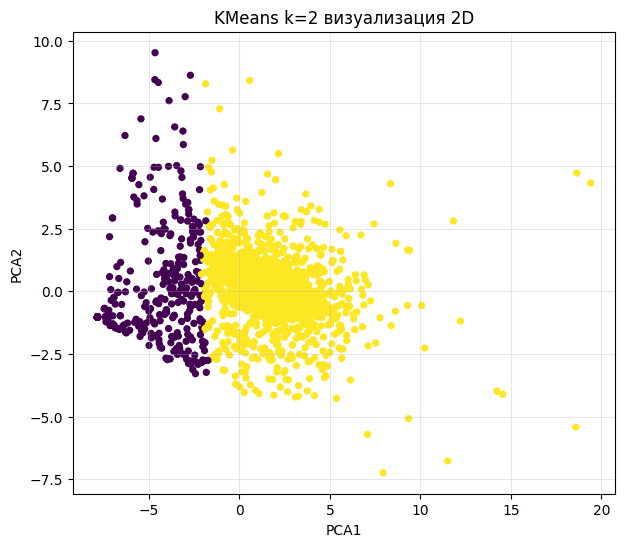
The figure shows that the K-Means algorithm divided all industries into two clusters. The left group of points, forming "cluster 1," corresponds to organizations and industries with lower digitalization intensity, while the right group (cluster 2) brings together industries and organizations with higher spending on implementing digital technologies in their business processes. The first cluster can be conditionally called the "catch-up economy."

It predominantly includes organizations engaged in various types of agriculture, forestry, hunting, fishing and fish farming, certain types of manufacturing, water supply and waste management, as well as some traditional industries such as construction and transport. These types of organizations are characterized by relatively low spending on digital transformation, minimal use of specialized software, and consequently less pronounced barriers that organizations experience when implementing various types of digital technologies.
At first glance, there's nothing unusual here, but deeper analysis revealed that the low level of barriers to digital technology adoption is explained by the weak intensity of their implementation.
The second cluster looked entirely different, consisting primarily of organizations in wholesale and retail trade, information and communications, financial and insurance services, professional, scientific and technical activities, administrative services, as well as select organizations in hospitality, hotel business, and real estate operations. This cluster can be called the "digital strain economy."
This group recorded the highest spending on digital technology implementation. At the same time, the level of talent shortages, infrastructure constraints, and organizational problems in organizations within this group turned out to be 60–80% higher on average than in organizations and industries representing the "catch-up economy" cluster. Meanwhile, the use of specialized software in the "digital strain economy" was 3–8% higher than in the "catch-up" sectors.
A comparison of 36 digitalization indicators revealed profound differences between economic sectors in terms of the nature of digital transformation. The "catch-up economy" cluster included industries where most indicators fell below the average level. The "digital strain economy" cluster, by contrast, included industries where most digitalization indicators were substantially above average.
The reason for this, in our view, lies in the very nature of digital transformation. As long as an organization uses a minimal number of digital solutions, many problems simply don't manifest themselves. But as digital maturity grows, dependence on IT infrastructure, data quality, computing power, talent shortages, and specialized software usage increases sharply.
The Main Paradox
Digital transformation is effectively creating a new structure of economic dependencies. The results show that the level of digitalization can no longer be assessed solely by investment volume or the number of technologies deployed. True digital maturity of an organization or industry manifests itself in its ability to cope with the growing complexity of the digital environment itself. In essence, the Russian economy is gradually dividing not simply into "digital" and "non-digital" industries, but into industries that have already entered deeply into the phase of complex digital transformation and industries where the digitalization process remains superficial for now. The higher an industry's level of digitalization, the more expensive this process becomes. The paradox of the modern digital economy is that technological leaders are not those who have implemented the most AI technologies, but those who can withstand the consequences of their own digitalization.