An analysis of digital colonialism and technological sovereignty models for developing nations. A comparison of Russia's 'fortress' approach and China's regulated openness as alternatives to dependence on Western digital platforms.
10 min read
Share:
The transformation of the global order marks a shift from an era of American dominance to competitive digital multipolarity, where influence is determined less by military might than by control over digital infrastructure, data flows, and technology platforms. Under platform capitalism, transnational digital ecosystems are creating a new form of dependency increasingly referred to as digital colonialism. For Global South countries, this presents a serious contradiction: accelerated economic growth is often accompanied by deepening technological dependence.
If a state doesn't control its cloud infrastructure, algorithmic systems, and national data flows, it risks becoming merely a supplier of information to external technology hubs. In an environment of growing interdependence—increasingly weaponized as a tool of political and economic pressure—Indonesia's traditional and current "Free and Active" doctrine (note: assumes preservation of Indonesia's strategic autonomy through active participation in international cooperation while rejecting dependence on any single power center) requires rethinking. It's in this context that the concept of Benteng Indonesia ("Indonesian Fortress") emerges—a flexible sovereignty model oriented not toward self-isolation but toward strengthening state resilience (note: building resilience through control over key resources and infrastructure while maintaining participation in the global economy without self-isolation).
Combining control over strategic resources—including critical minerals and energy infrastructure—with development of resilient digital systems and flexible regulation of economic openness allows developing countries to reduce dependence on global technology corporations, build their own digital infrastructure, and chart a more independent development path.
Introduction: The New Architecture of Power
In recent years, industrial enterprises' dependence on foreign cloud platforms and digital services has come to be viewed as a potential source of strategic risk. In theory, changes to service terms, sanctions restrictions, or unilateral termination of access to digital infrastructure could trigger serious disruptions to enterprises and entire economic sectors. This demonstrates that under current conditions, sovereignty is defined not only by control over territory but also by a state's ability to manage data, algorithms, and digital infrastructure.
As developing economies seek to overcome dependence on a "data colonialism" model—in which social and productive activity is converted into data arrays without commensurate economic returns for their owners—traditional geopolitical alliances are losing their former stability. To preserve strategic autonomy, Global South countries need to study and compare alternative models of technological sovereignty developed outside the Western world. The most instructive examples are Russia's "fortress" model and China's regulated openness model.
Comparative Models: Russia's "Fortress" and China's Regulated Openness System
In the context of digital multipolarity, non-Western states increasingly view advanced technologies not only as a source of economic growth but also as an instrument of strategic governance. Russia and China offer two distinct models for ensuring technological sovereignty.
The Russian Model: Autonomy Through Resilience
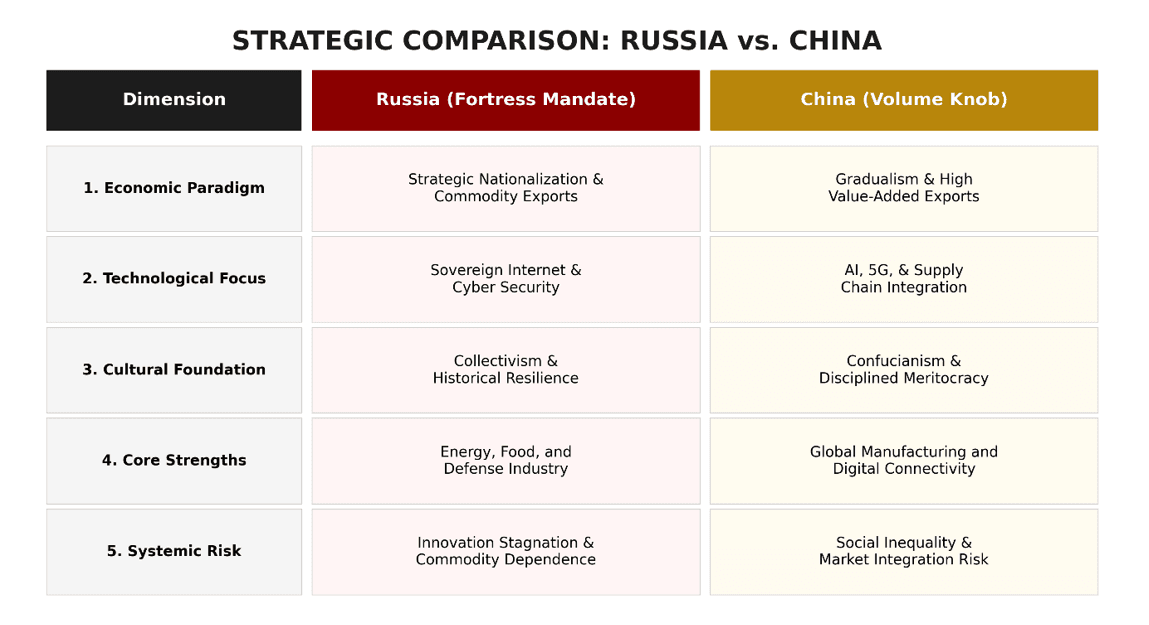
Russia's approach is grounded in the logic of strategic resilience and minimizing external risks. The state has consistently strengthened control over key economic sectors, including energy, defense industry, and critical infrastructure. The primary objective is to maintain manageability, ensure internal stability, and reinforce sovereignty by reducing dependence on external factors.
This isn't about complete self-isolation, but rather a variant of state capitalism that involves selective participation in the global economy. The ideological foundation of this model combines state pragmatism, conservative values, and elements of the Eurasian development concept. Its material base rests on energy independence, food security, and preservation of technological competencies developed in the defense sector.
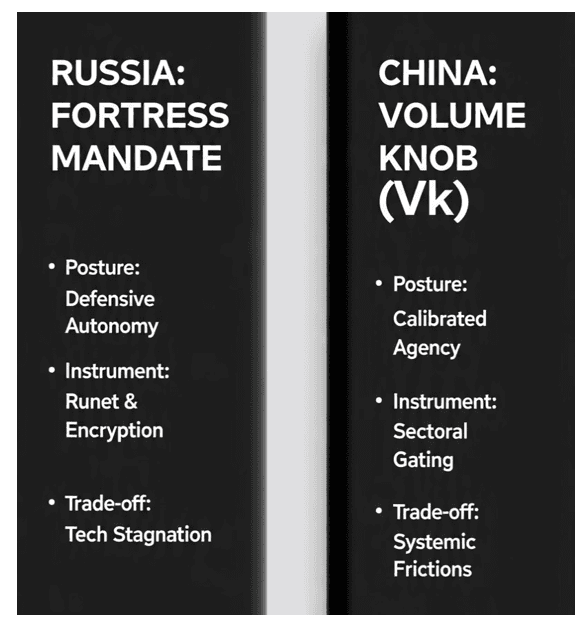
In the digital sphere, the Runet—Russia's national internet infrastructure—plays a pivotal role, capable of ensuring communication resilience and the functioning of critical services even under severe external constraints. It simultaneously serves as both a protective perimeter and an instrument of state control over the digital space.
The Chinese Model: Regulated Openness as a Development Tool
China's strategy operates on a different logic. Rather than creating a relatively closed system, Beijing seeks to manage the degree of economic and digital openness, adapting it to current development objectives.
Within the framework of "socialism with Chinese characteristics," the state selectively opens certain sectors to foreign investment and technology while maintaining tight control over strategically important areas. This approach allows China to extract maximum benefit from global integration without losing political control over key resources and infrastructure.
The distinctive feature of the Chinese model lies in combining centralized strategic planning with broad opportunities for local experimentation. The private technology sector develops actively, yet remains embedded within the overall system of state priorities. It's precisely this combination that has enabled China to achieve significant results in areas such as artificial intelligence, next-generation telecommunications, and digital platforms.
The cultural prerequisites for this model include traditions of hierarchical governance, meritocratic personnel selection, and collective coordination of efforts. An additional factor is the high discipline of state institutions, which ensures the concentration of resources on priority development areas.
A Geopolitical Compromise
Despite their shared orientation toward strengthening sovereignty, Russia and China offer fundamentally different methods of achieving this goal. The Russian model bets on increasing resilience by limiting external risks and developing internal capabilities. China's strategy, by contrast, relies on managed integration into the global economy with the aim of expanding its own technological and economic influence.
Accordingly, their structural vulnerabilities differ as well. The Russian model faces risks of commodity dependence and potential slowdown in innovation development. The Chinese model confronts problems of social inequality and the need to constantly maintain balance between market dynamics and political stability.
Ultimately, the success of any given strategy is determined not only by the pace of economic growth. What matters most is the state's ability to flexibly regulate the degree of economic openness, adapt to external shocks, and maintain strategic autonomy amid growing global uncertainty.
Searching for Strategy in an Era of Digital Multipolarity
Overcoming dependence on external technology centers requires finding a balance between two different models of ensuring sovereignty. The Russian approach relies on the principle of strategic resilience, viewing digital infrastructure as a potential source of external risks and pressure. Reliance on energy independence, food security, and technological competencies in the defense sector allows for the formation of a relatively autonomous system capable of functioning even under severe external constraints. At the same time, such a strategy carries the risk of technological lag and continued dependence on raw material exports.
The Chinese model employs a different approach. Here, openness serves not as an immutable principle but as a managed development tool. The state expands access for foreign investment and technology in sectors where it promotes economic modernization, while simultaneously limiting external influence where it might threaten national security or long-term stability. Thanks to the scale of its domestic market and close interaction between the state and the private technology sector, China has achieved substantial progress in artificial intelligence, telecommunications, and digital platforms. However, the high degree of integration into the global economy generates its own challenges related to socioeconomic imbalances and the need for constant political control over a rapidly changing economic environment.
For Indonesia, as one of the largest states in the Global South, neither of these models can be replicated in pure form. Complete orientation toward self-isolation limits development opportunities, while unconditional openness increases dependence on external technology centers. Under these conditions, the need arises for its own model that combines the advantages of integration with mechanisms for protecting national interests.
The Doctrine of Digital Sovereignty
One possible solution is the concept of digital sovereignty, implemented through the Benteng Indonesia ("Indonesian Fortress") model. Its key idea lies not in refusing to participate in the global economy, but in creating institutions that allow the state to maintain control over the most important elements of the national development system.
Such a strategy involves simultaneous participation in international production, financial, and technological networks while maintaining mechanisms for managing critically important resources and infrastructure. This means forming a flexible sovereignty model capable of adapting to changing conditions in the global economy.
Within this framework, Indonesia can rely on three complementary directions.
The first direction is resource sovereignty. Indonesia possesses the world's largest nickel reserves, which have strategic importance for battery production, electric vehicles, and modern energy systems. However, having resources in itself does not guarantee sustainable development. To obtain long-term advantages, it is necessary to control not only raw material extraction but also subsequent stages of the production chain, including processing, component manufacturing, and development of high-tech industries.
The second direction is flexible regulation of digital economy openness. The state must have the ability to adjust the degree of external actors' access to the national market depending on the economic and geopolitical situation. Such a policy allows for simultaneously attracting investment and technology while maintaining control over strategic data and critically important infrastructure.
The third direction is developing the institutional and infrastructural foundation of sovereignty. This involves creating effective interaction between regulatory frameworks, digital infrastructure, and industrial policy. Legislation in the sphere of data protection, national data processing centers, telecommunications networks, and the energy system should be viewed as elements of a unified development architecture.
A Strategic Model for Managing Sovereignty
Putting digital sovereignty into practice requires moving beyond the simplistic opposition between complete independence and complete dependence. In today's world, sovereignty is no longer an absolute state but rather a country's ability to manage the degree of its integration into global systems.
This requires simultaneously addressing three interconnected challenges: ensuring control over strategic resources, regulating the level of openness in the digital environment, and consistently developing national institutions and infrastructure.
Indonesia's main problem lies not in a shortage of material resources but in the mismatch between its high resource potential and limited institutional capacity to leverage it. The country possesses substantial nickel reserves and other strategic resources, yet their presence doesn't automatically translate into sustainable economic advantage. That requires developing national production chains, improving the quality of public administration, and building a domestic technological base.
A crucial element of this strategy is a mechanism for flexibly regulating economic openness. Its purpose is to maintain an optimal balance between attracting external resources and protecting national interests. During periods of favorable international conditions, the state can expand international cooperation, stimulating the inflow of investment and technology. When external risks increase, the degree of openness can be reduced, lowering the likelihood of critical dependence on foreign providers of infrastructure and digital services.
This approach is especially relevant given the growing role of digital platforms and cloud services. Recent years have shown that dependence on foreign digital infrastructure providers can create risks no less significant than dependence on imported energy resources or industrial equipment. Restricted access to cloud services, software, or data transmission channels can directly impact the operations of businesses, financial institutions, and government agencies.
That's precisely why developing digital sovereignty is impossible without creating one's own material foundation. Data centers, national cloud platforms, backbone communications networks, submarine cables, and energy infrastructure form the foundation on which the modern digital economy is built. Any digital system ultimately relies on physical assets that require energy, equipment, and stable communications channels.
The Physical Foundation of Digital Sovereignty
Digital sovereignty is often perceived as exclusively a matter of regulating data and software. In reality, however, it has a pronounced material dimension. The transmission, storage, and processing of information are impossible without energy capacity, computing resources, and telecommunications infrastructure.
Consequently, a state's ability to control digital space depends directly on its ability to ensure the stable operation of the corresponding physical systems. National data centers, backup communications channels, proprietary cloud solutions, and reliable energy supply become elements of sovereignty just as important as transportation infrastructure or defense capabilities.
For Indonesia, integrating digital infrastructure with the country's resource and energy base is particularly significant. The combination of developed communications networks, modern computing capacity, and a growing renewable energy sector can transform participation in the global digital economy from a source of dependence into an instrument of national development.
Conclusion
The global economy is entering a period of profound transformation, accompanied by a shift in the centers of economic and technological activity toward Eurasia. The previous model of globalization is giving way to a system of digital multipolarity, in which states compete not only for markets and resources, but also for control over data, digital infrastructure, and technological standards.
Russia and China offer two different models for ensuring technological sovereignty. The first relies on resilience and reducing external dependence. The second leverages the advantages of global integration while maintaining state control over strategic development priorities.
For Indonesia and other Global South nations, a third path appears most promising—digital sovereignty. Its objective is not to choose between openness and isolation, but to create mechanisms that allow flexible management of their own engagement with the global economy.
Cooperation with international associations, including BRICS, development of indigenous digital infrastructure, and leveraging resource advantages can create the foundation for a more independent position in the global system. In this case, digital sovereignty ceases to be a static goal and becomes a state's ability to independently determine the terms of its participation in global economic and technological processes.