This text is an automatic translation from Русский. It was generated by AI and may contain inaccuracies.
Read original →Russian Diesel Hindered Not by Sanctions, But by Refinery Repairs — IEA
The IEA does not expect the return of Russian diesel to significantly ease the global fuel market. The obstacle is not sanctions, which the US partially lifted last week, but damaged refineries.

Diesel Returns to Market in 24 Hours
On the evening of October 9, Donald Trump announced an agreement with Vladimir Putin for the supply of Russian diesel to the American and global markets. According to the U.S. President, Russia will immediately ship over 300,000 tons, with an additional 500,000 tons in November, and then 1 million tons. Washington, in support of this deal, lifted all restrictions on transactions involving Russian diesel fuel. Moscow responded promptly and partially lifted its diesel export ban starting October 10, aiming to send 500,000 tons to the global market in the initial phase.
The IEA, however, released its October oil market report on October 14, after the deal was struck, and offered a reserved assessment. The agency believes that the easing of Russian export restrictions is unlikely to significantly alter the global diesel balance, as exports are constrained by a shortage of operational capacity at Russian refineries. The potential impact of the deal can be gauged by comparing its volumes to what the market has already lost.
Deal to Cover No More Than a Fifth of Lost Exports
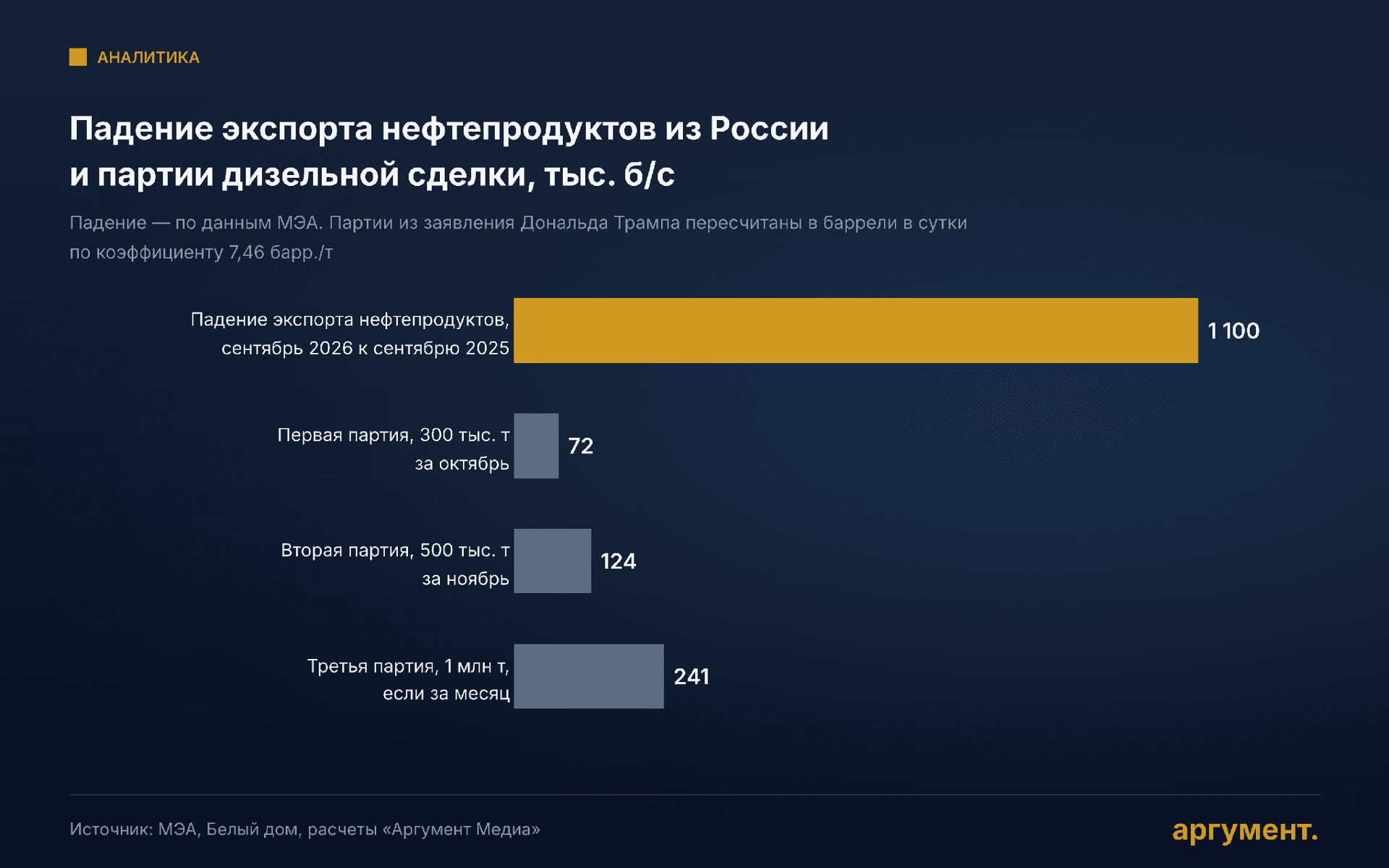
In September, Russia exported 1.24 million b/d of petroleum products is 1.1 million b/d less than a year ago. Russia, along with the Middle East, has dropped out of the market: their combined net diesel exports, according to the IEA, fell by 1.3 million b/d over the year, to 820,000 b/d. Wholesale diesel in Singapore in mid-September cost more than $200 per barrel. And while prices have since retreated from record highs, the IEA estimates that diesel is still almost twice as expensive as crude oil and its pre-crisis level.
Against this backdrop, the promised Russian shipments to the US are small relative to the lost capacity. Converting at 7.46 barrels per ton, 300,000 tons for October yields about 72,000 b/d, and 500,000 tons in November yields about 124,000 b/d. Even a million tons shipped in a month is approximately 240,000 b/d, which is about one-fifth of the export volume lost over the year.
It all comes down to refining. Gasoil production and exports in Russia, the IEA notes, have fallen due to Ukrainian drone attacks on refineries. From January to September, Russian plants processed about 170 million tons of oil, 14% less than a year earlier. In the second half of September, refining dropped to approximately 3.6 million b/d: the Syzran, Saratov, Ryazan, Tuapse, and Kirishi plants were shut down, while the Yaroslavl and Moscow plants more than halved their output.
The domestic diesel market is currently withstanding this. In the week of October 6-12, retail diesel, according to Rosstat, fell by 5 kopecks, to 86.67 rubles per liter, and there are no disruptions at gas stations. However, the export surplus is determined not by the price at gas stations, but by how much fuel plants produce in excess of domestic demand.
Therefore, restoring refineries is crucial for increasing exports, and this depends on more than just repair timelines. According to Reuters sources, the main unit at the Syzran plant will take at least a month to fix. Furthermore, on September 25-26, the Novoshakhtinsk, Perm, and Ilsky plants were hit, followed by the Ryazan plant on October 15. As long as these attacks continue, each promised shipment hinges on which plants are operational at the time of dispatch. Little fuel remains for export, and Russia primarily benefits from the high-priced market through crude oil.
Crude Oil Drives Revenue
Russia's Oil and Petroleum Product Export Revenues in September increased by $3.6 billion month-over-month to $17.67 billion, surpassing September 2025 levels by $4.32 billion. Of this, $14.5 billion contributed came from crude oil, with only $3.16 billion from petroleum products.
This growth was driven by price, not volume. The price of Urals, loaded at the Baltic port of Primorsk, excluding delivery to the buyer, rose, according to IEA estimates, increased by $28.29 per barrel month-over-month, reaching $94.3, while total exports remained at August levels of 6.52 million barrels per day.
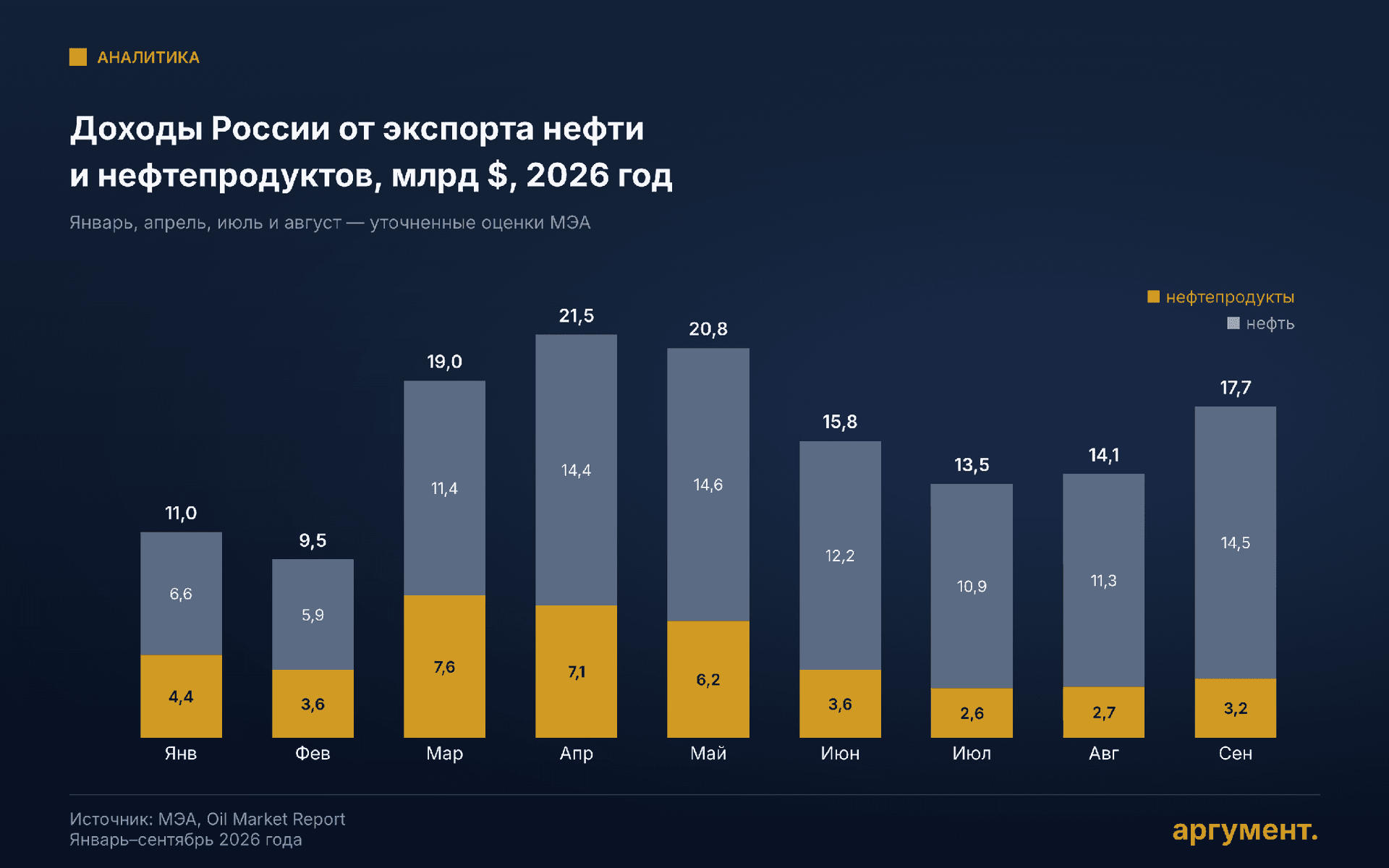
Monthly figures clearly show how revenue tracked the Middle East crisis. In January and February, it did not exceed $11 billion: the tax price for Urals hovered around $41–45 per barrel, and in February, exports fell to their lowest point since February 2022. The war in the Middle East and disruptions in the Strait of Hormuz drove prices up, with revenues peaking for the year in April at $21.5 billion.
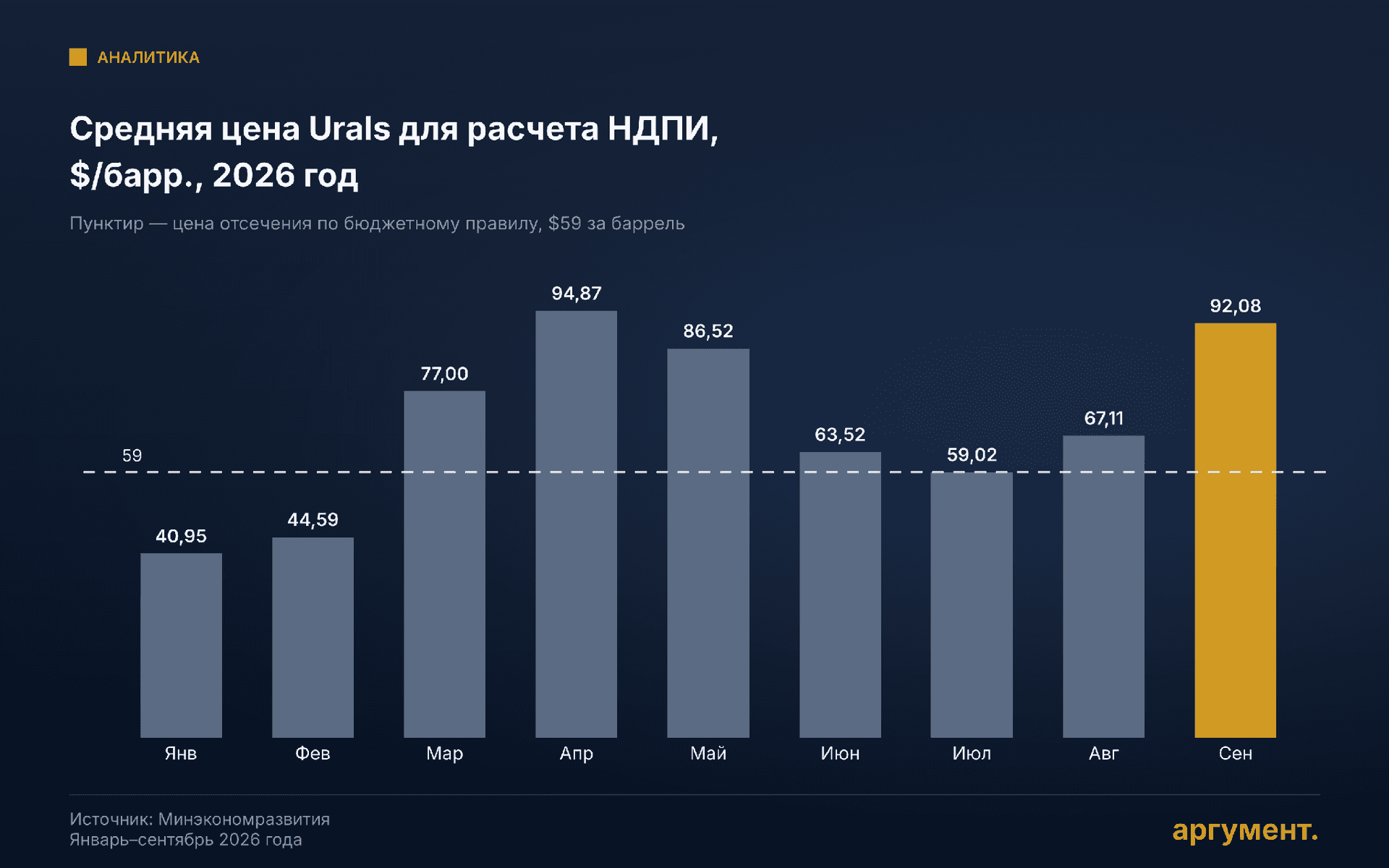
This summer, oil and refined products diverged. Oil prices fell in line with the market, with the tax price for Urals dropping to $59 by July. Refined products, however, saw a steeper decline: in June, processing fell fell to 4.1 million b/d, a multi-year low, and in July, the diesel export ban was extended to all producers. Revenue from refined products plummeted from $7.59 billion in March to $2.63 billion in July.
The September surge was more modest than the spring rally. New attacks on oil infrastructure in Gulf countries pushed Urals back to $92 per barrel, but revenue from refined products barely increased. Their share of export earnings shrank from 40% in March to 18% in September. Russia is selling expensive crude oil, while the market's most in-demand commodity, diesel, is being exported in minimal volumes. For the budget, this means more than just lost revenue.
Expensive Diesel Hits the Budget
The budget receives not exporters' revenue from oil, but taxes, and the main one, the mineral extraction tax (MET), is calculated based on the average monthly Urals price. In September, this price was $92.08 per barrel, 37% higher than in August. This is the second-highest result of the year after April's $94.87 and 56% above the budget rule's cut-off price. Companies will pay the September tax in October.
For now, the gains from expensive oil are being used to compensate oil companies. Federal budget oil and gas revenues in September totaled 452.4 billion rubles, and for the first nine months declined by 17% year-over-year. Fuel damper payments in September reached 305.5 billion rubles, a four-and-a-half-year high. The damper increases with the widening gap between export and domestic fuel prices. Consequently, the budget is currently subsidizing, rather than profiting from, expensive diesel abroad.
Moreover, the oil window is closing faster than the fuel window. Oil exports from Persian Gulf countries in September returned to over 75% of pre-war levels, and the IEA anticipates a 7.7 million b/d increase in global supply by 2027. The diesel market, according to the agency, is expected to remain tight for most of 2027, with inventories not recovering until the second half of the year. Russia's earnings from this market will depend more on the pace of refinery repairs than on Washington's sanctions.