An analysis of Russia's fuel market situation: the extension of the export ban, gasoline and diesel price dynamics, stabilization measures, and forecasts for emerging from the crisis.
6 min read
Share:
The improvement began with logistics, not refining
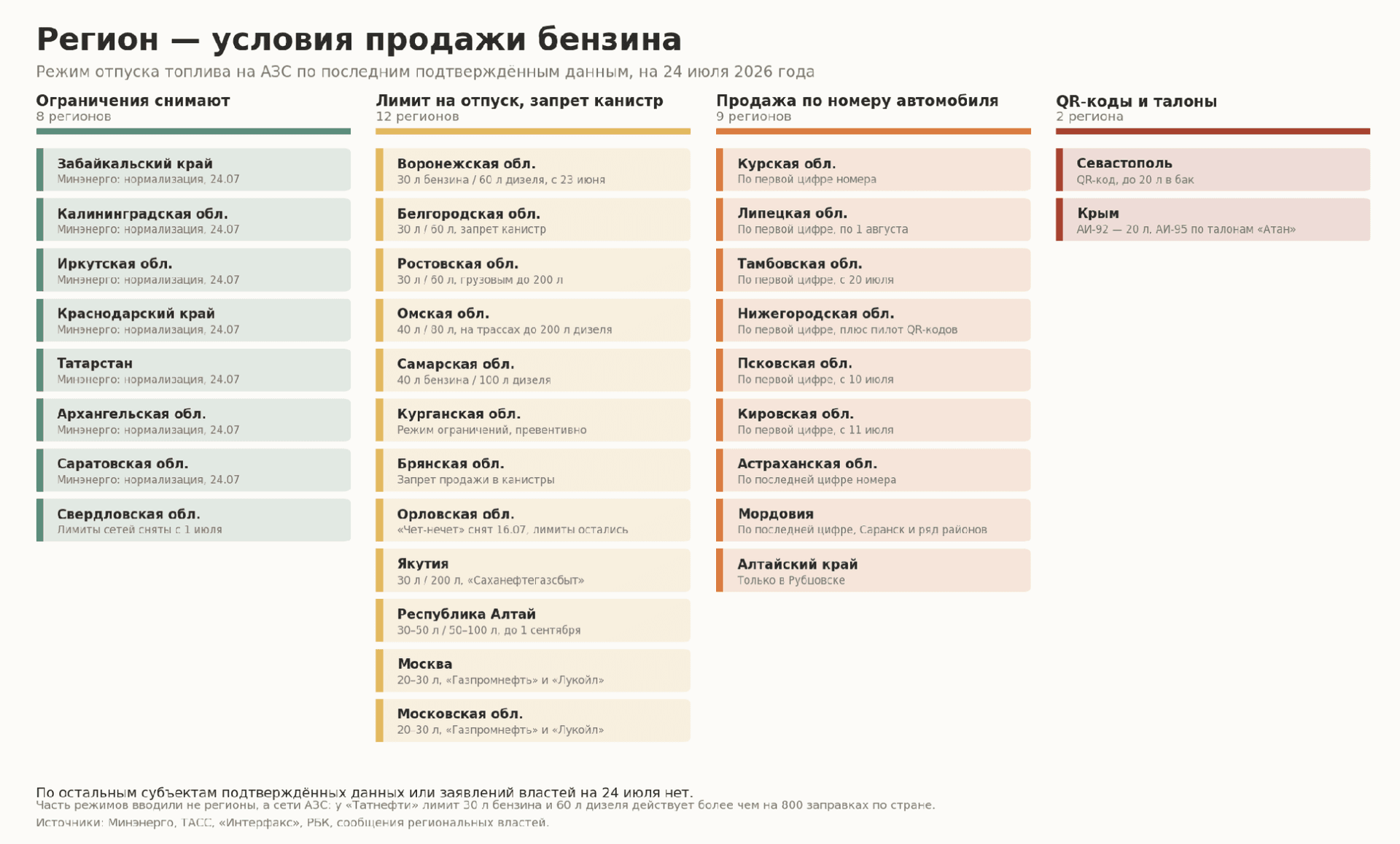
Russia has begun gradually lifting restrictions on gasoline sales. On July 24, the Ministry of Energy announced stabilization in Zabaykalsky Krai, Kaliningrad and Irkutsk oblasts, Kuban and Tatarstan, adding that the market is normalizing in Arkhangelsk and Saratov oblasts. The ministry described the improvement through two indicators: an increase in the number of operating gas stations and a reduction in queues. Energy Minister Sergey Tsivilev clarified that work with the regions to meet their needs will continue—a formulation that speaks to an ongoing process rather than its completion.
A day earlier, Deputy Prime Minister Alexander Novak described the market situation more cautiously: "The situation is now somewhat leveling out, though it's still tense overall, but things have improved in many regions." He cited the ban on petroleum product exports, saturation of the domestic market through imports, increased production volumes, and postponement of refinery maintenance schedules as sources of improvement.
On July 23, Interfax sources reported that authorities are discussing extending the ban on diesel fuel exports for producers by another month, while the gasoline export ban would be extended for six months straight. A draft resolution has been prepared, with Novak making the final decision. The current ban was introduced through July 31, 2026.
The asymmetry in timeframes speaks louder than the extension itself. For diesel, they're discussing one month; for gasoline, six. The difference reflects an assessment of how long each of these two markets can manage without external support. Diesel has more breathing room because its output represents a larger share of refining capacity and recovers faster (historically, Russia's diesel production surplus exceeded 50%, while gasoline was under 20%). For gasoline, authorities are planning through winter.
Refining recovers as reserves enter the fray
We shouldn't forget about existing storage facilities and reserves, which have also played their part in gradually stabilizing the situation. According to Energy Ministry data cited by Vladimir Putin in late June, gasoline inventories declined just 4% year-over-year to 1.7 million tons. A 25% drop in output alongside a 4% decline in inventories means the cushion was drawn down carefully and distributed manually.
Next came decisions that wouldn't have been discussed in calmer times. Some refineries were permitted to produce Euro-3 standard gasoline through the end of 2026, while simultaneously arranging fuel imports, including from India and Kazakhstan. Belarus ramped up deliveries of motor gasoline and diesel to Russia to record levels in June. Imports worked as a buffer, but a finite one: sales volume of Belarusian gasoline on the St. Petersburg exchange plummeted dozens of times starting July 3, because Belarusian refineries had already sold out nearly all their July shipments.
Still, signs of a turnaround have emerged. Kommersant's industry sources Industry sources say that more refinery capacity is coming online now than is being retired. This should have a positive impact on the market by fall
Weekly growth slowed, annual growth did not
From July 14 to 20, gasoline rose in price by 1.66% after 2.25% the week before, while diesel increased 1.87%. The average liter of gasoline cost 77.31 ₽, diesel — 93.54 ₽. By grade: AI-92 — 73.60 ₽, AI-95 — 79.47 ₽, AI-98 and higher — 100.27 ₽. This dynamic also indicates that the market has redistributed resources and we can now say that we're reaching a growth plateau.
Fuel has already ceased to be a sectoral story and has become a macroeconomic one. In a Central Bank survey, analysts sharply raised their inflation forecast for 2026 to 6.2% from 5.3%, specifically against the backdrop of rising fuel prices, considering that the Central Bank itself on June 19 had maintained its forecast in the 4.5–5.5% range. And the regulator confirmed its commitment to its own forecast by continuing to cut the key rate — it reached 14% per annum.
The national average price and the price in Sevastopol are different worlds
During the week of July 14 to 20, gasoline prices changed in 79 regions. A decline was recorded in only two: Zabaykalsky Krai by 1.0% and Saratov Oblast by 0.2%. In Moscow, gasoline rose in price by 0.4%, in St. Petersburg — by 0.2%.
The scale of variation is illustrated by another example. During the week of June 23-29, gasoline prices rose most sharply in Sevastopol, jumping 30.0% at once—and this is a region where fuel is still dispensed via QR codes, with no more than 20 liters per tank.
Between these extremes lies a patchwork of regimes. According to media calculations as of July 18, sales restricted to even and odd dates have been introduced or are being introduced in nine regions, mostly in the Central District. In Lipetsk Oblast, the regime has been established through August 1. In Altai Krai, the mechanism operates only in Rubtsovsk, while in Mordovia it applies in Saransk and some districts.
Sources: Ministry of Energy, TASS, Interfax, RBC, regional authorities' reports
And timely measures taken by local authorities at the onset of the fuel crisis played no small role in stabilization. For example, Oryol Oblast was the first to introduce the "even-odd" system on July 4, then lifted it on July 16 while maintaining dispensing limits, and Governor Andrey Klychkov explained that the decision not to return to unrestricted sales was driven by concerns that motorists from neighboring regions would come to fill up in the oblast. As long as neighboring regions maintain different regimes, any easing creates a risk of demand spillover, and the region that lifts restrictions first pays for it with queues.
A separate divide has emerged within retail. Major chains kept price increases within inflation limits, while at independent gas stations prices climbed above 100 rubles per liter, because independents purchase on the exchange and are forced to raise prices more quickly. Novak drew attention to this and instructed the Ministry of Energy and FAS to prepare reports on price stabilization, while FAS itself initiated 15 cases against oil companies over fuel prices.
The damper will show whether the improvement holds
The most accurate indicator of fuel market stability is embedded in the tax structure. The government decided not to extend the moratorium on zeroing out the fuel damper after May 1, 2026, which restores the mechanism's original stringency. The indicative price for AI-92 for 2026 has been set at 62,300 rubles per ton, while payments to oil companies are reset to zero if the average monthly exchange price deviates from the indicative price by more than 20% for gasoline—that is, rises above 74,760 rubles per ton.
The market is currently hovering right at this threshold. In late July, the exchange benchmark for gasoline ranged between 69,900 and 74,800 rubles per ton. If the average crosses above the threshold, no compensation will be paid for the month, and vertically integrated companies will have to cover the difference from their own profits or pass it on to retail prices. And the payments involved are substantial: in 2025, oil companies received 881.8 billion rubles from the budget through the damper mechanism.
So we can say that the acute phase of the crisis is indeed passing—this is evident from the queues, the number of operating gas stations, and the slowdown in weekly price increases. What will make it sustainable is the return of exchange prices below the damper threshold.