This text is an automatic translation from Русский. It was generated by AI and may contain inaccuracies.
Read original →Central Bank Holds Rate, Pushes Easing to 2027
On October 23, the Bank of Russia maintained its key rate at 14%, pausing for the second consecutive time after ten previous cuts. The forecast came as a surprise: the average rate in 2027 is now projected at 12.5–13.5%, up from 10.5–12.5% in July. We delve into why the regulator is extending its tight money policy throughout the next year.
Price growth accelerated to 8% in Q3
Current seasonally adjusted inflation in Q3 was 8% on an annualized basis. Core inflation, which excludes the most volatile goods, also accelerated. As of October 19, annual inflation reached 6.8%, and the Central Bank expects 7.1–7.6% by year-end. The 2026 forecast has been revised upward for the second consecutive time: in July, it was already raised from 4.5–5.5% to 6–7%.
It's not just about gasoline. While motor fuel continues to drive the volatile component of the index, persistent price growth remains at 5–6% year-on-year and shows no signs of slowing. Elvira Nabiullina attributed this to the temporary shutdown of capacity in certain sectors, which directly impacts prices and influences expectations.
On top of that, tariffs have increased. The indexation of utility services from October 1st, according to preliminary data, exceeded the Central Bank's forecast, and citizens will only see this reflected in their November bills. This means the main impact on expectations is yet to come.
Expectations Stuck at Highs
Household inflation expectations for October decreased by 1 percentage point to 13.2%, but over a five-year horizon, they rose from 10.7% to 12.2%. People expect slightly less price growth in the coming year, but they are losing faith that inflation will slow down for good. Additionally, expectations among analysts and financial market participants have significantly increased.
Therefore, there were no alternatives to a pause at the board meeting. Only maintaining the rate was substantively discussed, with some participants advocating for a hike. The signal remained neutral: the Central Bank is not promising a cut in December, nor further tightening.
The decision also has a purely arithmetic logic. While interest rates in the economy rose in Q3, this increase was absorbed by expectations, and monetary conditions did not tighten in real terms. There's also no cooling that would warrant taking a risk: the Central Bank raised its GDP growth forecast for 2026 to 0.5–1% from 0–1% in its July projection.
Budget Helped, Capacity Failed
In September, Nabiullina outlined two conditions for further rate cuts: the parameters of the three-year budget and the effects of capacity shutdowns. The first condition worked in their favor. The budget proved slightly more conservative than the assumptions in the July forecast and projects a zero structural primary balance by 2029, which, all else being equal, would have allowed for rate cuts according to the previous scenario.
The other factor, however, disappointed. The Central Bank expects the idled capacities to be restored in 2027, but cannot yet specify when exactly this will happen. As a result, this marks the third consecutive upward revision of the average rate forecast for next year.
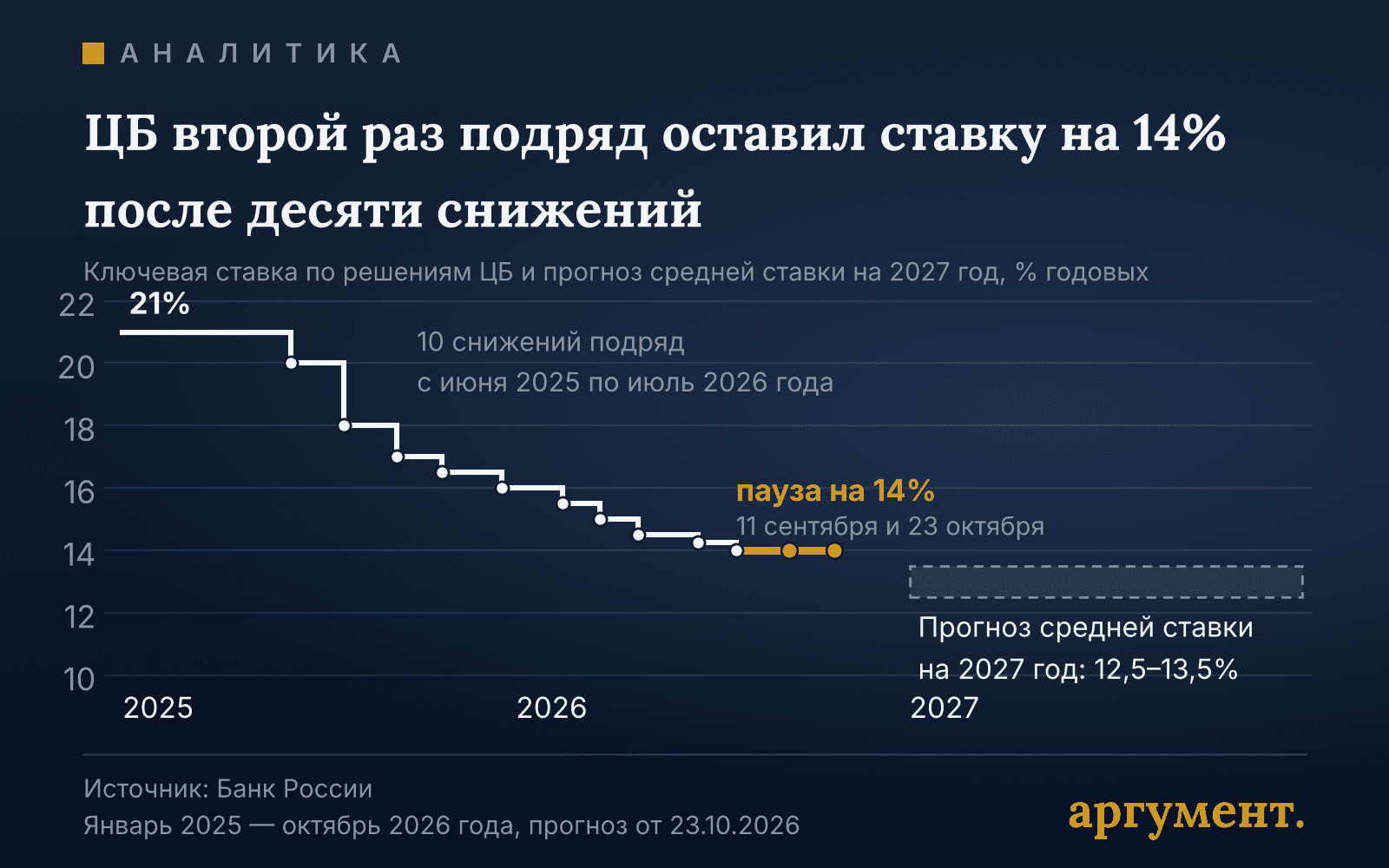
In April, the Central Bank projected an average rate of 8–10% for 2027; in July, it was 10.5–12.5%. The new range begins where the July one ended, with its upper bound just 0.5 percentage points below the current rate. While there's still room for reduction, it has diminished, Nabiullina acknowledged.
External factors offer only temporary support. Due to the situation in the Middle East, the Central Bank raised its forecast for Russian oil prices to $72 per barrel in 2026 and $55 in 2027. Expensive oil boosts export revenues and supports the ruble, though the fiscal rule limits this effect. However, the regulator anticipates a nearly 25% price drop next year and identifies rising fuel costs as the primary source of global inflationary risks.
Borrowers Will Pay for the Pause
A prolonged pause primarily impacts those taking out loans. Nabiullina stated that subsidized mortgage volumes should not grow, and family mortgages are becoming more targeted, which will increase the share of market-rate mortgages. Loan demand has not yet cooled: the Central Bank raised its lending growth forecast for 2026 to 8–11%, with retail lending accelerating in September ahead of changes to family mortgage terms.
The regulator sees no threats to companies. While the share of firms whose profits do not cover interest expenses slightly increased by July 1, the Central Bank considers the difficulties of the largest borrowers temporary. The argument is simple: even the elevated forecast implies that the average rate in 2027 will be lower than in 2026.
Related articles
 Macroeconomics
Utility Tariff Hikes Push Inflation Beyond Central Bank Forecast
Following the indexation of housing and utility services, prices rose by 0.96% in a week, with annual inflation jumping to 7.17%. This figure surpasses the upper bound of the Bank of Russia's forecast for 2026.
 Analysis
The Central Bank Hits Pause
The Central Bank has halted its key rate cuts at 14% amid accelerating inflation of 5-6%. We examine how rising fuel prices, the budget deficit, and lending activity are shaping monetary policy.