The Dilemma of Bank Financial Stability and Sustainable Economic Growth
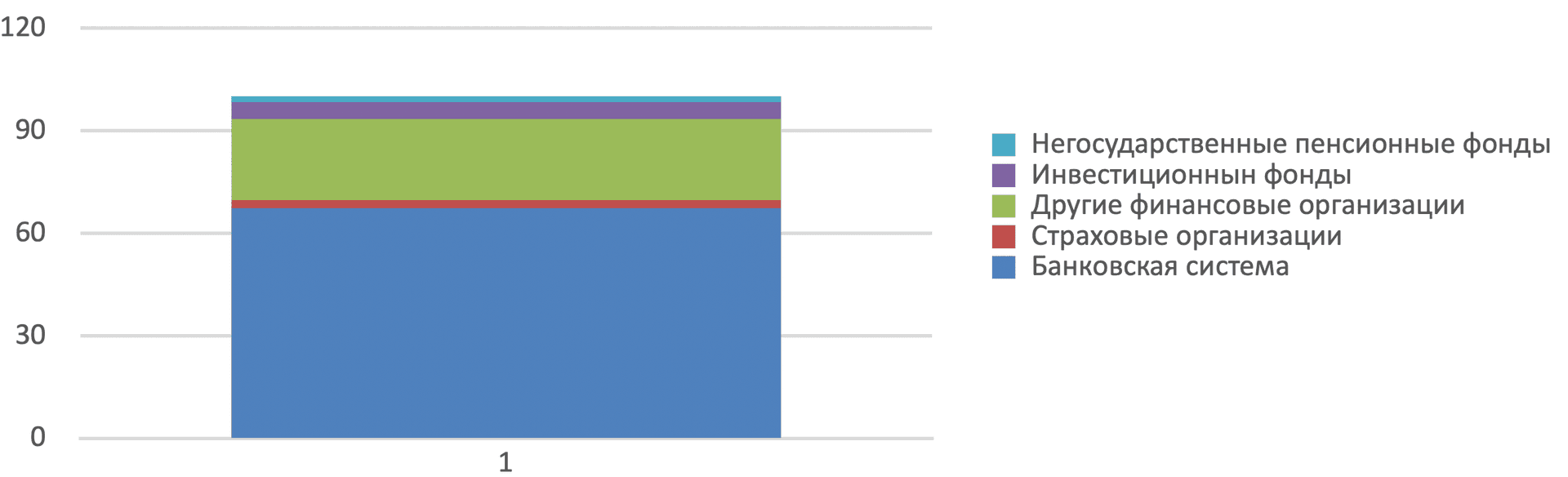
Banks control more than 67% of Russian financial institutions' assets. We analyze how to reform banking regulation in Russia to simultaneously maintain financial stability and stimulate economic growth.
7 min read
Share:
Financial Stability and the Role of the Banking System
The contemporary challenges facing developed and developing countries amid geopolitical shocks and persistent uncertainty risks have led to slower economic growth, high inflation, and tight monetary policy by central banks aimed at maintaining price and financial stability—all of which have highlighted a number of theoretical and practical problems requiring solutions.
One of the central issues in this field remains the problem of finding a balance between ensuring financial stability in the financial market and economic growth. In turn, the stability of the national economy, the level of investment activity, and the resilience of the financial system largely depend on the stability and efficiency of the banking sector. This is especially true for economies where banks have historically dominated the financial market. In Russia, they account for more than 67% of financial institutions' assets (Fig. 1)1.
Fig. 1. Structure of financial assets of the institutional sector "Financial organizations" of the financial account of the Russian Federation as of 01.01.2026. Source: compiled by the author based on data from the Central Bank
But banks are commercial institutions, so they react painfully to macroeconomic shocks and external threats while pursuing their own objectives (efficiency and sustainability). This can conflict with the national economy's need for resources. Although central banks bear responsibility for financial stability and influence it through monetary and prudential policies, they often overlook issues of economic development. For Russia, this is particularly important under conditions of unprecedented political and economic pressure.
Creating conditions for credit availability to economic entities without compromising price and financial stability requires appropriate development of macro- and microprudential regulation.
The practical recommendations proposed below were validated by research testing a number of hypotheses based on establishing statistical relationships and econometric modeling. In particular, data were obtained confirming the influence of credit institutions' business models on the financial stability of the banking sector, which suggested the advisability of regulating risks to ensure banks' financial stability based on their business models. The next conclusion is that in current Russian conditions, we see no contradiction between the tasks of maintaining financial stability and stimulating business activity. This is evidenced by the fact that both financial stability and economic growth are positively influenced not only by macroeconomic indicators but also by the banking sector's lending activity. At the same time, the role of proactive credit risk management by banks is increasing.
The above allowed us to propose directions for banking regulation aimed at harmonizing the tasks of maintaining financial stability and stimulating economic growth: evolution from a predominantly restrictive paradigm to a system integrating risk-restrictive, stimulative, and countercyclical mechanisms. It appears that under current conditions, the regulatory approach should be built along several main directions.
Four Directions for Developing Banking Regulation
1. Development of Russia's banking system to strengthen its role in stimulating economic development.
Under Federal Law No. 86-FZ of July 10, 2002 "On the Central Bank of the Russian Federation (Bank of Russia)," the Bank of Russia's objectives are defined with emphasis on the development and financial stability of the financial market and the banking sector in particular. However, for the Russian economy, the tasks of economic development come to the forefront. Under these conditions, the question of the Bank of Russia's responsibility not only for price and financial stability but also for the business activity of economic entities requires elaboration. In this case, an additional function of the Bank of Russia should be the following: "in cooperation with the Government of the Russian Federation, implements measures to stimulate the country's economic development" (Article 4). It should be noted that in international practice there is an approach where promoting economic growth (including through stimulating employment) is the objective of the national regulator's activities.
Achieving this goal is impossible without reforming Russia's banking sector. The current differentiation of banks by their involvement in international activities (banks with basic and universal licenses), which has proven ineffective given banks' exposure to Western sanctions policy, must give way to differentiation based on business objectives. We propose dividing banks into commercial banks—whose goal is operational efficiency in shareholders' interests—and banks that combine commercial functions with project implementation in partnership with development institutions, aligned with priorities set by the Russian Government. Currently, commercial banks actively cooperate with development institutions in the national economy's interests, but the effectiveness of such interaction requires constant attention, as discussed at the 25th All-Russian Banking Conference organized by the Association of Russian Banks in Moscow. In our view, the effectiveness of banks' interaction with development institutions would be enhanced by implementing the above proposal regarding special status for banks that partner with development institutions. Such banks could combine purely commercial activities with project implementation in partnership with development institutions. We believe commercial activities should be separated from projects implemented in the national economy's interests through separate balance sheets. The purpose of this separation is to strengthen control over resources received from development institutions and improve performance assessment of such banks. In some cases, it would be appropriate to use trust management arrangements within government programs, which would separate commercial bank resources from funds allocated under specific programs.
At the same time, we believe it's advisable to revise the regulatory model for bank activities. Both types of banks would operate under their licenses and be supervised by the Bank of Russia accordingly. However, the Bank of Russia's microprudential policy should differ by bank type: while regulatory instruments for commercial banks are economic ratios (capital adequacy, liquidity, risk concentration, and others), for banks partnering with development institutions, the commercial balance sheet should be the object of prudential regulation, while activities involving development institutions should be assessed based on target indicators and the performance of financed projects.
2. Reforming the banking regulation model.
Our empirical research confirms the dependence of banking sector financial stability on credit institutions' asset structure: an increase in the loan portfolio's share of assets acts as a positive factor, while conversely, a decrease in liquid assets' share does the opposite—the stronger banks' specialization in lending activities, the higher the interest margin and, consequently, financial results. Thus, we've obtained data confirming the influence of credit institutions' business models on the financial stability of the banking sector as a whole. This suggests it would be advisable to regulate risks to ensure banks' financial stability based on their business models. Banks' disclosure of information about risks, assessment and management methods, including the relationship with their business model, also requires standardization.
3. Focus on microprudential regulation to ensure banking sector financial stability.
Current practice in developing banking sector financial stability regulation shows an emphasis on using macroprudential policy (MPP) instruments. For example, the Bank of Russia widely applies macroprudential limits on loans to individuals. The regulator uses them to reduce loan portfolio losses, especially during stress periods, and decrease the number of borrowers who may face difficulties. Currently, for instance, such MPP limits are set for mortgage loans (by loan type), auto loans, unsecured consumer loans, etc.—a broad list of loans. In the Bank of Russia's view, "MPP reduces the share of loans (credits) with elevated credit risk issued during a quarter. Limiting the share of risky loans in new originations ultimately leads to improved credit portfolio structure as the portfolio turns over"2. This raises the question of whether it's advisable for regulators to limit banking risks through sectoral caps, thereby substituting for the development of internal bank risk management systems, including risk assessment and reserve formation to cover expected losses—thus creating a real source for banks to write off problem loans. We believe that a relevant way to minimize banking risks and improve the banking sector's portfolio structure would be to differentiate risks for reserve formation on homogeneous portfolios not only by overdue debt and loan collateral (as currently practiced), but also by debt burden indicator (DBI) levels, instead of the macroprudential limits currently applied to banks.
Similarly, instead of a macroprudential surcharge on the growth of credit exposures to large companies with elevated debt burdens, it would be more appropriate to incorporate the Debt-to-EBITDA ratio (the ratio of a company's total debt to its EBITDA) as a risk parameter when assessing loan loss reserves.
In our view, risk assessment for the purposes of forming reserves on restructured loans also requires corresponding changes.
4. Development of differentiated incentive-based regulation.
To channel credit flows into priority economic sectors, the regulator can provide banks with preferential treatment by reducing capital requirements on such loans. In Russian practice, this is implemented through lower risk weights for technological sovereignty projects, structural adaptation, and sustainable development, which encourages banks to finance investments in these areas. A promising direction is extending this approach to the regional level to support infrastructure projects that are significant for local territories.
Thus, the trajectory of regulatory development should shift toward creating a system that not only establishes protective barriers but also actively uses regulatory incentives to direct capital into priority areas of the economy.