This text is an automatic translation from Русский. It was generated by AI and may contain inaccuracies.
Read original →Analyst Boldyasov: Russia's Grain Surplus Pressures Prices and Weakens Export Potential
While Russia possesses sufficient nominal capacity for harvest storage, a deficit in modern infrastructure and export restrictions are leading to market oversupply. Analyst Boldyasov discusses grain storage challenges, export prospects, and government support measures for agricultural producers.
Why Russia Lacks Modern Grain Storage Facilities
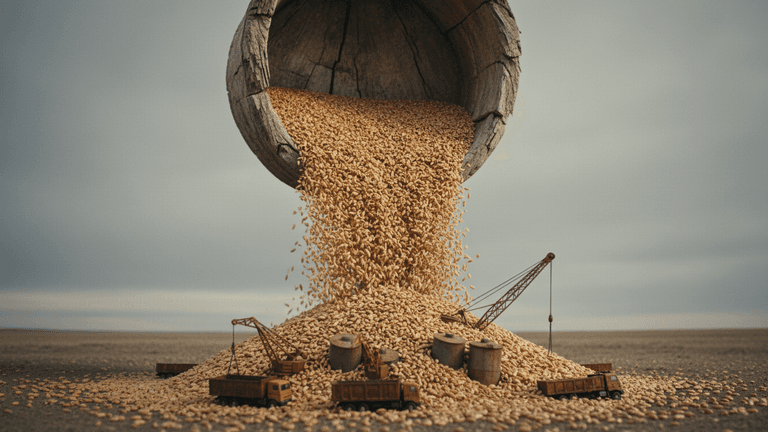
Market Analyst Alexey Boldyasov In a conversation with "Argument Media," Alexey Boldyasov notes that while the nominal capacity of Russian grain storage facilities is sufficient to accommodate the harvest, the actual situation differs significantly from these formal figures. A substantial portion of the infrastructure, he explains, fails to meet modern grain storage requirements.
"The nominal capacity of storage facilities in Russia is sufficient to accommodate the harvest. The problem lies in the deficit of modern storage infrastructure that meets contemporary requirements. Therefore, grain preservation will remain questionable even with an apparent surplus in storage capacity," Alexey Boldyasov stated.
According to the expert, the insufficient pace of modernization prevents a turnaround in the situation. Consequently, even with available capacity, the issue of preserving the harvested crop remains unresolved.
Under these conditions, agricultural producers are compelled to seek more flexible solutions. One such option is storing grain in specialized polymer sleeves, which allows for harvest placement directly on farms and reduces reliance on traditional elevator infrastructure.
Grain Surplus Pressures Prices and Reduces Sowing Areas
The accumulation of significant commodity stocks has a dual effect on the Russian grain market. According to FAO forecasts, by the end of the 2026/27 season, Russia's grain stocks are projected to increase from 35.9 million to 43.2 million tons, including wheat from 27.6 million to 34 million tons. On one hand, this accumulated surplus could form the basis for a sharp increase in exports in subsequent seasons, once physical export restrictions are lifted. A similar scenario already played out in 2022/2023.
On the other hand, the excess supply exerts downward pressure on domestic prices, reducing production profitability and farmers' interest in expanding grain crop sowings.
As Boldyasov explains, under such conditions, agricultural producers are naturally reallocating acreage to more profitable crops, primarily oilseeds.
“Excess supply puts downward pressure on prices, which inevitably reduces production incentives. The reduction in grain acreage in favor of more profitable oilseeds is a natural consequence under such conditions, which we have observed in recent years.”
The current situation could have consequences not only for individual seasons but also for Russia’s long-term export potential. If farmers continue to reduce grain plantings due to low profitability, this will lead to lower harvests and reduced volumes of grain that Russia can export in the future.
According to the expert, this is a natural market correction in response to oversupply: a temporary surplus of products could lead to weakened supply in the long term.
Will Russia Lose Traditional Markets?
Despite challenges in grain sales, Russia remains among the world's largest wheat exporters, though competition for buyers is intensifying. According to FAO data, in July–September of the 2026/27 season, Russia's share of global wheat exports decreased from 21% to 13% compared to the same period last season, while the European Union's share grew from 16% to 23%.
However, Boldyasov believes that current export restrictions are unlikely to lead to a permanent loss of markets.
“Current restrictions are unlikely to lead to a loss of markets. They will recover once exports open up, and Russian grain will once again be competitive and in demand.”
The expert anticipates that once physical export restrictions are lifted, Russian supplies will be able to recover, and accumulated commodity stocks will enable an increase in export volumes.
What Support Measures Is the State Using?
Amid export challenges, grain supply logistics are being restructured, including more active use of Baltic Sea port infrastructure. According to data, According to Rusagotrans, 2.05 million tons of wheat were exported through Baltic ports in October 2026, accounting for 61% of Russian exports, up from 52% in September.
Additionally, grain purchases for the intervention fund began on October 29. According to the National Mercantile Exchange, by November 20, the state had acquired approximately 172,000 tons of wheat, with a potential purchase volume of up to 3 million tons. This mechanism allows for the purchase of a portion of products from the market, forming reserves and supporting demand in conditions of oversupply.
Another area of focus is the expansion of preferential lending programs designed to support the financial stability of agricultural producers.
However, Boldyasov emphasizes that the aggregate of measures taken so far is insufficient to fully offset the consequences of overstocking.
"Even a comprehensive set of measures does not fully absorb the entire commodity surplus and overcome the consequences of overstocking. The capacity of new logistics routes is clearly insufficient, and the main buyers of Russian grain are located in the Mediterranean, which makes exports through Baltic ports inconvenient, but necessary."
The scale of procurement interventions remains an additional limitation: the volumes of grain acquired by the state are still small relative to the overall commodity surplus.
Therefore, despite the expansion of logistical capabilities and financial support, the problem requires a more systemic approach.
What the Russian Grain Market Needs
According to the analyst, in the long term, a comprehensive set of measures must be developed to ensure farmers can count on an acceptable level of profitability and operate under clear and predictable rules.
The development of alternative logistics routes will be particularly important. This involves not only the construction of new transport capacities but also the preparation of backup solutions that can be quickly deployed in the event of export restrictions or other external problems.
“In the future, a set of measures will be needed to guarantee farmers a reasonable income and clear rules of the game. It is important to develop ‘backup’ logistics routes and solutions, as the market’s ability to adapt in difficult conditions will depend on their availability and the speed with which they can be opened.”
The main problems facing the Russian grain market extend beyond a temporary harvest surplus. The industry simultaneously needs to address issues of modernizing storage facilities, increasing production profitability, and diversifying export logistics.
Related articles
 Analysis
Grain Hits a Bottleneck at the Ports
Russian grain producers are selling wheat at a loss due to export problems through the Black Sea. The Ministry of Agriculture is discussing a temporary elimination of export duties and a package of support measures for the industry.