Grain Interventions: A Quarter Century of Regulation
After 25 years, grain interventions in Russia have yet to become a fully effective market stabilization tool. So why does the government continue to rely on this mechanism despite its questionable effectiveness?
2026 marks 25 years since the first grain purchases into the State Intervention Fund (GIF). Debates among agricultural industry experts and government representatives continue to this day about both the appropriateness of using this instrument and its specific parameters. In 2020, media outlets began publishing commentary, including from representatives of Russia's Ministry of Agriculture, about the end of the intervention policy era against the backdrop of selling off remaining grain in the GIF (approximately 2 million tons).
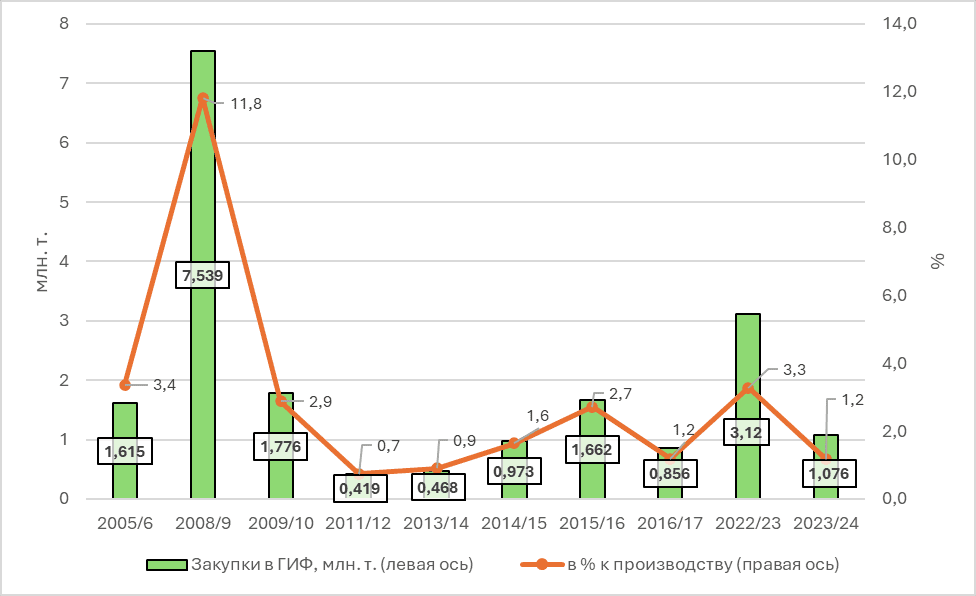
However, in 2022, after a record harvest (157.6 million tons according to Rosstat), 3.1 million tons of grain were purchased into the GIF between August and December—the largest volume in trading history after the record purchases of 2008/2009. In 2023-2024, the GIF also accumulated grain, albeit in somewhat more modest volumes (around 1.1 million tons), while grain sales through commodity interventions were suspended only in July 2025.
What's wrong with grain interventions? Why aren't they being abolished?
Grain interventions are—
In the context of the Russian market, grain interventions refer to the purchase/sale by the state, represented by its agent company (GK "OZK"), of grain crops for the purpose of stabilizing prices in agricultural product markets and maintaining grain producers' incomes (Federal Law №264-FZ "On Agricultural Development," Article 14).
Grain is purchased into the GIF when prices fall below certain values determined by Russia's Ministry of Agriculture, and sold from the GIF when established price thresholds are exceeded. In this way, the state creates additional demand for grain to increase market prices or increases supply to decrease them, which helps smooth out price fluctuations in the grain market.
The scale of intervention policy
The volumes of intervention purchases using wheat as an example—the main crop purchased into the GIF—are shown in Chart №1 below.
Chart No. 1. Volumes of state procurement interventions (in the wheat market). Source: compiled based on data from NTB and IGC
The chart data clearly shows that after the 2008/9 season, purchase interventions play an insignificant role relative to gross wheat harvests (no more than 3% of production) and, consequently, cannot reverse the negative trend of falling prices in conditions of excess supply in the market.
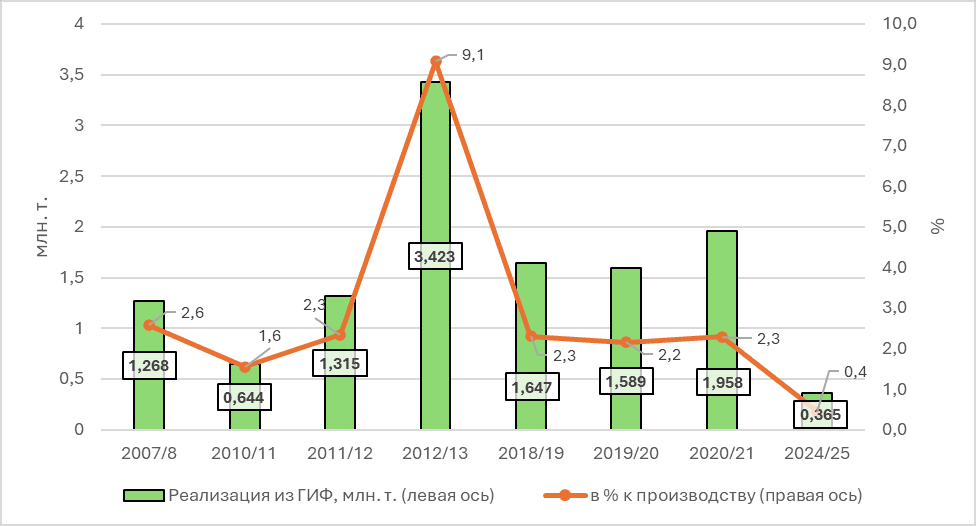
Wheat sales volumes from the State Intervention Fund (excluding sales outside exchange trading on the NTB) are shown in Chart No. 2.
Chart No. 2. Volumes of state commodity interventions (in the wheat market). Source: compiled based on data from NTB and IGC
A similar conclusion can be drawn regarding commodity interventions. The volumes of wheat sales by the state, excluding the 2012/13 season, are also insufficient to produce any serious shifts in market conditions.
Problems and "Diagnosis"
Beyond the small-scale market operations, intervention policy in Russia has a number of other weak points:
High burden on the budget system:
grain interventions are inherently "programmed" for losses: the state purchases grain at high prices and sells at low prices;
in addition to procurement costs, the state bears expenses for organizing storage, transportation to elevators, and conducting exchange purchases.
Lack of certainty regarding the timing of purchases/sales:
interventions begin only at the discretion of the Russian Ministry of Agriculture, rather than automatically when prices reach threshold levels.
Thus, at present, state procurement and commodity interventions in Russia represent an expensive budgetary mechanism whose scale does not allow it to impact the market with the required force, while the cumbersome and unwieldy nature of interventions prevents effective management of agricultural producers' expectations.
Grain interventions in their current form are not a market-regulating instrument, but rather a means of building state grain reserves and a tool for targeted, selective support of milling enterprises.
International Experience
Government grain market regulation measures similar to Russian interventions, or resembling them, have been actively employed in other countries as well.
EU
The intervention price policy has been actively implemented in EU countries since 1962, covering not only grain markets but also meat, wine, and dairy product markets.
By the 1980s, intervention stockpiles reached their peak, creating the infamous "grain mountains," "butter mountains," and "wine lakes." With European markets fully self-sufficient, countries began subsidizing export deliveries to move their reserves. In 1992, following the "MacSharry reform," intervention prices were sharply reduced to avoid oversupply and excessive government spending. Further measures to diminish the regulatory role of interventions were undertaken during the "Fischler reform" of 2003 and the CAP reform of 2013. A system of agricultural sector subsidies became the strategic substitute for the intervention price policy.
Currently, the intervention price for grain is set at 101.31 euros per ton—a level unchanged since 2000/1—with grain purchases capped at 3 million tons. Grain interventions have thus been effectively removed from the government grain market regulation system and now serve merely as a safety net.
USA
In 1938, the United States introduced a non-recourse commodity loan system under which farmers received loans secured by their harvest. If prices were satisfactory, farmers would sell their grain on the market and repay the loan; otherwise, the pledged grain would transfer to the agent company (in the U.S., the Commodity Credit Corporation). In 1949, the U.S. shifted to a system of direct intervention purchases at minimum guaranteed prices.
Starting in 1973, against a backdrop of substantial intervention reserves, the country transitioned to a policy of compensating the difference between market prices and government-set minimum prices. The elimination of compensation payment programs was formalized in 1996 amid liberalization of the country's agricultural sector.
The U.S. periodically returned to individual price support instruments, but intervention policy no longer played a systemic role in government regulation of the grain market.
India
Since 1964, with the establishment of the Food Corporation of India, substantial grain purchases for government reserves have been conducted annually at minimum support prices. The purchased volumes are then sold at subsidized prices to the population through food assistance programs.
In other words, in India intervention purchases serve not only as an instrument for maintaining desired price dynamics and farmer incomes, but also as a vital link in food security.
Implications for Russia:
In developed countries, interventions were abandoned in favor of direct payment policies back in the last century due to their high cost and the problem of surplus stockpiling.
Abroad, grain interventions were effectively implemented in the form of minimum guaranteed price policies for grain, whereas in Russia interventions are limited in volume and not mandatory.
Interventions and similar regulatory mechanisms have survived only in countries where government grain procurement assumes the existence of stable and guaranteed sales channels (as in India).
The Future of Grain Interventions
Problems with implementing intervention policy are recognized both by the expert and industry community and at the government level. Yet grain interventions continue to be conducted. Why?
First, interventions are one of the few instruments for supporting grain prices in the country. The government has a wide range of measures for reducing prices: export duties, quotas, and others. However, for raising prices, intervention purchases are virtually the only tool available.
Second, the move away from grain interventions in advanced capitalist countries became possible thanks to a well-designed subsidy system, as well as the development of market infrastructure: agricultural insurance; risk hedging on the futures market; spot exchange trading, and so on. In Russia, subsidies to grain producers are paid out in a "manual" adjustment mode, the futures market is in its infancy and lacks high liquidity.
It can be expected that in the near future, government procurement and commodity interventions will continue to operate as a regulatory instrument. However, the focus in managing the State Intervention Fund will increasingly shift toward forming and maintaining a government strategic grain reserve in specific quantities. In other words, grain interventions will become a tool for replenishing the country's grain "breadbasket."
The scenario of a possible transformation of grain interventions into a guaranteed price policy, discussed in expert circles, is unlikely, since the government is clearly not prepared to purchase such significant volumes of grain given the ever-increasing cost of grain production and the absence of stable channels for subsequently releasing the State Intervention Fund for the next round of purchases.