This text is an automatic translation from Русский. It was generated by AI and may contain inaccuracies.
Read original →What Will Become Scarce?
University of Chicago professor Alex Imas explains why in the age of AI, the main scarcity may shift from producing goods to human participation—attention, trust, experience, and the uniqueness of services.

Starbucks is a massive company (market cap around $112 billion) selling one of the most standardized products in the modern economy. Making coffee—even complex beverages—is easy to automate and replicate. If the economy really is moving toward full automation, Starbucks should have been the canary in the coal mine, the first candidate for replacing people with machines: the technology has existed for years. And in recent years, the company did go down that path. Seeking to boost already thin margins, management increasingly automated coffee-making processes and introduced rigidly standardized customer service procedures.
But the opposite happened. After experimenting, management admitted that excessive automation of coffee shops was a mistake. CEO Brian Niccol noted that things like "handwritten names on cups," ceramic dishware, and comfortable seating encourage more customers to "linger and sit in our coffee shops," and that "small details and hospitality drive satisfaction." As a result, Starbucks beganhiring more baristas and scaling back automation. That's an important signal.
Economics is the science of decision-making under constraints—that is, scarcity. If advanced AI brings material abundance—if machines can produce many, perhaps all, forms of human output at very low marginal cost—will economics become irrelevant? No.Scarcity will persist, but the type of scarcity that matters will change. Ultimately, the answer to any question about the future economy of advanced AI begins with identifying what becomes scarce. Once you answer that question, the rest of the analysis becomes fairly straightforward. In this article, I'll examine what will become scarce when automation can replicate many (if not all) forms of human production, and what that might mean for new types of jobs.
Before industrialization, it was hard to separate a product from the person who made it. The weaver who made your shirt, the baker who baked your bread—you knew these people personally, and their skill and reputation were tied to the product they sold. Economic transactions had a distinct social component, intrinsically linked to the consumption experience. Industrial production changed this, breaking down craft into standardized, repeatable operations. Capitalism, built on predetermined and uniform workflows, gave birth to something new—the commodity form, in which a product's value resides in the product itself, separated from whoever produced it. A table is a table, a phone is a phone. The screen you're reading this article on was designed in one country, manufactured in another, using components from around the world. But none of that matters to the experience of buying and using the device.
Marx described this process in ideologically loaded terms. The commodity form, he argued, is built on exploitation: the ability to pay workers less than the value of what they produce. This became possible because the capitalist production process is based on alienation: the worker is separated from the product of his labor, from the process of creating it, and ultimately from other people.What was once human craftsmanship became abstract "labor power"—a factor of production, which could be bought and sold just like raw materials. Marx saw this as capitalism's fundamental pathology. But for economists—and for the world at large—the commodity form became a source of tremendous prosperity. When production was no longer tied to specific individuals, it could be divided, reorganized, shipped across oceans, and scaled so that a small amount of resources could be transformed into enormous wealth. Both things were true simultaneously: the commodity form created vast wealth and prosperity, but made the person behind a particular product invisible and ultimately replaceable.
This is exactly how most people imagine AI's impact on the economy. If a machine can produce everything a human can—write a brief, generate an image, compose a song, diagnose from an X-ray—then the employee will be replaced in all aspects of production, and jobs will simply disappear. Labor will be substituted by capital. David Autor and Neil Thompson challenge this view in their recent paper. They argue thatAI won't simply destroy jobs, but will transform the economic value of human expertise.They distinguish between expert and non-expert tasks within each profession. When automation eliminates simpler tasks—as accounting software did for bookkeeping clerks—the remaining work becomes more specialized, wages rise, and the pool of suitable workers narrows. When automation eliminates more complex tasks—as inventory management systems did in warehouses—work becomes more accessible, employment expands, and wages decline. The same technology can produce opposite outcomes in the labor market, depending on which part of the work gets automated.
But Autor and Thompson also consider a harsher scenario: AI develops to a level where human expertise loses all economic value. In such a scenario,AI will eliminate labor scarcity and create what Herbert Simon once called an "intolerable abundance"(intolerable abundance). And here, the automation of production would no longer mean a manageable workforce transition of the kind we can understand from past episodes of automation. We would need tools to sustain the social sphere, distribute income, and maintain democratic stability without the labor market that has historically held all these elements together.
I want to consider a different scenario: automation may be able to replicate human production and the goods it creates—this is, of course, a big "if"—but human labor still doesn't disappear. How is this possible? Much of the analysis takes the economy as a given: there's a set of jobs and a set of goods and services that the economy produces. If the same set of goods and services can be produced using cheaper machines, then machines replace people and jobs disappear. But the economics of structural change, combined with deep properties of human preferences, points to something else:as people become wealthier, they don't simply want more goods. They want things that aren't commodities in the standard sense.The social properties of products—relationships, status, exclusivity, what René Girard called the mimetic properties of desire—become far more important once basic needs are satisfied. And demand for these properties will bring the human element back into the production process, and with it, jobs.
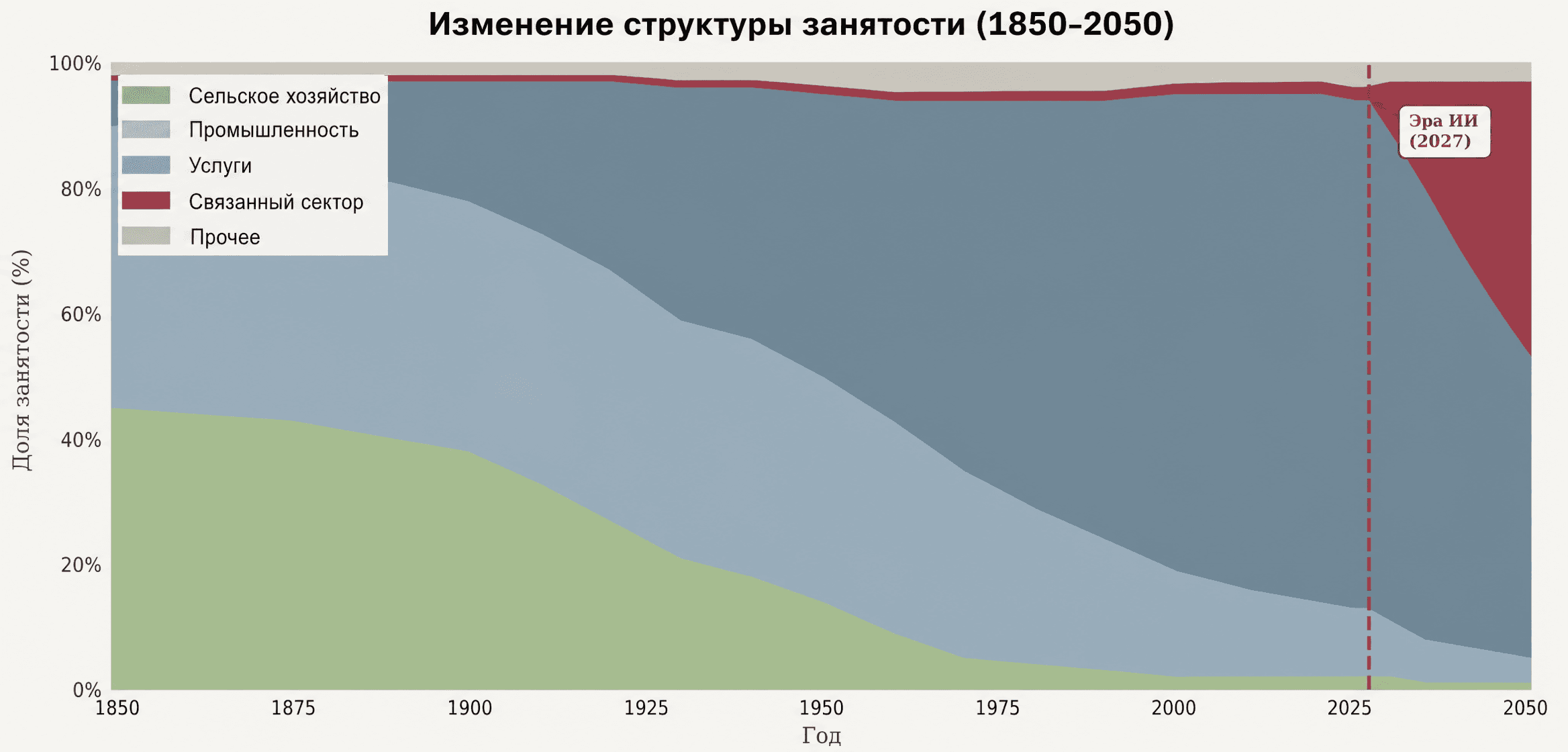
If this is true, AI won't simply automate the commodity economy. It will trigger the emergence of something new: a post-commodity economy, where a growing share of spending will go toward goods and services whose value is inseparable from the human who provided them. The same economic forces that moved 40% of the American workforce from farms to factories and offices will shift workers out of automatable commodity production into what I'll call the relational sector. By this I mean the labor-intensive, provenance-rich, sometimes artisanal part of the economy where the human aspect is part of the value of the good or service itself. The economy of scarcity won't disappear—scarcity will simply shift [1].
This argument isn't being made for the first time (see my writing,writing by Seb Krier,Adam Ozimek and Philip Trammell). The purpose of this article is to make the argument more precise. I'll start with what we know about how economies have historically responded to large-scale productivity shocks—that is, with the economics of structural change. Then I'll introduce a new element:a behavioral microfoundation,rooted in mimetic preferences that generate desire for exclusivity and status, and explain why artisanal goods—where the human element is directly tied to value—have particularly high income elasticity of demand. I'll then walk through a simple model that yields a clear prediction: automated sectors shrink as a share of GDP, while the relational sector grows. After that, I'll connect this framework to a question I raised in a previous post: can AI lead to negative economic growth? This framework works even more strongly against that thesis.
My thesis here is already the strongest version of the labor share of income story. I'm not claiming that the aggregate labor share must necessarily rise or even remain at current levels. As automation advances, it may well decline.My thesis is about sectoral reallocation in wealthy economies: as AI makes goods production cheap, spending and employment shift toward relational sectors with high income elasticity of demand, where human involvement still carries value. In other words, the labor share may decline, yet relational sectors can still remain a significant part of the economy. Moreover, the intrinsic properties of demand for human relationships ensure that labor persists as a substantial part of the overall economy—meaning it won't shrink to zero. In the accompanying technical note, I work through a formal version of these arguments—check it out if you're interested in a more rigorous economic case.
But I also want to emphasize: this framework works best for the developed world, where income growth can finance the transition. For the developing world, whose economies were built on producing goods for wealthy countries, the picture is more complex and potentially more troubling.
From farms to factories and…
Economics has a name for the situation when new technology dramatically boosts productivity in one sector: structural change. The canonical example is agriculture. In 1900, roughly 40% of the American workforce was employed on farms. Today it's less than 2%. Did people stop eating? No, quite the opposite: they eat more and with greater variety.Large-scale automation made farmers, and later industrial farms, far more productive.Agricultural output increased, prices fell. But since people can only eat a limited amount of food, the share of income spent on food declined as prosperity grew, and workers moved first into manufacturing, then into services. The simultaneous drop in prices and reallocation of labor to another sector produced a perhaps counterintuitive result: the more productive and automated sector became a smaller part of the economy, even though it produced more and served more demand. The less productive sector—services, where costs didn't fall but actually rose—became a larger part of the economy. This is known as Baumol's cost disease. The transformation can be seen in Taiwan's example in Figure 1.
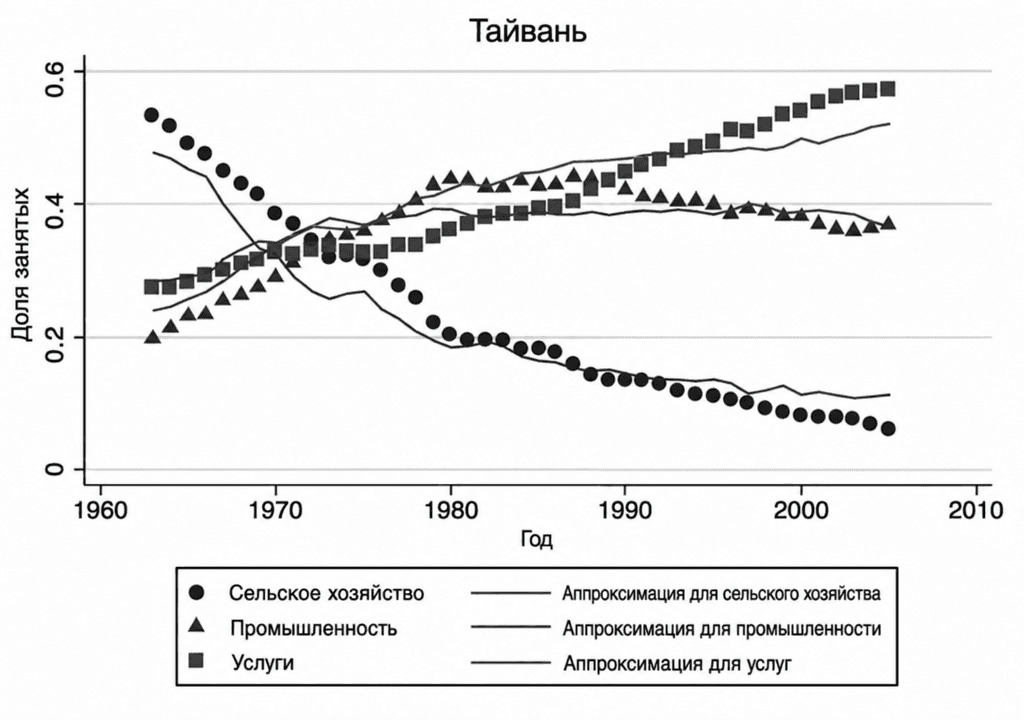
The formal economics of this process is beautifully laid out in a paper by Diego Comin, Danial Lashkari, and Martí Mestieri published in Econometrica in 2021 (thanks to Peter McCrory for pointing me to it). Their key insight is that demand is non-homothetic: as people get richer, they don't simply buy proportionally more of everything. They shift spending toward sectors with higher income elasticity of demand—goods whose demand grows faster than income. Agriculture has low income elasticity: you can only eat so much food. Services have high elasticity: there's always a better restaurant, a more engaging experience, a more attentive doctor. Their framework fits the historical data well: it explains agriculture's decline, manufacturing's hump-shaped rise and fall, and services' steady ascent.
The key finding from Comin and co-authors is that the main mechanism isn't Baumol's cost disease per se. It's that lower prices in automated sectors raise real income, and rising income shifts demand toward sectors with higher income elasticity.Baumol's cost disease then amplifies this shift when these sectors remain relatively difficult to automate.The reason they may be "hard" to automate could be technological—as it was in the past. But it could be something else: the value of such sectors may depend precisely on them not being automated. This is the relational sector, where the very fact of non-automation is part of the value proposition. In other words, even if automation rates across sectors were similar, we'd still expect the relational sector to grow in importance if that's where wealthier households want to spend a larger share of their money.
How does this relate to the transformation of jobs under AI's influence? Comin, Lashkari, and Mestieri estimate thatincome effects explain more than 75% of the observed patterns of structural change. Price effects—the standard story about automated sectors becoming cheaper and people buying something else—explain only about a quarter. The dominant force is actually quite simple: as people become wealthier, they start wanting fundamentally different things.
Importantly, this is already visible in the spending patterns of wealthy households. In the 2022 U.S. Consumer Expenditure Survey, householdsin the top income quintile (the wealthiest 20%) spent roughly 4.3 times more overall than households in the bottom quintile (the 20% with the lowest incomes).But in categories with a strong relational component—restaurants, entertainment, education, and so on—the gaps are significantly larger. In other words, wealthy households don't simply buy more stuff. They shift spending toward goods and services where the human element, experience, or social meaning matters more. This is precisely the pattern Joachim Hubmer describes in his paper The Race Between Preferences and Technology. Using household data across the full spectrum of consumer spending, he shows that higher-income families spend relatively more on labor-intensive goods and services as a share of total consumption. He interprets this as evidence of non-homothetic preferences: economic growth increases demand for labor-intensive sectors through the income effect, even when other technological forces pull in the opposite direction.
If advanced AI technologies significantly reduce the cost of producing a wide range of goods and services, this logic predicts a structural transformation. The share of automated sectors in the economy will shrink. Sectors with higher income elasticity of demand will grow. The question is: which sectors and goods will have high income elasticity of demand in a world after the deployment of advanced artificial intelligence technologies?
The Relational Sector and Desire
Here, I think it's useful to look more closely at the factors that shape human preferences and desires. Economists typically model demand as if preferences were formed in isolation; the "utility" I derive from a good, service, or experience is determined by itshedonic component(for example, how good the coffee tasted, how quickly I received my coffee after ordering) [2].This makes sense when people's budget constraints affect the satisfaction of basic needs—food, shelter, and clothing. But once these needs are met, another force begins to shape people's desires and even becomes dominant.René Girard called this mimetic desire:the idea that we desire objects not only because of their intrinsic properties, but also because other people desire them too. We want what others want, and we want it even more when they can't have it—for status, social capital, reputation, and so on. Desire is not simply a relationship between a person and an object; it's also a function of what other people desire.
This idea didn't originate with Girard—it can be traced through centuries of reflection on human nature. Augustine wrote aboutlibido dominandi, the lust for domination, as a defining feature of desire. For him, people's motivation was closely tied to the pleasure of possessing what others are denied. Hobbes, inLeviathan, placed competition for glory and honor at the center of his account of human conflict—people were motivated not only by material comfort but by "superiority" over others, and this drive is never satisfied because it is inherently comparative. Rousseau went even further. In hisDiscourse on the Origin of Inequality"he distinguished betweenamour de soi,the basic instinct of self-preservation, andamour propre, the need to be considered superior to others. Self-regard is the engine of social life and, in Rousseau's view, the source of most of its suffering: once people begin comparing themselves to others, they derive pleasure from feeling superior and pain from feeling inferior, and this comparison steadily intensifies.
Cultural critic Dave Hickey put it in simpler terms. In his excellent essay collection "Air Guitar: Essays on Art and Democracy" (thanks to Tim O'Reilly for the tip), Hickey notes thatpeople in developed countries often pay more for things than they're worth in a functional sense. One of his examples is an Armani suit.No one buying Armani is buying a better way to stay warm. They're buying the brand, the connection to Armani's history, its meaning, its reputation, the fact that other people know what it is and want it. Hickey emphasizes that desire is based not only on what goods are sold, but on what they signify. And this meaning, this provenance, is difficult to commoditize and produce at scale—it's precisely the scarcity of the good that gives it meaning. While Armani uses industrial machinery to produce its ready-to-wear, a significant number of people are involved in creating its high-end suits. Thanks to advances in manufacturing, industrial processes can certainly replicate the functional aspects of a high-quality suit, including its aesthetics. But humans remain in the process precisely because they're what give the suit its value.
Why does this mimetic, relational dimension of desire matter to Comin et al.'s concept? Because it'scomparative, and therefore difficult to satisfy. Goods possessing this quality should have particularly high income elasticity of demand as incomes rise.
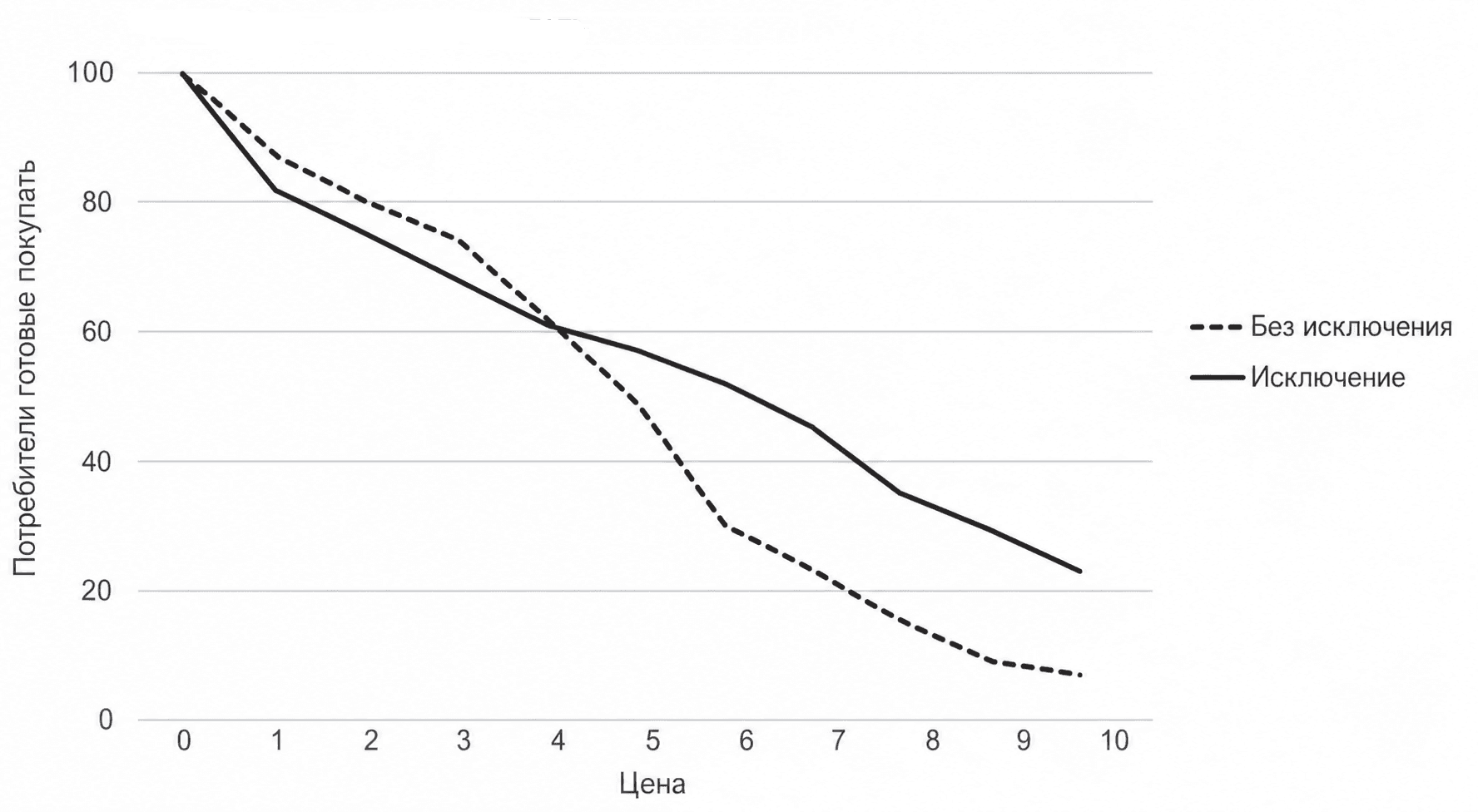
Kristof Madarasz and I confirmed the mimetic aspect of preferences in the context of basic economic exchange. We first developed a formal model in which a person's desire to obtain a good increases as others want it but cannot have it. This model predicts that people will value things more when there is actual exclusion—when access to a particular object is limited and others are left out. In our experiments, willingness to pay roughly doubled when subjects learned that a random group of people would be excluded from receiving the product (Figure 2 below), even though the product itself was identical. This wasn't status signaling (subjects were anonymous) or scarcity heuristics (the exclusion was random). It was driven purely by the preference to possess what others don't have.
We also conducted an experiment in which we obtained actual demand curves as a function of mimetic preferences. You can see how the demand curve shifts substantially to the right as the probability of exclusion increases (Figure 3). And the effect is not small—median willingness nearly doubles again!
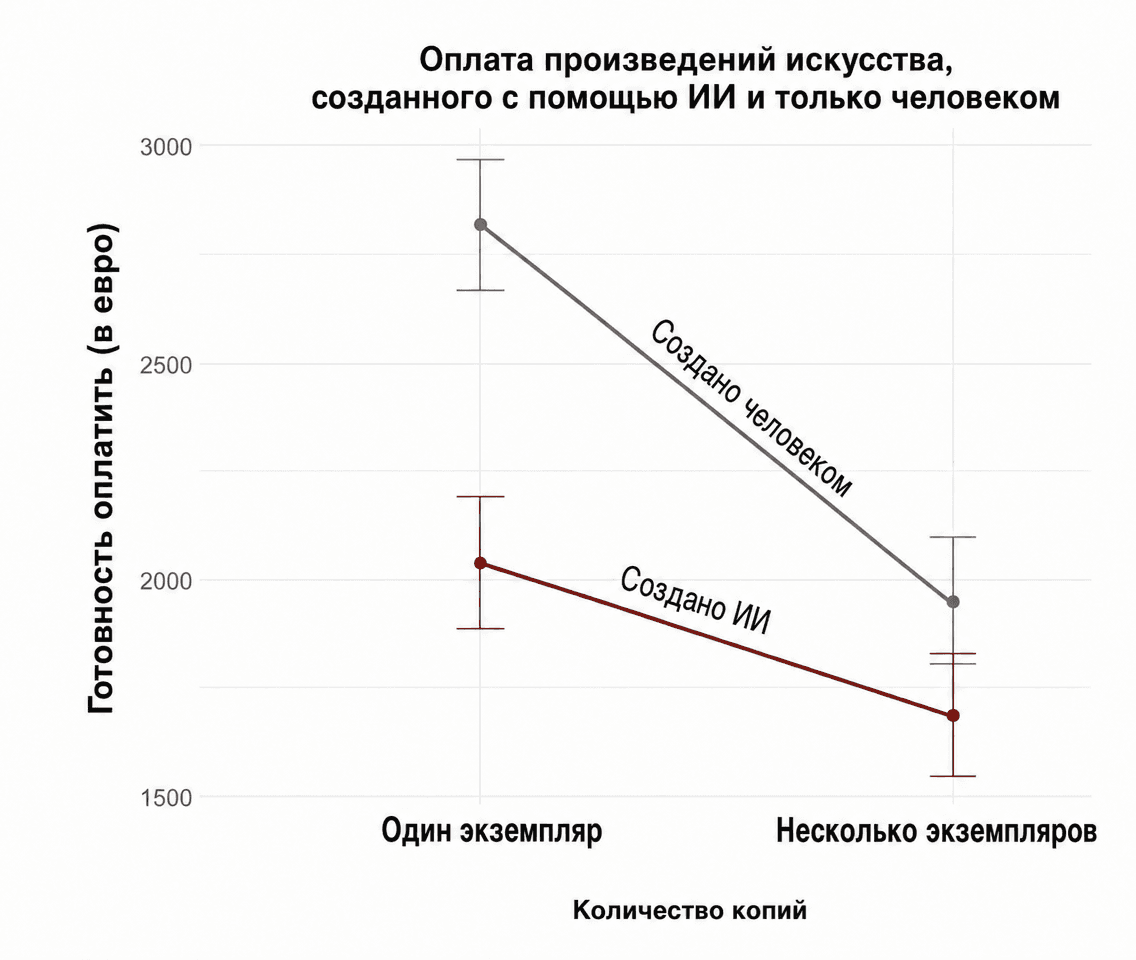
The key connection to AI is traced in new research conducted jointly with Graylin Mandel. We found thatAI involvement undermines the perceived exclusivity of a good; objects created with AI are perceived as inherently reproducible and non-unique.People bid on physical copies of artworks whose descriptions varied in how AI involvement was framed. The value of human-created artworks increased by 44% due to exclusivity (one copy versus many), but AI-assisted works increased less than half as much, just 21%. AI involvement itself created a sense that the artwork was inherently non-exclusive, as if it could always be reproduced, regardless of how many copies were claimed to exist.
I want to emphasize that this extends far beyond artists and luxury goods. Walter Benjamin wrote about this in a different context, about the "aura" of a work of art that mechanical reproduction destroys. But the economic logic goes beyond art. Itextends to any categorywhere the human element is integral to the value: teachers, nurses, therapists, childcare workers, coaches, hospitality workers, clergy, guides, and many forms of local services. In all these cases, the person is not merely a resource in the production process. Their judgment, attention, memory, warmth, or presence is an integral part of the value. These are cases where, as Seb Krier, provenance remains scarce even in a world without scarcity.
This matters for structural change because the mimetic component of preferences is inherentlyincome elastic. When you're poor, most of your spending goes to necessities, where the identity of the producer doesn't matter. As you get richer, a larger share goes to goods where you're not just buying a functional product; you're buying a story, scarcity, the sense of possessing something that others want too. This is what gives relational goods and services high income elasticity: as incomes rise, the premium for exclusivity becomes a larger share of total value, and that premium is what human-made goods can deliver.
The End of the Commodity Economy?
Let's return to the commodity form. I defined it earlier: the abstraction of a product from the person who made it, which made industrial capitalism possible. What happens to it when AI can produce that commodity itself?
The obvious answer is thatthe commodity form reaches its logical endpoint. A product with no human in it at all. But the less obvious answer, the one that follows from taking structural change seriously, is that AI doesn't just perfect the commodity form. It also triggers (in the strict sense) a decline in its share of economic activity.
Here's the mechanism more precisely. When AI automates the production of goods, prices in that sector fall. This raises real income. If the goods and services people want more of as they grow wealthier are disproportionately concentrated in the relationship-oriented sector, demand shifts in that direction. Then Baumol's "cost disease" amplifies the result: if the relationship-oriented sector remains harder to automate, it becomes relatively more expensive and absorbs an ever-larger share of total spending.
But in the context of AI-driven automation, Baumol's "cost disease" isn't a bug—it's a feature. AI researcher, technologist, and co-founderCollective Intelligence Project(CIP)Saffron Huangrecently articulated this idea in a highly compelling piece about a potentially positive future of AI-driven structural change:
Here's a plausible positive scenario that doesn't require a bunch of new AI breakthroughs. I wanted to clearly show the path "from here to there" rather than hand-wave, so the beginning sounds grim, but it ends positively—I promise.
A recession leads to a hiring slowdown and the breakdown of early career ladders. A political window opens for industrial policy in AI: governments incentivize companies to launch apprenticeship programs to bridge the training gap between junior and senior office workers and teach people to critically evaluate AI outputs. These programs help redeploy people from clerical and administrative positions into education—especially one-on-one tutoring for elementary and middle school students—or into nursing, giving them AI tools to accelerate their acquisition of clinical care skills. People with an appetite for risk or strategic thinking become entrepreneurs and managers who oversee the work of AI agents. Industrial policy matters, but AI itself also helps reduce regulatory and compliance burdens in construction. This sector expands, and the urban and infrastructure environment begins to improve—for instance, high-speed rail development becomes more realistic.
Later, material abundance enabled by robotic manufacturing makes goods cheap and more accessible for domestic production. As a result, the bulk of people's spending shifts toward human-delivered services—what today is considered luxury. For example, quality education: in many places, including the US, mass schooling has historically been low quality for most people, creating numerous secondary negative consequences. Personal attention from teachers for younger students plus personalized AI learning for older ones helps close this gap. People become healthier: cheap AI triage of medical problems lowers the barrier to preventive and essential care. Entrepreneurship becomes easier thanks to access to AI agents. The overall standard of customer service rises—retail and hospitality see more high-end service similar to what you'd find in Japan. Everyone works three to four days a week. Baumol's cost disease transforms from a problem into an advantage: the relative expense of human services stops being a budget headache and becomes a labor market solution. That's where the jobs are—and these are jobs actually worth having.
The relative cost of social services stops being a budget problem and starts being viewed as a labor market solution. The "stagnant" sector, the one that resists automation, is precisely the sector where spending and employment grow. The relationship-based services sector becomes more expensive because the goods sector becomes cheaper, and that's what provides employment.
What does this actually look like? Saffron painted a plausible picture. Material abundance driven by automated manufacturing means goods are cheap. Most of people's spending goes toward human-provided services: today's luxury items become the baseline for tomorrow's consumers. As goods production becomes automated, income and employment flow into sectors with high income elasticity of demand: what I call the relational sector, including the arts, as well as care, education, hospitality, therapy, personal services, crafts, and community organizations, where the human elementispart of the value. The "stagnant" sector absorbs an ever-larger share of spending and jobs precisely because it can't be automated. That's where the jobs are. If you're interested in a mathematical model of this process, I developed one here. Here's a potential picture of what that might look like.
Admittedly, Marx would have found such an outcome strange. But I want to be careful here. A product with a pronounced human element is not the same thing as decommodified labor. A tailor who makes you a suit, or a teacher who knows you personally, may still be selling labor tied to interpersonal relationships to capital. The social relations of production can remain fully capitalist, even if the human aspect of the product becomes more economically significant.
So my claim is narrower. Artificial intelligence may reduce the share of spending in the commodity sector and increase the share going to goods and services where the human element remains visible and valuable. This is not the end of commodification in the Marxist sense. It's a shift in the structure of demand. Nevertheless, it matters for labor markets: the direction of structural change may tilt toward work that is, in some cases, more personal, more relationship-oriented, and less interchangeable than what it replaces.
Rethinking the Demand Collapse
This brings us back to what I wrote about earlier, and what concerns many people, especially after the publication of Chitrini's piece. In my essay on whether advanced AI could lead to negative economic growth, I showed that if AI automates most labor and the wage share in the economy shrinks dramatically, the economy could potentially contract. The mechanism is this: people with money (capital owners) are already satisfied, while people without money (displaced workers) can't buy anything. Demand collapses because the people who kept the economy running by purchasing goods and services no longer have the money to do so.
The key equation from that piece was:
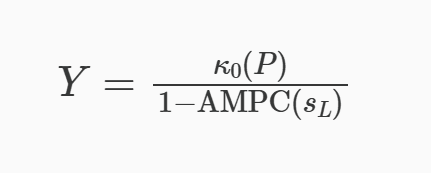
Demand collapses when the multiplier shrinks (as the labor share s_L falls) faster than baseline consumption (k0) can expand (due to saturation).
Mimetic desire contradicts this scenario, since this aspect of demand is not quickly satisfied. As noted above, the fact that the preference for status and exclusivity is comparative in nature means that people will constantly reallocate spending toward goods that satisfy this preference as incomes rise. The non-homothetic CES model captures this by allowing expenditure shares to shift continuously with income. This is notmeansthat there literally is no ceiling anywhere; time constraints and other scarce complementary goods still matter. But it does mean that the economy has a much larger relief valve than simple saturation theory suggests.
Even if demand for automated goods hits a ceiling, demand for goods unrelated to physical production and physical impact can continue growing across a very wide range. Structural reallocation acts as a relief valve: the economy doesn't need everyone to keep buying more and more automated goods. It needs spending to shift toward those areas that matter more to people as they grow wealthier.
The Future of Work
If the model is correct, then the in-demand jobs of the future won't be monitoring AI systems or prompt engineering. Those are transitional roles in the automated sector.The permanent jobs will be in interpersonal services, where the human element is the product itself.
Some professions already exist and are growing: nurses, therapists, teachers, boutique fitness instructors, personal chefs, tailors, brewers, artists, spiritual advisors, childcare workers, and countless other professions in hospitality and care.Others are just emerging:user experience designers, human-AI collaborative artists, product provenance certification specialists, community curators. Many haven't been invented yet, just as six out of ten jobs people hold today didn't exist in 1940.
The most common objection I hear when I talk about this: "But not everyone is creative, not everyone will become an artist." I think that's a misunderstanding of the issue. You don't have to be Picasso. You need to be the person whose involvement creates the sense that the product was made for someone, by someone. The economics of structural change tells us that when technology makes one type of production cheap, the economy doesn't collapse. It transforms. It shifts toward what technology can't make cheap. For AI, that's precisely those things where human involvement has inherent, irreplaceable value.
An Alternative View
In conclusion, I'd like to consider an alternative view. In essay by Philip Trammell explores the possibility of a future in which labor becomes a luxury. In his essay, Trammell poses an asymptotic question about whether the aggregate labor share will remain high in the limit as capital accumulates and machine production options proliferate. This essay focuses on a different question: what will happen to sectoral spending and employment in wealthy economies when artificial intelligence makes the production of goods cheap?
On this question, I think it's worth taking a broader historical and theoretical perspective. First, the data on structural change suggest that income effects do the heavy lifting. The prevailing historical pattern is not simply that sectors with rapid productivity growth become cheap and shed labor; it's that as societies grow wealthier, they reallocate spending toward other types of goods. This is the main finding of Comin, Lashkari, and Mestieri's work: their model is built to explain the decline of agriculture, the hump-shaped rise and fall of manufacturing, and the sustained rise of services, and they find that income effects explain the bulk of within-country sectoral reallocation. Trammell makes an excellent point that standard macroeconomic models underestimate the possibility that labor will remain important because they over-aggregate and often assume homothetic preferences. But I think the relevant question isn't whether the aggregate labor share increases. It may not. The relevant question is which sectors absorb spending and employment once goods production becomes cheap, and whether the sector that absorbs reallocated labor remains a substantial part of the economy.
Hubmer's example is useful here, as it shows these two claims can diverge: higher-income households spend relatively more on labor-intensive goods and services, so growth itself shifts demand toward sectors with higher labor shares, even as other technological forces reduce the aggregate labor share. And as for the question of whether labor remains a substantial part of the economy, one need only look at what very wealthy people (billionaires, for instance) spend their time and money on today (thanks to Tom Cunningham for this point). Certainly, much is spent on capital and non-relational goods, but a huge portion of time and money goes to "relational" products: the wealthy buy handcrafted clothing, purchase handmade art created by a particular person, eat carefully selected and hand-prepared food, and spend (perhaps too much of) their time on various platforms trying to ensure their thoughts are heard and discussed by other people. René Girard would say this is no accident—it's a consequence of a basic property of human desire.
Second, the history of artisanal decline needs to be studied carefully. Indeed, over the past two centuries, a significant portion of traditional artisanal employment has disappeared. But this alone is not evidence of weak demand for goods produced in the artisanal sector. Industrialization replaced the functionaloutputof many artisanal goods with much cheaper products. A machine-made shirt, chair, or phonograph could satisfy the basic consumer need for a tiny fraction of the former cost, and for most households, budget constraints were still tight enough that the cheaper good won out. Thus, this historical pattern is consistent with my argument. The question is what happens after a good becomes cheap enough. Structural change suggests that once consumption of basic goods becomes cheap and incomes rise sufficiently, spending shifts again—this time toward sectors where the human element itself is part of the value. So I don't think the historical decline of artisans is the final word on this matter. I think it's just one stage in a longer process.
Finally, the category of human-related goods is much broader than artists and goods representing authenticity. Education, care, hospitality, therapy, and various local services, for reasons outlined elsewhere in this essay, fall into categories where the value of the service is likely to become increasingly tied to the person providing it. The U.S. Bureau of Labor Statistics Consumer Expenditure Survey shows that households in the top income quintile spent significantly more on these interpersonal categories than lower-income consumers, and even now these sectors constitute a significant portion of the economy—together they employ nearly 50 million people in the United States. This supports the claim that the interpersonal sector will occupy a substantial share of the economy after the introduction of adjusted gross income.
---
[1]: It should be noted that I'm not claiming human labor will remain the only scarce resource. Land, energy, computational resources, and other fixed or quasi-fixed inputs may also absorb a significant share of income. My claim is merely that human labor, even if it's no longer the dominant scarce factor, may still remain a substantial part of the economy as demand shifts toward sectors where the human element itself is part of the value.
[2]: This doesn't mean economists have completely ignored the social dimension of preferences. Consider, for instance, the work of Akerlof and Kranton on the economics of identity, Alberto Bisin's research on how culture shapes preferences, and many others. Behavioral economics also has a long-standing tradition of modeling how contextual effects influence decisions and beliefs.
---
This article was prepared and translated into Russian by the Argument Media editorial team with the author's consent.