This text is an automatic translation from Русский. It was generated by AI and may contain inaccuracies.
Read original →The Role of the Creative Worker in the 21st Century Economy
How creative labor and creative workers are becoming the foundation of new productive forces. An analysis of economic transformation driven by digital technologies and AI in the 21st century.
Introduction to the Research Context
When considering which factors drive the development of national economic systems, human potential is among the first that comes to mind. In practice, human potential is functionally and substantively expressed through active labor activity. In classical political economy, labor is understood as purposeful activity aimed at producing goods.
As we know, labor encompasses a wide range of gradations, though traditionally we distinguish between: productive and reproductive, productive and unproductive. Furthermore, recalling the words of the outstanding Soviet writer M.M. Prishvin that "free labor is creative labor by its very nature," we will discuss productive labor and the creative worker who embodies this corresponding potential.
Creativity as a Special Form of Commodity in the Creative Economy
In the 21st century, we are witnessing a qualitative leap in the system of technological development; so-called "new" productive forces are taking center stage, based on creative labor and the creative worker. These "new" productive forces (such as digital technologies, microelectronics, and artificial intelligence systems), mediated by the logic and content of the scientific-technological revolution, have outgrown the late-capitalist form of their embodiment (the mode of production). In particular, we're seeing the replacement of so-called "living" labor with "objectified" labor, natural intelligence with artificial intelligence—a trend confirmed by relevant statistics (Figure 1).
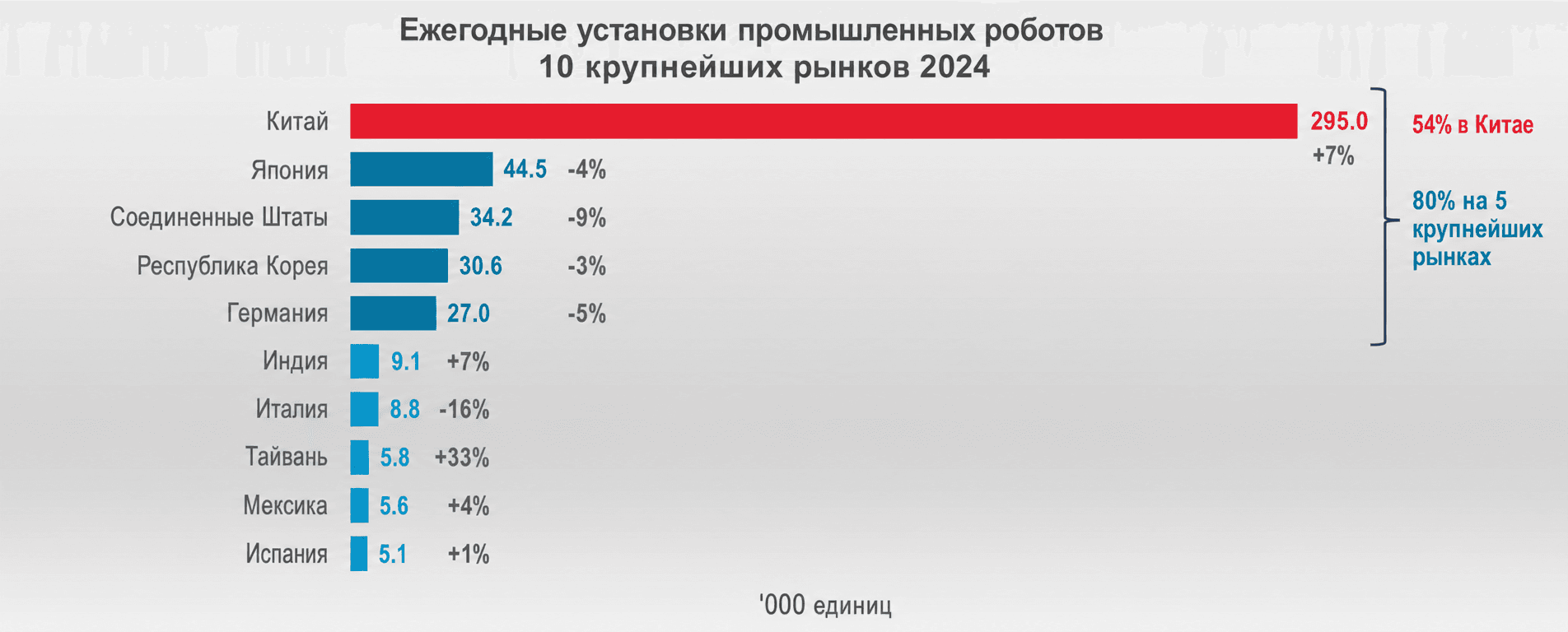
As we can see from the number of industrial robots in operation per 10,000 employees, China surpassed Japan and Germany back in 2024. Over the course of 2024, the percentage of newly deployed industrial robots was +7% in China, -4% in Japan, -9% in the US, -3% in South Korea, and -5% in Germany.
A country's level of industrial capacity also reflects the degree of automation in its manufacturing sector. In line with these identified trends, the nature of labor is also changing, becoming knowledge-intensive and accompanied by an increasing role of creativity in the labor operations being performed.
It should be particularly noted that within these historical boundaries, we're observing a transformation of the commodity production system and the commodity form itself. Creativity is becoming one of the key commodities of the 21st century, turning into a fundamental factor of competitive advantage for global companies. According to current UNCTAD data, the growth rate of creative product exports is outpacing the dynamics of traditional industries and could account for approximately 10% of global GDP by 2030.3Creativity, at the same time, possesses specific characteristics that distinguish it from traditional goods. It becomes a special form of commodity that encompasses not only the final product but also the creative process itself, the personal qualities of the worker, and their capacity for creative synthesis.
Simultaneously, as simple labor is reduced, the share of creative labor grows. As a consequence, an objective contradiction emerges between (post)capitalist productive forces and the existing mode of production and distribution, which must be resolved dialectically to form a new (post)industrial system of social organization.
Today, in the academic field, there is no complete model of the (post)industrial economy of the future. Such a model is always the result of social consensus and objective laws governing the development of the historical process. In substance, the economic model of the 21st century represents a macro-object that is historical and has specific spatial-temporal boundaries, as well as corresponding forms of embodiment. At the core of its structure lie appropriately organized productive forces and production relations.
Within the spatial-temporal boundaries of the 21st century economic model, qualitatively different systems coexist simultaneously: the industrial system, which is in its phase of regression, and the post-industrial system—within the boundaries of phase transformation—the shift from the genesis phase to the phase of active development, accompanied by a change in production relations.
Key Characteristics of the Creative Worker Through the Lens of Accelerationism
Within the regression phase of the industrial economic system, a process of divergence and diffusion of the main social classes occurs, along with a complication of the social-class structure driven by the logic of the system's evolution. It is under these conditions that the creative worker takes center stage and becomes the primary productive force with the following specific characteristics.
First, the creative worker is the fundamental element of the corresponding social class—the "core" of the 21st century economy.
Second, for the creative worker, a qualitative transformation occurs in the content of their labor—it becomes a need rather than a necessity requiring corresponding resources for satisfaction; creative labor is based on the creative component of the labor process, which determines its quality, functionality, and content specifics.
Third, the creative worker's primary resource—their personal qualities—can no longer be subject to alienation.
The creative worker existed long before the creative era began; but only by becoming part of it did they become the concrete historical form of this era, with all its defining characteristics. Thus, it is the historical epoch itself that has determined the direction of the creative worker's labor evolution.
One of the key defining features of the 21st-century economic system is accelerationism, which represents the acceleration of technological and social processes related to immaterial production, aimed at overcoming the limitations of the commodity-capitalist system and creating post-capitalist forms of labor and social organization. This involves leveraging productive forces, including the creative potential of workers, for radical transformations (the principles of disruptive thinking). Accelerationism undoubtedly exerts significant influence on the natural process of the creative worker's evolutionary dynamics, speeding it up, which manifests substantively in the following forms of economic practice:
- participation in digital platforms and collaborative projects, where creative workers can use platforms for the joint creation of knowledge, products, or services;
- reproduction of new forms of employment, within which creative workers cease to be merely hired employees and become active participants in creating new forms of social organization, thereby demonstrating the potential of the "General Intellect";
- formation of cultural and educational spaces, where knowledge and skills are transmitted outside traditional market mechanisms, forming new models of collaboration.
It's also worth mentioning the risks of accelerationism. Most often cited is the danger of further reproduction of capitalist relations (and even new feudal ones—so-called "digital feudalism"), intensified exploitation, and technocracy.
Creative labor, procedurally, is realized through the following algorithm: idea – mental image – mental object – transformation into material object/service (creative products). For creative labor, the predominant characteristics are market forms of practical implementation.
Creativity serves as a systemic element in the structure of creative workers' labor, functioning as the primary commodity of the creative era—one that is not synonymous with artistic creation. Creativity ontologically represents a cognitive ability of the subject to realize creative synthesis; it is a combinatorial process through which a new form of an object is created. Creative workers produce economic value through the process of creative synthesis and generate income, typically by designing and creating new forms and objects, while enjoying greater autonomy and flexibility.
From a social perspective, creative workers form a corresponding social class. The critical mass of creative workers is concentrated in relevant institutions known as creative industries (up to 12% of employment, 3.1% of GDP, with average annual growth rates around 15%). Creative workers are predominantly located in urban agglomerations (approximately 80% of employment), since it is there that business industries act as the driver of creative sector development.
Accordingly, the presence of a critical mass of workers possessing high creativity is essential for the transition to a "creative economy," which requires rethinking attitudes toward human labor. In this regard, the creative worker represents both an expressive means and the result of the evolutionary dynamics of concrete historical social development.
Sources (3)
- Полнотекстовая версия статьи: Гречко М.В., Плешивцева А.А. О роли креативного работника в экономике XXI века // Вопросы политической экономии. 2024. № 3(39). С. 150-168
- (Электронный ресурс. Дата обращения: 08. 12. 2025 г.)
- UNCTAD Report. World Economic Situation and Prospects. Free Economic Society of Russia. 2025