An analysis of the creative class formation through the lens of social division of labor theory. How the transformation of productive forces and the role of knowledge influence the emergence of new social groups in the economy.
6 min read
Share:
Introduction
As we know, Karl Marx in the mid-19th century proposed an original perspective on the state and historical prospects of humanity's development, consisting of viewing social development through the prism of class struggle. Ontologically, class differentiation derives from the system of social division of labor and begins with the period of primitive community disintegration: "The division of society into classes [...] ruling and oppressed, was an inevitable consequence of the previous insufficient development of production"1. Today we are witnessing a revolutionary, qualitative leap in the system of productive forces. There is also a transformation in the content of labor, accompanied by an increasing role of knowledge in performed work operations.
Alongside transformations in the quality of productive forces, changes in social structure are occurring. In the social dimension, various homogeneous groups are emerging and actively developing as an objective result of resolving social contradictions (for example, class-based ones). One such group is the creative class, whose main element is the creative worker.
Conceptual Definition of the Creative Class
In research practice, it is considered good form to begin the constructive part of a work with a scientific definition of each introduced concept. In the presented text, the "creative class" is understood as an objective social entity, distinguished on the basis of the content of labor.
Political economy has proven that social class derives from the system of social division of labor, which inevitably preserves the class division of society, manifesting as the foundation of social inequality. The concept of the creative class helps us understand the content of the process—its evolutionary dynamics as a specific social community (Figure 1).
Sources (6)
1. Энгельс Ф. (1970). Развитие социализма от утопии к науке. К. Маркс и Ф. Энгельс. Избранные произведения в трех томах. М.: Политиздат. Т. 3, С. 132 – 134.
2. Florida, R., Mellander, C., Stolarick, K. (2008). Inside the black box of regional development - Human capital, the creative class and tolerance // Journal of Economic Geography. Vol. 8. Pp. 615 - 649.
3. Гречко М. В., Плешивцева А. А. (2024.). О роли креативного работника в экономике XXI века // Вопросы политической экономии. № 3(39). С. 150 - 168. DOI: 10.5281/zenodo.13895711
The foundational element in the labor structure of creative class representatives is creativity and ideas directed toward (1) creating a creative product and (2) advancing human qualities. Moreover, in the concept of the creative classthere occurs synthesis of abstractly conceived component parts of the subject—creativity, creative labor, the creative worker. It's particularly important to note that the creative class is objective, and therefore concrete.
Social classes are a product of economic relations that correspond, in qualitative terms, to the economic system within whose boundaries their genesis and subsequent development occur. Representatives of various schools and movements within the social sciences noted as early as the beginning of the 21st century that the creative class is not a product of socioeconomic theory; it is a particular form of sociality that exists objectively. The class identity of the creative class manifests itself in subjective self-identification, where creative experience and self-realization are placed at the forefront.
Subsequently, drawing on a dialectical-materialist understanding of the development process, we can grasp the logic of social change and class fluctuations. Building on this, and relying on a system of arguments about the dialectical nature of social change, we present our reasoning regarding the logic of the creative class's genesis.
Qualitative characteristics of a concrete historical epoch
The creative class acquires the form of its genesis within the boundaries of a concrete historically formed epoch, commonly called the creative era. The creative epoch on one hand creates objective preconditions for the genesis of the creative class, while on the other hand it reproduces the class itself as a consequence —its own specific product. The main features of the creative historical epoch are as follows:
accelerationism and the steady decline in the share of reproductive labor and routine work in the production structure;
a shift in the system of core motivations toward enthusiasm, creativity, and self-development;
an inversion in the labor market: a transition from employer dictatorship to formal worker dominance, mediated by the development of digital ecosystems.
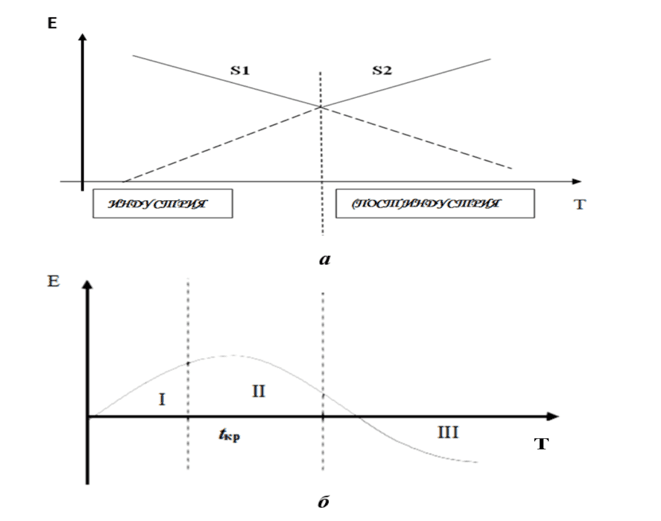
The genesis of the creative class is occurring under the influence of shifts in the system of productive forces that took place at the turn of the 20th and 21st centuries, and an understanding of the difference between quantitative and qualitative changes in the structure of labor. There is a stable relationship between these changes, expressed in the fact that quantitative accumulations at a certain critical juncture will lead to qualitative transformations, manifested in the form of a leap (Figure 2).
Figure 2 - Evolutionary dynamics of the economic system. (a - abrupt nature of the evolution of the economic system (S1) over time (T) and its transition to a new quality (S2); b - graphical representation of the phases of evolution of the economic system) Source: developed by the author.
At the foundation of the creative class genesis lies the growing complexity of property types and forms of economic activity, mediated by a reduction in the real subordination of workers to capital in favor of formal subordination. The creative class, which is in its genesis phase, lacks clearly defined class characteristics. This research field is currently being populated with individual elements obtained through discussions and observations. By the early 2000s, according to Richard Florida, approximately 30% of working Americans belonged to the creative class2. The "core" of the creative class consists of people employed in science and technology, the arts, education, as well as those with related creative professions.
Accordingly, the genesis of the creative class is mediated by the formation of a social stratum within the system of social division of labor, based on a corresponding type of labor —workers in the creative sector (industries). It is within these specific historical boundaries that the creative worker becomes the primary productive force and the quantum of the corresponding class.
The Creative Worker as a Quantum of the Creative Class
Let us outline the main features of the creative worker and their qualitative characteristics, drawing on the research framework established earlier3.
First, the creative worker represents a primary, indivisible element—a "quantum" of the corresponding class.
Second, creative workers are actively reproduced in post-capitalist core countries capable of creating adequate conditions for a qualitative transformation of labor content, which becomes a necessity.
Third, creativity serves as a systemic element in the structure of the creative worker's labor—a cognitive ability to realize creative synthesis.
For the creative worker, the tools of labor are intellect and mental activity aimed at forming thought-images. Creative workers earn income by designing and creating new forms and objects, enjoying greater autonomy and flexibility.
In today's economy, built on innovation and creative practices, there is demand for expanded reproduction of actors who carry the creative potential for socio-economic change, along with adequate creative institutions. Creative industries serve as a vital "core" for reproducing creativity. Creative industries possess a set of qualitative characteristics, the main ones being:
creative nature of activities;
in the Russian Federation, they fall under Federal Law N 330-FZ "On the Development of Creative (Artistic) Industries in the Russian Federation";
workers in creative industries are constantly in need of skills for working in hybrid creative teams based on a symbiosis of natural and generative AI.
Today, according to UNESCO data, creative industries account for approximately 3.1% of global GDP. According to current data from Creative Economy Outlook 20244, the share of creative industries in national economies ranges from 0.5% to 7.5% of GDP, with employment ranging from 0.5% to 12%. According to UNCTAD data, the growth rate of creative product exports outpaces the dynamics of traditional sectors5.
As for our country, according to the HSE statistical report "Russia's Creative Sector in Numbers: 2024. HSE"6 the creative sector's contribution to Russia's GDP stands at 3.5%, with 6.2% of total employment. Notably, half of those employed in creative professions are ICT specialists (26.1%) and culture and arts professionals (24.3%). Structurally, the creative sector creates conditions for localization and intellectual enrichment of space through both youth (32.5%) and workers with higher education (56%).
Russia's creative class is geographically concentrated primarily in Moscow and Moscow Oblast, accounting for 33.1% of total employment in creative professions. As we can see, creativity has a predominantly urban cluster localization, thereby creating the so-called phenomenon of spatial "creative inequality."
The creative industries foster a nurturing environment for generating ideas. In the Marxist framework, creative labor serves as the source of idea reproduction; accordingly, creative ideas are reproduced through the activity of creative workers, created as responses to emerging needs of social interaction. These ideas help highlight corresponding class determinants which, in relation to the creative class, manifest themselves in the transformation of systems of meanings and values (the shift from survival values to self-expression values), the constant search for and intensification of personal time, and changes in everyday life. A corresponding class style emerges, based on a blend of hedonism and bohemianism. One might assume that the future development of the creative class depends on how and in what forms existing contradictions will be resolved—contradictions driven not least by the dynamics of scientific and technological progress.
In Conclusion
At the same time, we must recognize that current discussions about the creative class remain in the realm of explicating specific conceptual content. This research field is now being populated with individual elements obtained through discussions and observations. Today, the "creative class" can hardly be considered unambiguously as a fully formed social class (system of relations). Rather, it is a "proto-class"—a certain form of sociality that exists objectively.