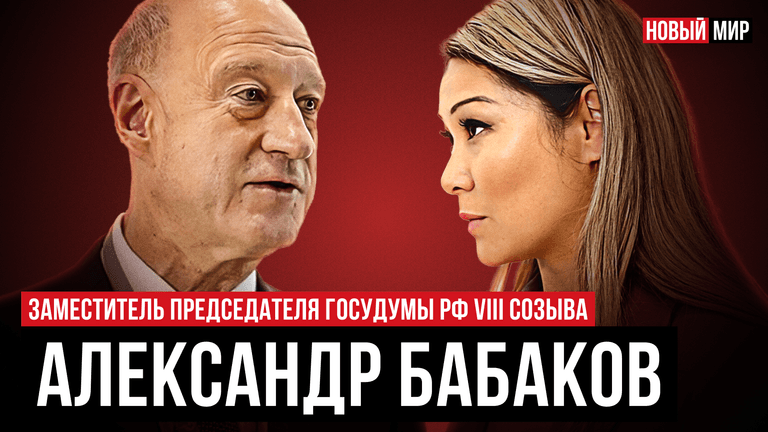
Alexander Babakov outlined his vision for the Russian economy over the next 25 years: why monetary emission should replace the Central Bank's high interest rates, how to restore confidence in the ruble, and how to create an alternative to the dollar through BRICS institutions. An interview on macro planning, the defense industry, and AI.
24 min read
Share:
What will Russia look like in 25 years? Alexander Babakov shares his vision for the future of the economy—from macro planning and monetary emission to artificial intelligence and the transformation of banks. Where is our place in the world, and how can we restore confidence in the ruble?
Watch the video version of the interview on RUTUBE.
— Alexander Mikhailovich, delighted to have you here. Our program is called "New World"—we're sketching out what things will look like in 25 years. From 2000 to 2025, we've seen obvious progress in the Russian economy and Russian industry. Now, looking ahead—what contours are emerging? There are so many factors, of course, making it difficult to say, but at least approximately, and building on what we just heard at the plenary session from our President Vladimir Putin—many different economic topics were touched upon. What caught your attention? What's most pressing?
— If we're talking about the economy, what naturally stands out is that the President's words contain key points that deserve special attention. What did he start with? Our economy must be an economy of high wages. This isn't about quantitative indicators. What the President is clearly indicating is that this is an economy of high technology, an economy connected with the revival of practically an entire industrial sector—namely: machine tool manufacturing, mechanical engineering—complex industries. And naturally, their influence on other spheres of our life presupposes that specialists will work there whose compensation will objectively be much higher than what exists today. Moreover, speaking about wages, if you noticed, he pointed out that this is one of the sources of demand growth. And demand growth itself will stimulate supply, and the balance between supply and demand is precisely what affects pricing.
— We're creating it through wages, if we simplify?
— Of course. The whole world fights for demand. And our current economic situation is such that we're starting from a fairly low position. On one hand, that's good. What's bad is that the previous period was like that... But let's forget about it and talk about the present and future. An economy of high wages, an economy of high technology means that the near future opens up a vast space for change. You mention 10, 15, 25 years. Twenty-five years is actually quite a lot. Our neighbors, the Chinese, showed that 25 years ago they didn't know about many things. Not just artificial intelligence—they didn't even know about high-speed rail lines; their first high-speed trains appeared quite recently.
— Yes, about 5 years ago.
— And today they have 46,000 kilometers of laid track. So, speaking about our present and future, we must understand that by laying down such signals today, orienting ourselves toward these messages—high wages, high-tech production, and as a consequence—technological sovereignty, economic sovereignty, financial sovereignty—all these are elements without which modern Russia cannot exist. Moreover, this indicates that in the near future, I hope, and am almost certain, we will return to growth rates that will exceed not only last year's 4.3%, but will go much further.
— The growth forecast is being revised and, of course, it's a bit disappointing. I think people were counting on more.
— Today, in fact, the President is somewhat above the fray. We're witnessing a clash of views, a battle of opinions, and this is a normal process. We're not talking about antagonistic contradictions that require some special ways of resolving problems. Yes, there's an ideological struggle, a clash of views on economic development. This is a normal, natural process for any living organism, a healthy organism. But I hope that ultimately the viewpoint of those economists, those experts who are convinced that our own sovereignty must be based on our own economy, on our own financial sovereignty, will prevail. That is, on the state's ability to create money supply independently, without tying it to external factors. In our domestic economic policy, we shouldn't orient ourselves toward factors that exist beyond Russia's borders. We should study them, but we shouldn't tie ourselves to them. We constantly wake up and hear: the ruble exchange rate is an internal factor, but it's linked to an external benchmark—the dollar. Then again, there's information that perhaps not everyone is waiting for, but it comes through every radio—the price of oil. All of this is great. But today the price of oil is an element that characterizes our export opportunities related to selling oil abroad. Yet 80% of budget revenues today are formed not from oil and gas revenues. This means that our country has found a development path that is harmonious and natural for it.
— As president, you're sidestepping the question of monetary policy a bit. Still, do you as an expert have an antagonism toward such a high rate?
— Of course. I believe that in this case we're fighting the remnants of the 1990s, when liberal views in economics were imposed on us from outside and prescribed limitations on our ability to be independent in making decisions in the financial sphere. We're essentially talking about financial colonialism imposed on us by the metropole that issues the dollar. Why does this happen? Because there's this orientation that our economy—we keep hearing—is limited in its potential, in its capabilities. They cite limitations: labor resources, production capacity. And all of this supposedly represents a natural constraint that prevents our economy from moving forward today. But in my view, this is not just a delusion—it's a dangerous delusion. Because if we look at world experience, at our own country's experience that was characteristic from 2000 to 2013, when we grew at rates of 8-10% per year, it becomes clear: there's actually no significant impact from labor or production capacity constraints.
Moreover, I can prove fairly quickly that even the claim that we're currently unable to increase our labor force is also disingenuous. Because there's no labor shortage as such. There's a shortage of highly qualified labor. But even that, one could say, is absent. If we look at the enormous number of enterprises engaged in the raw materials sector, we'll see that very literate, highly qualified, highly educated people work there, creating a product that leaves our country and doesn't come back. That is, we've had a huge foreign trade surplus for more than 25 years now. This means that by producing and extracting raw materials, oil, and selling them abroad, we leave part of it there—in the form of accumulations, though it's unclear so far who holds them: individual enterprises, or even the state as a whole. But this money supply in the form of currency doesn't return to the country. It brings us neither goods nor services. Yet these people work here. So if we start seriously thinking about reducing, optimizing the export volumes that are characteristic of our country today—not eliminating exports, not abandoning them, but optimizing them—then the question arises: why do we sell, let's say, such an amount that we have approximately...
— So you mean not selling for currency, but for something else?
— No. We sell for 500 billion, we buy for 300—we have 200. Why do we sell 200 more than we buy? Generally, any export orientation isn't just an attempt to sell the best you have, to conquer foreign markets, but it's primarily oriented toward the fact that thanks to foreign currency earnings you can cover the country's external debts or purchase critically important goods and services for the country during a certain period of time. But why do we store such an amount, around $100-150 billion, without using it? Let's either not sell that amount, optimizing the volume, or then use it for its intended purpose: buy goods, equipment. But simply converting it into dollars and accumulating dollars—this is at minimum absurd, and actually it's even destructive for the economy.
— Where are these dollars located now?
— Beyond our country's borders. They're in enterprise accounts, they accumulated and were frozen. We sell, we accumulate again. Even in 2025, which is generally challenging for the economy overall, more than $100 billion in foreign trade surplus is projected. But what are we doing this for? We're withdrawing internal resources. Moreover, I want to say, when we talk about inflationary processes, one element of inflation is that we leave money behind. What's the essence? People who receive high salaries here—these are very professional people, I repeat, working in export industries. Enterprises that receive profit or revenue receive it in rubles. But since their product goes abroad, its equivalent doesn't appear on the market in the form of goods and services. What does this mean? This increased money supply in the form of income isn't countered by a commodity mass. Naturally, an inflationary process occurs. This is the ABC of economics.
— But goods still need to be produced. And how do you produce when the economy is frozen by such a rate?
— This kind of activity, among other things, significantly affects inflationary processes. And for them to decrease, we need to develop our own production. After all, inflation in 2023-2024 began to decline. And then the Central Bank activated a mechanism related to importing artificial inflation from abroad. Because the dollar exchange rate strengthened substantially, and the ruble fell. What did this lead to? The same goods that were brought from abroad became more expensive in rubles. And this sharp jump, you remember, led to the ruble cheapening by almost 30-40%. It delivered a colossal inflationary blow to the economy, and this served as the official argument for the Central Bank that the key rate needed to be increased to fight inflation. But that's not what should have been done: we should have stimulated our own production, which would have filled our economy with necessary goods. We shouldn't have been importing these goods. Why were they imported? Because they weren't produced in the country. So we need to create the prerequisites for these goods to be produced inside the country. And the dynamic toward growth leads to this affecting inflationary processes. Our Chinese neighbor demonstrates not only the highest growth rates in its economy: both in the previous year and this year no less than 5% is planned. And their inflation is 0%—zero, understand.
— But they have a somewhat peculiar yuan exchange rate. Isn't that related?
— Not related at all. Moreover, this is an example that tells us we need to look and answer the question: is there something unique they're doing that we can't apply? I'll answer this question for you right away. There's nothing unique. Moreover, when I discuss with my group of colleagues and experts, we have an idea that we need to apply a new economic model based on a universal economic machine. The universal economic machine is a set of tools that have been applied not for decades, but even centuries by many countries.
— So this is another New Economic Policy, then? Would that be fair to say?
— Yes, you could say that. We need the right guidelines. If we want to be sovereign, these instruments must be directed toward the domestic side of our economy. We need to understand that a country like Russia cannot have any inherent limits on its development. So the first thing we need to do is use elements of macro-planning that were characteristic of the Soviet Union, of certain periods even in our modern Russia (though to a lesser extent), and that are characteristic of all progressively developing countries today.
— China too?
— Of course. Macro-planning means looking 50 years ahead.
— Are these comprehensive plans in the Chinese economy?
— Yes, calculated by sector, horizontally and vertically. These are enterprises, these are individual industries. To calculate the set of projects we need to implement, we should write in one column what we need, and in another column what we have available to make it happen.
— So not trying to get out of the situation we've been put in, but rather adapting that situation to fit our plan.
— And fill it all with money.
— And is there money for such a development plan?
— We have an emission center — what's the Central Bank for?
— You mean print money like America does?
— Not like America, but like any normal country. A country that has an emission center...
— You've really scared us with this: money printing equals inflation. Is that wrong?
— It's complete nonsense. The hyperinflation of the 1990s wasn't caused by too much money in the economy, but too little. And this can be proven too—I've talked about it many times. What happened was the destruction of the Soviet economy, and the two-circuit system that existed—cashless and cash money—merged overnight. We suddenly threw such a quantity of money onto the market by combining them that our goods supply simply wasn't ready for it.
— Am I understanding correctly that if production now manufactures enough goods, then money printing won't fuel inflation?
— Absolutely. Moreover, money printing is controllable. Today we have this notion—the biggest misconception that continues to be imposed on us, including by representatives of the financial bloc—that they'll print money at our Mint, people will come with bags and scatter across towns and villages with this money. Nothing of the sort happens. There's a project: this project has calculated consumption. We know that this enterprise's output will already be purchased. We know the demand, we know the volume, we know the price parameters. Give the money so production can happen, and you'll immediately get an effect within the economy. Because by our calculations, government investments—investments in industrial enterprises generally—already in the first year provide up to 30% return of this money to the state through excise taxes, taxes and so on. Imagine the profitability of such an enterprise, where 30% already comes back in the first year. This applies to practically all sectors, even complex ones that require 5-7 years of investment and enterprise construction.
— Does ramping up the military-industrial complex, those enterprises connected with defense, affect overall consumer activity or not?
— They do affect it, and not all negatively—in all countries the military-industrial complex is a growth driver. What's the West doing today? It's stimulating its own economic development through defense industry development. But our situation is objective. Moreover, when I hear talk about the need to optimize or cut military spending, I want to ask a simple question. Does Victory have a price? So we're saying that such expenditures are inevitable, necessary for the current period in our country. Now the second question. Are such expenditures that we're making today a burden on the economy? To some degree yes, but I'd say that it's precisely the defense industry today that has revived a huge number of sectors and enterprises working for defense. And we shouldn't be talking about needing to think about optimizing, looking at defense spending. We need to look at the simple report that Mikhail Vladimirovich Mishustin gave our president in May. He said that over the past period, especially in 2024, we can state that by this point our gross domestic product has grown to 200 trillion. And before the start of the special military operation it was 130 trillion rubles. What does this tell us? The economy has really grown, and it's given such returns: our budget revenue has grown enormously. Expenditures have grown, but revenues have grown too. And when we talk about defense spending: it was one thing three years ago, now it's grown, but budget revenue has also grown. And the budget itself has grown. So the answer is simple: we shouldn't cut military spending, we should increase the budget and budget revenue.
— That also requires money printing.
— Money printing isn't a dirty word. Money printing is a normal economic process. Uncontrolled money printing is connected with the global political changes we had in the early 1990s. There haven't been other examples of hyperinflation and, consequently, impact on the money printing process since then.
— I've only seen hyperinflation in Venezuela, when it was 180 thousand percent...
— How can you compare Venezuela's economy, Turkey's economy, which they constantly cite to us. Turkey has had 40 years of external balance deficit. Everything's different. We should talk about our own country, our own economy and its capabilities. For us, hyperinflation is impossible under current conditions of our economic potential. So we need, on the contrary, not to restrict money printing. Listen to what the president says about investment. But investment isn't only private. What about the state itself? Possessing its own monetary center, it should issue money and provide the government with it. For what? So that government expenditures, which they call expenditures—these aren't government expenditures, they're investments—so that these government investments are directed into the economy. And then we'll get the quickest feedback effect in the form of returns through shares. We've been through this already. This is the experience even of 2022-2024. And even 2025. In 2025 we've already practically reached zero growth today, and that's a problem. This is also a subject for comparison. Let's compare 2025 with 2023 and answer the question of what prevented us from growing today. We can say for certain, first of all, it's the interest rate, which reduced lending capacity. This is, consequently, a completely one-sided view of financial problems through fighting one factor—inflation—as if we have no other economic categories that matter.
— Such a complicated word, "cooling," which doesn't convey the essence of the process. And the essence of the process is the slowing of all processes in the economy: producers can't get credit, the whole chain stands still, and everyone keeps their money in the savings bank.
— I was a teacher. Imagine I walk into the classroom and say: look, please read the book up to page 10, but don't read further. You'd find that ridiculous.
It's like putting a child in a room where they'll grow but there's a ceiling.
We think this is normal, and there are even people who try to justify it.
Yes, they've really drilled that into our heads, it's true. It scares me to hear it too. Let's take a broader view. We're talking about 20, 25 years ahead. If we look at major macro-regions: Europe, America, Russia, China. How will the balance shift? Right now, for instance, it reminds me a bit of Roosevelt. It's clear there will be a recession, everyone sees the slowdown, everyone's scared. And these harsh measures with a planned economy, plus the fact that there was a war in Europe.
The optimal combination of planning and market. There's no need to set them against each other. All sectors will develop. Planning applies to the overall economy. Don't enterprises and families plan?
What kind of planning does Russia need?
Macroeconomic planning, which includes what are called inter-sectoral balances. What does this mean? We need to properly coordinate through calculations, because we need to know: where, what volume, what type of enterprise needs to be created, what needs to be revived, and for what timeframe. Light industry can be built in a year. Heavy industry takes 5 to 7 years. There are power plants that take up to 5 years to build, and hydroelectric stations even longer. Nuclear plants too. All of this needs to be calculated. If our fathers and grandfathers could calculate it, we should be able to do it faster and more efficiently with artificial intelligence. Today we're standing here in Vladivostok. What do you think: building comfortable housing, solving the problem of providing this housing to absolutely everyone living in the Far Eastern District—whose function is that? The market's? It will never build it. Why? You can't demand that of it. If we're talking about the market and business—what's its goal? Profit. Can profit be the goal of state development? That's the whole delusion. The entire financial and economic school thinks our country is an "enterprise." But it's not an enterprise, a state cannot be an "enterprise." The state has completely different goals. After all, can you put a price on childhood, on old age? Ultimately, on solving the demographic problem. There are qualitative characteristics to our life. You walk out of your house, and there's a park.
It's always very scary to get the plan wrong.
There's no need to be afraid, everything can be calculated. Aren't you scared that the market, which deprives us of the ability to move toward qualitative indicators, pushes us only toward quantitative ones and erases from our lives everything that doesn't fit into the program of achieving profit, killing everything else?
What percentage of our Russian economy right now is planned economy?
The government has started to formulate it. Notice what we do every year in the State Duma? We adjust the budget. But what kind of three-year plan is that? It means we simply have a three-year forecast and a one-year plan. And sometimes we even try to adjust something within it.
Is it the same in China?
No, of course not. A plan is a plan. Imagine you're living at home, you come home with your paycheck and say: sorry, I didn't spend it on potatoes, I spent it on mom. That's called the absence of a planned economy.
— On the financial system: it's clear that the instruments and approaches are different, there are imperfections, but the global financial system is also, to put it mildly, imperfect and colonial, as you rightly said—it's tied to the dollar. How satisfied are you with the speed at which the world, BRICS, is trying to break away from the dollar? How do you see this playing out over the next 10-15 years? It seems very slow to me so far.
— Here I would measure things in different terms. Can we or can't we? Can there be a situation today where there's an alternative to the dollar? I can say—yes, there is. What's needed for that? Let's take the ruble as an example. Can the ruble be an alternative to the dollar?
— No. Not at this moment.
— Right, why? Because today the ruble as such is not a full-fledged monetary unit at all.
— And is the dollar full-fledged? What is it pegged to?
— Yes, the dollar is. This isn't a question of pegging. What most people today lack, not just experts but anyone who discusses this topic, is knowledge in the economic sphere. What is money? Money is equivalent. That is, when we talk about there being goods and money, we know the difference between them. When we say that money has functions—and there are different numbers of them in different theories, but we usually name five functions. And all these functions are clear: money must perform a certain set of functions as an economic factor. Why is the ruble not full-fledged money? Because one of its functions is accumulation, reserve, settlement. It doesn't always work even as a settlement currency, but more or less within the country. But accumulation, reserve—it doesn't perform these functions at all, because today no one believes, thanks to the Central Bank's policy, in the present or future of the ruble. We don't believe in it, and the West even less so. Any investor who wants to invest money here doesn't invest dollars or even their own national currency—they exchange it for rubles and invest. And then this ruble fluctuates from morning to night: it falls, it rises, it moves sideways. People don't trust it. When you ask our citizens, what do they talk about most? Dollars, euros, now they've started talking about yuan. This is the result of the monetary and credit policy we have: lack of trust in the national currency. So if the national currency performed other functions, namely: you could store in it, you could invest in it, and especially settle accounts in it.
— Does the digital ruble meet these criteria? Can it fill this niche?
— The digital ruble is simply a form of non-cash ruble. It's a form that implies more control. Why is it being implemented with such difficulty, in my view? Because it implies more transparency in its use. I think that doesn't suit everyone. The ruble we're talking about can be made fully backed—any currency is backed by the national wealth of the country that issues it—and you can give the ruble a gold content, which would make it even more attractive to foreign investors. But a monetary unit by itself cannot become a replacement for another monetary unit. Why? Because the dollar's dominance as such is ensured not by being beautifully drawn or painted with green ink, but because the institutions ensuring its functioning guarantee its dominance. There are banks, there's the International Monetary Fund, the International Bank for Reconstruction and Development, and so on. There's an entire financial framework that ensures the dollar's penetration into all spheres.
— So BRICS needs to build not a currency, but an international BRICS fund.
— We need to start with institutions. And not just one. As for institutions, I'm not sure work is being done, but there are ideas. I think sooner or later we'll get there.
— Why do you have such an attitude toward crypto? The technology has its place, and we're not disputing that.
— In the long term, it will be transformed. It exists, that's already a fact. If people are investing in it, that means it has prospects. But crypto is still unable to perform real functions, I repeat. Today, crypto is practically analogous to the closed part of monetary circulation. It's not transparent, which is why it's convenient and so much in demand. But in reality, this is not the way forward—people need to understand this, because otherwise we'll venture into very dangerous territory.
— I'm talking about something slightly different—about how the platform economy, which on one hand is indeed an accelerator and driver of all processes for us—that's a fact, and the economy is growing because of it, that's also a fact.
— This part is helping us today, including in the fight against sanctions and much else, but it also simplifies the process for everyone else. It's acceleration. There's a concept of the velocity of money—and this ensures a certain speed.
— But overall, these algorithms simply close into an ecosystem. If a person is surrounded by it, they gradually begin to trust this ecosystem.
— Banks will transform, but not because of crypto. It's not crypto but digitalization that will change things—it's already changed the fate of banks. Moreover, banks have already transformed. What was the purpose of banks appearing? What did banks emerge from? Money wasn't concentrated in one place—they found those who had a little bit, concentrated it, and then gave it to those who needed it. Then other functions appeared: they verified, controlled—what banks do today. Today, banks are generally a huge, though in some cases not always efficient, instrument. What's their work? They take money from the Central Bank, from enterprises, people bring it themselves. What's the main function of a bank? Not to accumulate, but to invest? Look at our Russian banks—what are they doing? Are they investing?
— And platforms are starting to invest.
— And our banks will transform. What is Sber doing? It's engaged in things that are absolutely necessary for the country today, related not only to artificial intelligence but also to entire ecosystems that allow a different view of their function. They're moving away from purely such notions: take from one and give to another—is that the function of a bank? No. Even in human history there were examples when in Japan, Korea, Germany there were integrated clusters, so-called financial-industrial groups. I think that our banks will partially transform in this direction as well, especially the large ones. They'll take entire industries under their control and ensure their functioning.
— Interesting. Since you've touched on the topic of artificial intelligence—you head a commission in the State Duma that deals with artificial intelligence, with the regulatory framework. There's no ideal legislative framework anywhere in the world to keep up with these processes—they're very fast. What will be the main focus of your commission's efforts, the main directions? How do you see this development?
— First, what we started with, and I hope will yield certain results in the near future, is the categorical apparatus. We really need to sort out the terminology. Because if you don't understand the topic itself, if you can't structure it through categories, then the topic isn't clear to you. We're now trying to find the right definitions for terms that will make the topic of artificial intelligence itself understandable to anyone—to users, to workers in this field. The Americans, trying to scare people, say that machines will replace humans after all. For example, the Chinese and we are convinced that humans come first. This machine will always remain a machine; it must be for humans. It's a convenient platform, a convenient set of solutions that can help people. Therefore, we must proceed from the priority of humans. Second, in defining terms, we must then move on to certain deeper topics about the life of this artificial intelligence. There's generative intelligence—we have a consensus on the danger. Because deepfakes can appear here, and embedded interpretations of terms and concepts of traditional values that are not in our favor, and anything else. That is, we must first assess the threats that this topic itself carries, and try not to limit development—because progress shouldn't be stopped—but to set restrictions on those directions where artificial intelligence's interference could cause real damage in the present or near future, including to humanity itself.
— But how do you set these restrictions?
— Believe me, where there's a will, there's a way. The Chinese are moving in this direction, they have experience, which is very interesting for us. We'll soon have an interparliamentary meeting at the level of interparliamentary contact groups, we proposed the topic of artificial intelligence to them. They fully supported it, because for them, moving forward means, among other things, understanding where this topic might lead. That's why we absolutely must consider sovereignty as a priority. Without national interest, without sovereignty, you can't venture into this topic. Otherwise we'll simply become hostages to other people's opinions, views, decisions, and so on. So we're also embedding this into the legislative sphere: from hardware to mathematics, we must work to ensure real sovereignty. And there's another important aspect. You can talk as much as you want about the essence of artificial intelligence, about the legislative framework for this topic. But if you don't have the economic mechanisms for developing artificial intelligence—namely, first and foremost, the electrical power that will allow you to process such a flow, not just process it but also provide solutions for such quantities of information—then all your hopes for your place in the mega-world will come to nothing. And we're a country that can't afford not to—we're obligated to afford it. That's why we consider it essential to link this topic in parallel to the general theme of solving infrastructure projects, in principle, in the energy sector, and to combine efforts toward the accelerated development of the energy sphere. China, again, shows how it does this. Today it's building energy capacity with such a margin, understanding that perhaps at some point the quantitative growth within the artificial intelligence topic will stop and qualitative changes will begin instead. Perhaps. Nobody knows this. At least today, one of the essential factors in developing this topic is the ability to provide it with the necessary electrical power. So all of this together will be the subject of our conversation.
— And this also requires planning, because here you can't change your mind a year later.
— Absolutely. Planning also includes another very important thing—forecasting. Understanding the sequence of actions, you can forecast these actions in the future and build in changes. In general, nothing happens without control.
— Thank you. Good. This was very interesting for me.