This text is an automatic translation from Русский. It was generated by AI and may contain inaccuracies.
Read original →Inflation in Russia in Early 2026: What Lies Behind the Slowdown in Headline CPI
Why might Russia's inflation slowdown in 2026 be temporary? Analysis of trend inflation (MCT) shows that despite CPI declining to ~5.9%, persistent price pressure remains above 7%. We examine inflation structure, Central Bank of Russia assessments, and risks for monetary policy.

On Inflation
In early 2026, inflation in Russia began to decelerate. However, the decline in the headline consumer price index does not yet indicate weakening persistent inflationary pressure. We're talking about the portion of price growth that is unrelated to seasonality, one-off fluctuations, and short-term shocks. This is precisely what matters most for monetary policy. Therefore, to assess medium-term risks, it's necessary to separate temporary price changes from their persistent component. This is exactly what trend inflation estimates help accomplish.
In international practice, inflation analysis isn't limited to comparing headline and core indices. Researchers and central banks increasingly use persistent inflation measures that isolate the long-term component of price growth and separate it from temporary noise, shocks, and relative price shifts. One of the best-known examples is the multivariate core trend (MCT) inflation estimate developed by the Federal Reserve Bank of New York. This indicator accounts for not only inflation persistence over time but also the breadth of its distribution across sectors. In other words, MCT distinguishes isolated price spikes from broad systemic inflationary pressure.
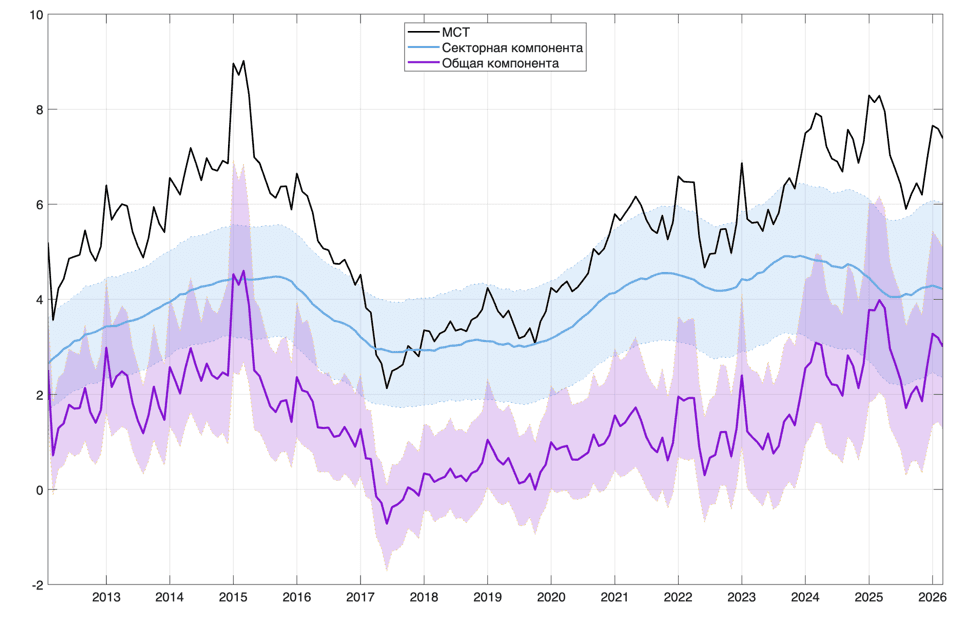
For Russia, the idea of isolating the persistent component of inflation is not new. The Bank of Russia publishes trend inflation estimates. However, such estimates don't answer questions about the internal structure of persistent price pressure. In the present work, the multivariate MCT model is applied to Russian disaggregated data for the first time. This allows us to assess not only the level of trend inflation but also to decompose it into common and sectoral components.
From October 2025 to March 2026, observed annual inflation fell from 7.73% to 5.87%, while core inflation dropped from 6.92% to 5.01%. Meanwhile, the median MCT estimate showed no comparable decline. On the contrary, it rose from 6.42% in October to 7.66% in January, then only partially corrected—to 7.60% in February and 7.38% in March. This means that against the backdrop of slowing headline CPI, persistent inflationary pressure remained elevated. Moreover, trend inflation during this period was substantially higher than both observed and core inflation.
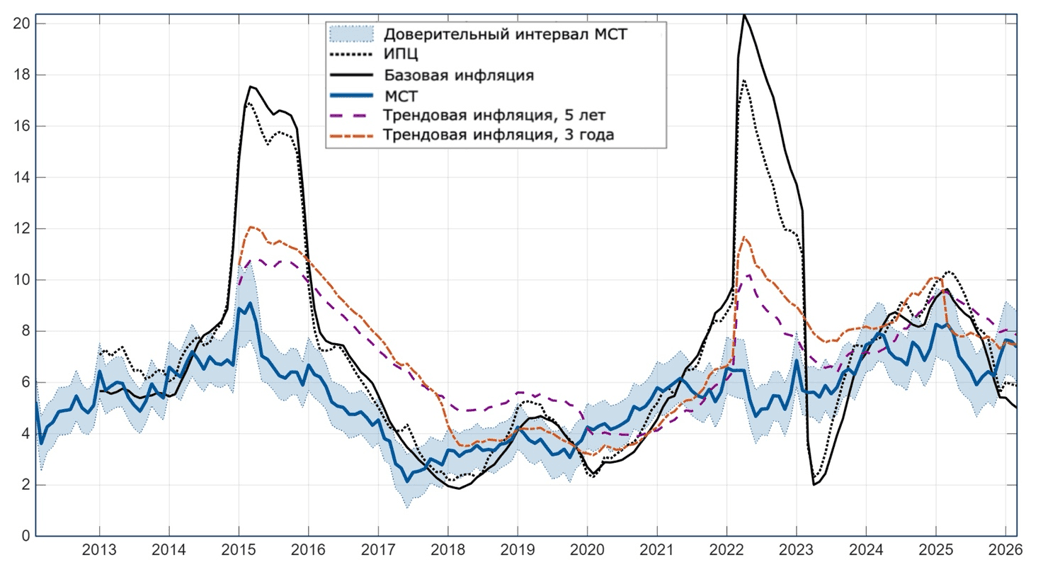
This result prevents us from interpreting the slowdown in aggregate inflation indices as a sign of sustained disinflation. In March 2026, a significant gap persisted between current inflation and its trend estimate. Actual inflation stood at 5.86-5.87%, while MCT remained near 7.4%. This gap indicates that much of the recent slowdown was explained by temporary and volatile factors rather than a sustained reduction in medium-term inflationary pressure.