This text is an automatic translation from Русский. It was generated by AI and may contain inaccuracies.
Read original →High Interest Rates and Corporate Debt Burden
A study on the impact of tight monetary policy on business: which sectors are most vulnerable to rising rates, how corporate debt loads are changing, and what banks and businesses should do to mitigate risks.

Every cycle of key rate increases is accompanied by alarming forecasts about rising defaults and mass corporate bankruptcies due to growing debt burdens. This raises a question that concerns banks, businesses, and regulators alike: how does tight monetary policy affect business? Analysis shows that panic is usually premature: on average across industries, the effect of tightening monetary conditions is short-term, with the exception of electricity, gas, and water production and distribution, where a statistically significant effect persists over the medium term.
What is debt burden and how do interest rate increases affect it?
The key rate is typically discussed as a tool for managing the economy. For businesses, it's primarily the cost of borrowed money. When interest rates rise, servicing existing floating-rate debt becomes more expensive, and new credit becomes costlier as well. Moreover, rising interest rates can lead to slower aggregate demand growth and, consequently, affect corporate revenues. As a result, what economists call debt burden may change—the ratio of debt payments (including interest) to revenue, or companies' ability to service obligations from their income.
The indicator in question is "composite," and tightening monetary conditions can have varying effects on all its components (interest rate, output, debt). Furthermore, this impact can be heterogeneous depending on the industry. Indeed, different economic sectors are characterized by different business processes, elasticity of credit demand to interest rates, sensitivity of sectoral output to declining aggregate demand, and so on.
What the analysis revealed: on average the effect is short-term, but risks are concentrated in specific sectors
In practice, periods of rising interest rates are most often accompanied by growing debt burdens primarily in capital-intensive sectors. This was particularly noticeable in 2014–2015, when debt burdens increased against the backdrop of sharp tightening conditions. Then, starting in 2015, most industries saw declining debt burdens, but from 2018 trends became somewhat more heterogeneous across sectors, related to slowing growth in the economy's nominal income. This raises a relevant question: does rising interest rates lead to sustained growth in debt burdens in specific industries?
Research findings indicate that the effect of high interest rates on the corporate sector is short-term in nature and is not accompanied by sustained deterioration in companies' positions. Nevertheless, the risk of rising debt burdens exists, but it manifests primarily in the moment and has pronounced sectoral heterogeneity (Figure 1). In our analysis, we identified economic sectors where tightening monetary conditions produces a statistically significant immediate increase in debt burden:
- mining and quarrying;
- manufacturing;
- transport and communications;
- wholesale trade.
Three scenarios: how the share of floating rates changes the picture
Figure 1 shows how debt burden growth rates change following a one-time 5 percentage point rate increase. We examine three scenarios that define the range of estimates depending on what share of debt is tied to floating rates:
- severe scenario: all debt is serviced at floating rates;
- baseline scenario: 45% of debt at floating rates, 55% at fixed rates;
- mild scenario: all debt at fixed rates.
In all scenarios, there is an immediate positive response in debt burden to monetary tightening, which then gradually fades.
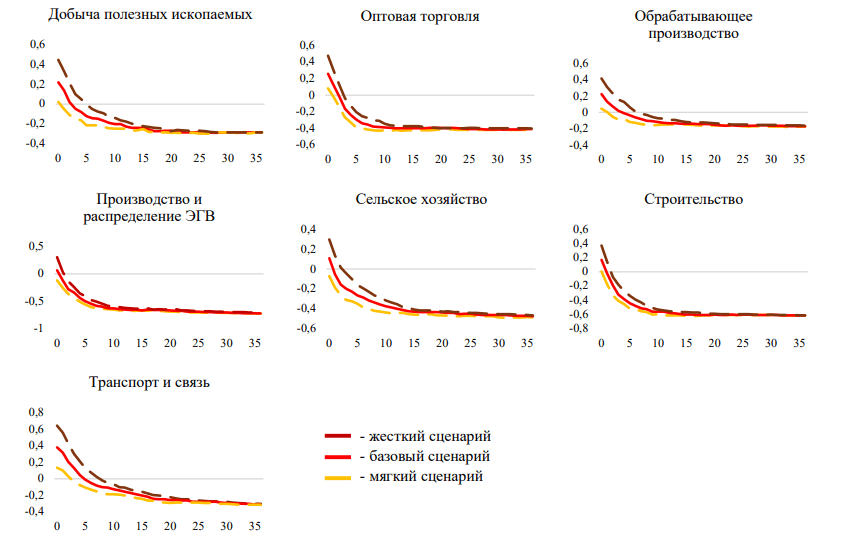
Which industries respond to monetary tightening?
Among these industries, transportation and communications stands out particularly: this is where the immediate change in debt burden in response to the shock is greatest. In a situation of sharp rate increases, the indicator can rise to levels associated with heightened probability of financial distress.
Why does this happen? In this industry, a significant portion of debt is tied to already completed or planned long-term investments in infrastructure and fixed assets, so when output decreases due to slowing aggregate demand, there won't be a significant reduction in debt. As a result, immediately after monetary tightening, the denominator in the debt burden indicator (revenue) decreases while the numerator (debt payments) remains high—producing a sharp increase in debt burden.
At the same time, in the medium term, debt burden levels don't change in response to monetary tightening, with the exception of the electricity generation and distribution industry, where debt burden levels actually decline over time following a sharp interest rate increase. One possible explanation is the government subsidy mechanism. Additional cash flows provided through subsidies allow companies to pay down part of their debt, which reduces the numerator in the debt burden calculation while the denominator remains unchanged. Together, this can lead to a decrease in debt burden levels in the medium term.
What this means for banks and business
Translating the results into practical terms, the key takeaway is this: a period of high key rates is primarily a test of corporate resilience in the first months after the increase, and this test plays out unevenly across industries. For banks, this means risks are particularly concentrated in transportation and communications, mining, manufacturing, and wholesale trade. Should a wave of bankruptcies materialize, the consequences for credit institutions would be serious: a rise in non-performing loans would worsen the bank's financial condition by reducing profits and increasing capital strain. Moreover, declining capital adequacy could lead to more restrained lending dynamics.
For businesses, these findings point to a practical need to reduce interest rate vulnerability: companies should assess the share of floating-rate obligations and, where possible, reduce it by locking in interest terms or diversifying borrowing sources. It's important to build liquidity reserves and contingency plans for revenue declines, and to accompany investment decisions with scenario analysis that models the impact of rate increases on interest payments and stability indicators.
Key Takeaway
Overall, the picture that emerges suggests that tight monetary policy doesn't necessarily mean a sustained deterioration in corporate financial health across the economy as a whole. The main effect on debt burden is immediate and concentrated in specific sectors. In other words, rising rates don't spell bankruptcy for companies, but in the short term they can amplify sector-specific risks—something that warrants attention.