This text is an automatic translation from Русский. It was generated by AI and may contain inaccuracies.
Read original →Does Russia Have What It Takes to Develop High-Tech Manufacturing?
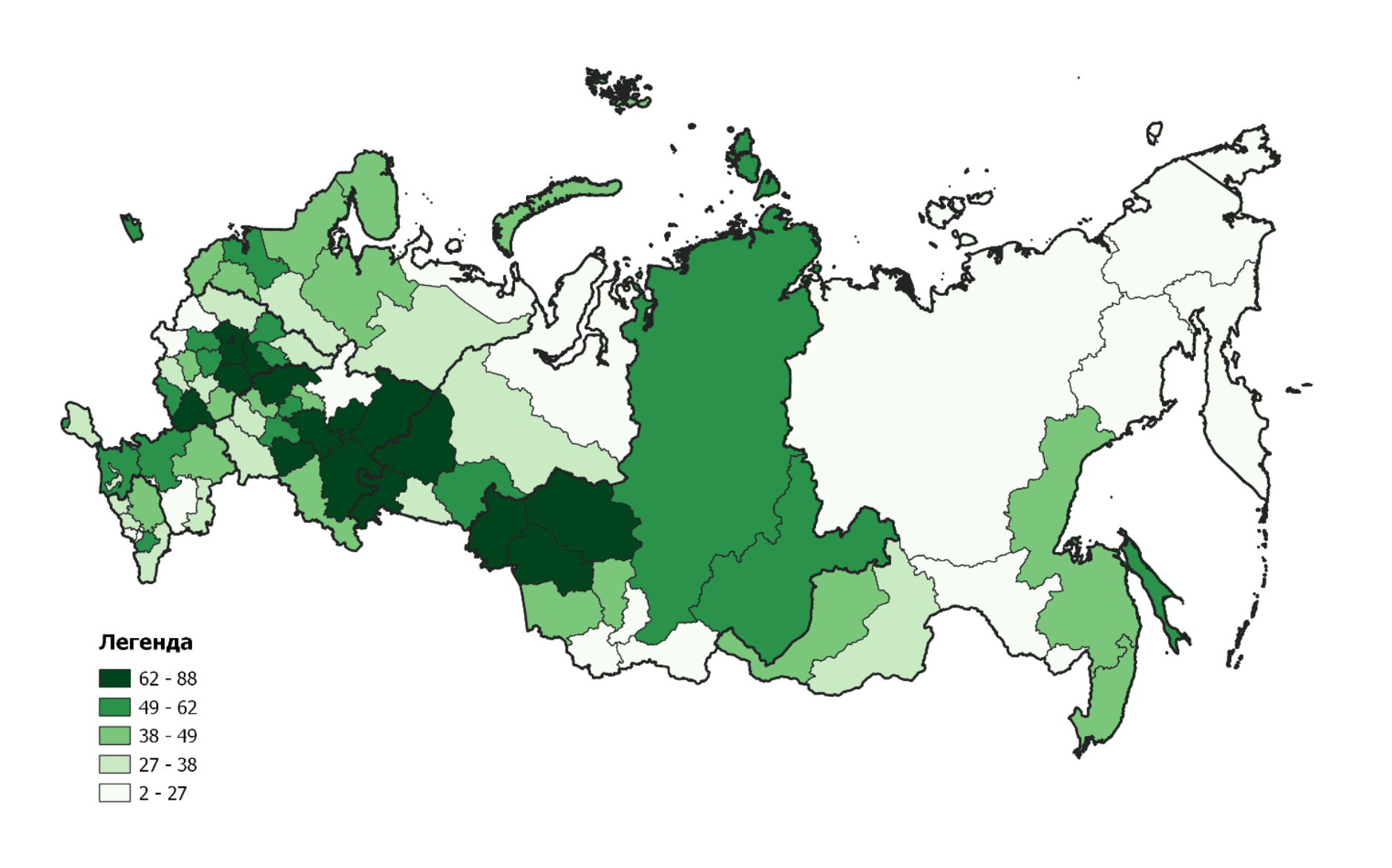
Conditions for high-tech manufacturing development vary dramatically across Russian regions: integrated infrastructure scores range from 2.26 to 88.36 points. What factors shape regional technology infrastructure, why some territories become high-tech manufacturing hubs, and what solutions could help regions with weaker foundations.

Infrastructure extends beyond production facilities
High-tech manufacturing is typically associated with modern enterprises, new equipment, and production lines. However, before mass production can begin, a product must be developed, a prototype manufactured, tests conducted, and specialists and suppliers found. If some of these capabilities are unavailable, a project becomes more expensive and drawn out, and sometimes relocates to where the necessary conditions already exist.
Today this issue has not only sectoral but also quite practical significance for regional development. Technological leadership is enshrined among Russia's national goals, and by 2030 the target is to increase by one and a half times compared to 2023 the share of domestic high-tech goods and services created on the basis of proprietary development pipelines in their total consumption.1 Such targets cannot be achieved solely through support for individual companies. Enterprises need conditions in which development can be brought to an industrial result without creating every element of the research and production base from scratch.
Therefore, infrastructure for developing high-tech production should be understood more broadly than the usual set of industrial parks, technology parks, and utility networks. It encompasses the entire system of resources and services that a high-tech company can access in a region or through interaction with other territories. This includes production facilities and equipment, engineering and research base, digital environment, specialist training, financing for technology projects, and mechanisms for interaction among companies, universities, and research organizations.
The Institute of Regional Economics and Intergovernmental Relations at Financial University conducted a comparative analysis of regions in terms of conditions for developing high-tech production. Industrial-technological conditions show the extent to which facilities, technology parks, and production cooperation are developed in a region. Financial-institutional conditions reflect the availability of targeted support for technology projects. Digital solutions adoption by organizations, training of engineering and scientific personnel, as well as opportunities for research, testing, and implementation of new technologies were assessed separately. The final assessment system included 24 indicators across 85 constituent entities of the Russian Federation.
Sources (2)
- 1. Президент Российской Федерации. Указ от 07.05.2024 № 309 «О национальных целях развития Российской Федерации на период до 2030 года и на перспективу до 2036 года».
- 2. Расчеты Института региональной экономики и межбюджетных отношений Финансового университета, 2026.