An analysis of Russia's solid waste management reform: the sorting rate has risen to 55%, yet landfilling has increased to 82.5%. Why the system isn't working and what needs to change for the transition to a circular economy.
17 min read
Share:
Sources (14)
1. Федеральный закон № 89‑ФЗ «Об отходах производства и потребления» от 24.06.1998 г.
2. Указ Президента РФ № 474 «О национальных целях развития Российской Федерации на период до 2030 года» от 22.07.2020 г.
3. Указ Президента РФ № 309 «О национальных целях развития Российской Федерации на период до 2030 года и на перспективу до 2036 года» от 07.05.2026 г.
4. Постановление Правительства РФ № 1156 «Об обращении с ТКО» от 12.11.2016 (ред. от 07.03.2025) (внесение изменений в Постановление Правительства РФ №641 «Об оснащении транспортных, технических средств и систем аппаратурой спутниковой навигации ГЛОНАСС или ГЛОНАСС/GPS" (с изменениями и дополнениями) от 25.08.2008).
Imagine a vast river. Every year it carries over 47 million tons of municipal solid waste—plastic, glass, paper, organics, packaging. According to the reform's design, this "river" should branch out: part of the "water" should go to recycling and return to circulation, with only sediment ending up in landfills. But reality looks different. Waste doesn't always have properly equipped and well-planned collection points, some waste is scattered by wind, collection sites exceed the service capacity for residential buildings, there aren't enough waste collection points, garbage trucks don't always follow their schedules, and during transportation, separated fractions get mixed together in the truck. The waste arrives at the sorting conveyor. It operates non-stop, like the "heart" of the waste industry. The belts move, workers and automated systems pluck out colored fragments: PET bottles, broken glass, aluminum cans.
At best, they manage to extract 13–15% of the total flow. These are valuable fractions, sent to the secondary raw materials warehouse. The remaining 85–87%—so-called "sorting tailings"—continue their journey. What are these "tailings"? A mixture of small fractions, food waste, dirty packaging, film that can no longer be washed or separated. The conveyor doesn't stop, and these gray, compressed masses fall into the garbage truck bed. Their final destination: the landfill. A giant body of waste that grows every year.
The paradox is that the conveyor itself creates an illusion of circularity. It hums, people work on it, it produces "processing" numbers for reports. But in reality, this isn't a closed loop—it's a broken "circuit": resources are extracted only for a moment, while everything else goes into the ground. Sorting becomes not a stage of recycling, but a filter that separates a small portion of valuable waste from a large hopeless mass. If you look at the waste stream as a "river," today a powerful "dam" has been built on it—sorting—but they forgot to build channels to return the "water" back. And almost all the "water," after pausing for a moment, flows into the same "ocean" of the landfill. To break this vicious cycle, we need not just to improve the conveyor, but to change the route: force the "tailings" not to disappear into the ground, but to transform into something new—recycled products, energy, compost, raw materials for industry. For now, the conveyor is merely a beautiful but sad path to the dump.
The share of sorted municipal solid waste in Russia increased from 3% in 2018 to 55.1% in 2024, the volume of recycling grew in absolute terms to 6.8 million tons, and investments in the sector exceeded 300 billion rubles. However, the share of waste sent to landfills during the same period didn't decrease—it grew from 73.2% in 2021 to 82.5% in 2024. The system sorts more, but also buries more. This is the main paradox of Russia's waste reform. Sorting works, but the circular economy isn't launching.
The gap between processing and recycling is one of the key "bottlenecks" of Russia's waste management model. In 2024, 26.3 million tons of municipal solid waste were sent for processing (sorting), but only 6.8 million tons went to recycling and neutralization—less than 15% of the total flow. The remaining sorted waste, including "sorting tailings," irretrievably ends up in landfills.
The typical operating scheme of a Russian municipal solid waste processing facility today looks like this: extraction of up to 13–15% of valuable fractions (glass, plastic, metal) and burial of the remaining 85% of the mass. Meanwhile, under regulations effective from September 2025, old facilities are required to extract a minimum of 9% of secondary resources, while new ones must extract 13 to 15% depending on capacity. These indicators are incompatible with the goals of transitioning to a circular economy, where waste should return to production rather than be hauled to a landfill after minimal manual sorting.
Statistics of a broken cycle
Analysis of data systematized from Presidential Decrees, federal projects, government reports from the Ministry of Natural Resources and Ecology, the Unified Interdepartmental Information and Statistical System (EMISS), the Accounts Chamber report, and the Russian Environmental Operator, reveals three key contradictions [1-10]:
Sorting grows, burial doesn't decline. The target set by Presidential Decree No. 309 of May 7, 2024 envisions sorting 100% of municipal solid waste by 2030 and burying no more than 50% of such waste. However, the actual trend is moving in the opposite direction. Over four years, the share of burial in the total mass of generated municipal solid waste has increased by nearly 10 percentage points—from 73.2% in 2021 to 82.5% in 2024.
Recycling grows, but exponentially slower than sorting. The share of recycled municipal solid waste increased from 11.6% in 2021 to 14.3% in 2024, and in absolute terms, the volume of recycling grew from 2.6 million tons to 6.8 million tons. However, the growth rate of recycling (approximately +1 percentage point per year) is insufficient to achieve the 25% use of secondary resources by 2030 set forth in the Federal Project "Circular Economy." At the current pace, the target indicator could be exceeded by 2027, but a qualitative transition requires not linear but structural growth that closes material loops.
Municipal solid waste generation is not declining. The volume of municipal solid waste generated between 2020 and 2024 has remained stable in the range of 45.9–48.5 million tons, and in 2024 it even grew by 3.8% to 47.7 million tons. This means that preventive measures to reduce waste generation (reducing packaging, extending product lifespans, changing consumption patterns) have yet to produce any noticeable effect. In 2024, according to the state report from Russia's Ministry of Ecology and Natural Resources, municipal solid waste generation declined only slightly from 48.5 million tons in 2020 to 47.7 million tons, but this reduction was largely achieved through reclassifying waste as by-products rather than through any real decrease in consumption.
"Processing (sorting)" ≠ recycling
It's impossible not to notice the wording: "The share of municipal solid waste sent to landfills, including waste that has undergone processing (sorting), in the total mass of municipal solid waste generated (G2)" in the EMISS data. In other words, even after sorting, extracted fractions often fail to find a recycler and also end up at landfills. In Russian practice, the typical scheme is: sorting at a facility → extraction of up to 15% recyclables (glass, plastic, metal) → the remainder (85%) goes to landfill. Therefore, the high percentage of landfilling in the table reflects not only the absence of sorting, but also the ineffectiveness of sorting itself without deep recycling.
Why sorted waste ends up back at landfills
Behind the seemingly positive figures for sorting growth lies a deep structural deficit. The municipal solid waste management system today has primary processing capacity but lacks sufficient infrastructure for deep recycling.
Total investment in the sector over six years, according to Kommersant1, exceeded 300 billion rubles, and concession agreements have been signed. However, the distribution of capacity being created remains unbalanced: processing – 55.1%, recycling – 14.3%, landfilling – 82.5%. Every ruble invested in developing sorting is practically not matched by a comparable ruble for recycling. Moreover, landfilling continues to account for a significant share of new capacity. This circumstance contradicts the target goals of reducing landfill disposal.
The situation is exacerbated by economic factors: secondary resources remain uncompetitive compared to primary raw materials, insufficient economic incentives, and investment barriers to establishing deep recycling operations. Falling prices for secondary material resources, unstable demand, and low profitability of recycling in a number of regions mean that companies are forced to scale back operations or shut down. In remote regions, due to vast distances and low profitability, the value of materials has become negative. Russia's secondary raw materials market is in a state of deep crisis, and without a radical overhaul of economic and administrative mechanisms to stimulate demand for secondary resources, this problem is unsolvable.
The Extended Producer Responsibility (EPR) system, designed to incentivize businesses to recycle goods and packaging after they lose their consumer properties, is not yet operating at full capacity. Although legislation provides for a phased increase in recycling targets—from 55% in 2025 to 75% in 2026 and to 100% starting in 2027 in accordance with Russian Government Decree No. 1041 "On the Values of Base Rates of Environmental Fees and the Coefficient Taking into Account the Difficulty of Extracting Waste from Used Goods for Further Recycling, the Availability of Technological Capacity for Their Recycling Taking into Account Changes in Physical, Chemical and Mechanical Properties of Materials During Repeated Use (Taking into Account Possible Cycles of Processing Waste from Used Goods), the Demand for Secondary Raw Materials Obtained from Such Waste for Use in the Production of Goods (Products)" dated August 1, 2024 (as amended March 11, 2026)—practice shows that producers may evade their obligations, while oversight mechanisms remain inadequate. In March 2026, Federal Law No. 31-FZ "On Amendments to the Code of the Russian Federation on Administrative Violations" dated February 20, 2026 came into force, tightening administrative liability for failure to submit reports on the mass of goods and packaging and for non-payment of environmental fees. However, these measures are insufficient: what is needed is targeted spending of environmental fees, a transparent incentive system, and reliable oversight of actual recycling.
Regional Disparities: Three Scenarios, One Dead End
Analysis of regional EMISS data for indicator G2 "Share of MSW Sent to Landfill" for 2021–2024 allows us to identify three types of Russian regions that are navigating the same "bottleneck" in different ways, Table 1.
The national average for indicator G2 has evolved as follows: 2021 – 73.2% → 2022 – 81.7% → 2023 – 80.5% → 2024 – 82.5%. Over four years, the share of landfilling has not only failed to decline but has actually increased by nearly 10 percentage points. This confirms the conclusion from our previous analysis that progress in waste processing at the macro level is not translating into reduced landfilling. Moreover, 2024 recorded the worst result across the entire observation period.
First cluster: landfill-dependent regions. This is the largest group, where the landfill disposal rate consistently exceeds 90%, and in some cases reaches 100%. It includes the Altai Republic, the Republic of Dagestan, the Tyva Republic, the Republic of Khakassia, Magadan Oblast, Kirov Oblast, Tyumen Oblast, and the Khanty-Mansi and Yamalo-Nenets Autonomous Okrugs. Regions with indicators exceeding 100% deserve special attention: Rostov Oblast (158% in 2024), Bryansk Oblast (134.6%), Sverdlovsk Oblast (110%), Astrakhan Oblast (106.1%), and Kaliningrad Oblast (105.5%). From a material balance perspective, such figures point to serious methodological problems in accounting: either the volume of municipal solid waste generated in the region is underreported, or the region accepts significant volumes of "outside" waste for disposal, formally worsening its own performance indicator.
Second cluster: transitional regions. Regions demonstrating a gradual decline in the landfill disposal rate while maintaining high dependence on landfills. This group includes the Republic of Tatarstan (declining from 94.6% in 2021 to 81.2% in 2024), Nizhny Novgorod Oblast, Novgorod Oblast, Oryol Oblast, Novosibirsk Oblast, and the Nenets Autonomous Okrug. This is where the "bottleneck" is most clearly evident: sorting facilities have already been built, but the final processing loop is absent. As a result, a significant portion of sorted waste still ends up in landfills, failing to create a closed loop.
Third cluster: regions with relatively low landfill disposal rates. The Republic of North Ossetia-Alania (12.4% in 2024), Ryazan Oblast (17.6%), Chukotka Autonomous Okrug (43.9%), and the Jewish Autonomous Oblast (2.4%). However, such low figures do not always indicate a high degree of circularity. In some cases, they may be explained by inter-regional waste transportation, peculiarities in calculating municipal solid waste generation, or incomplete coverage of waste streams—demonstrating statistical rather than actual efficiency.
International context: the gap is widening
Comparison with target benchmarks from European Union countries, the USA, and China underscores the scale of systemic lag in Russia's waste management model.
According to the European Environmental Agency (EEA), the European Union has set a goal to recycle 60% of municipal waste by 2030, and 65% by 2035 [11]. The EU's strategic objective is to reduce municipal waste landfilling to less than 10% by 20352. Already today, several EU countries demonstrate recycling rates exceeding 50% (Germany, Austria, the Netherlands, Belgium). In the USA, according to the Environmental Protection Agency (EPA) U.S., strategic waste management goals call for a waste recycling rate of 50% by 2030.3 Russia, with a recycling rate of 14.3% and landfill disposal at 82.5% in 2024, maintains a model characteristic of countries with the least developed waste management infrastructure.
China is demonstrating faster progress. By 2025, waste separation coverage in Chinese cities reached 100% of the population. China's key success factors include a combination of strict administrative oversight with broad public awareness campaigns, implementation of digital monitoring technologies, and phased expansion of recycling capacity in parallel with sorting. The approach of incinerating waste for energy generation is being reconsidered. It broke the circular loop and required producing goods from virgin materials4.
Russia operates a simplified sorting system (recyclables and mixed waste). China has a mandatory four-stream system (wet waste, dry waste, recyclables, and hazardous waste) with facial recognition monitoring at waste collection points and volunteer supervisors on duty. China has a developed legal and semi-legal sector of secondary material collectors. Russia has established a monopoly of regional municipal solid waste (MSW) operators under tariff regulation. However, the current system provides no incentives for economic actors to separate waste or pursue deeper recycling. This situation creates risks: operators may deliberately show negative financial results to justify further tariff increases. Additionally, there's a danger that operators lack their own fleet of specialized equipment—a significant share of vehicles may be contracted from subcontractors, which could eventually lead to contract failures and other negative scenarios. The waste collection infrastructure creates additional problems: accumulation points are not always properly equipped, often insufficient even for several neighboring buildings, leading to overflow and territorial contamination with rodents, unsanitary conditions, and so on, while the number of separate bins for plastic, construction debris, and other fractions proves inadequate. Moreover, even when separate containers exist, garbage trucks often mix all waste during collection, completely negating citizens' sorting efforts and preventing achievement of recycling goals.
In China, for waste-to-energy projects at combined heat and power plants using powerful filters to capture pollutants, considering government subsidies for waste-based energy sales, with waste heating value of 1,480 kcal/kg, IRR stands at 6.5% and ROE at 9.12% [12]. With waste heating value from 1,800 kcal/kg, IRR reaches approximately 8.65% and projects begin achieving payback.
Beyond waste-to-energy technology, chemical recycling technologies are developing (depolymerization and pyrolysis), anaerobic digestion of waste (producing biomethane from organic waste for urban transport fueling), and others.
According to financial reports from one of the largest MSW management organizations in the U.S., Waste Management Inc. achieves ROE ranging from 27-31% depending on the season5. One of Finland's largest companies, Lassila & Tikano, had ROE at around 12%6 (this and other cases presented by the author in this and other publications do not constitute investment advice).
In Russia, according to HSE research by Volkova V.A., profitability of secondary material processing stood at 1-2%, which is a relatively low indicator [13]. According to research by Gerasimov A.A., the industry-average net profit margin for non-hazardous waste collection enterprises in Moscow Oblast in 2020 was 2.4%, with similar figures for secondary material processing organizations at 0.8%, processing and disposal at 9.1%, and sorted waste disposal at 1% [14]. Insufficient market development, low returns under existing economic models and economic and administrative instruments, among other factors, serves as a demotivating factor for organizations entering the waste management sector.
Conclusions
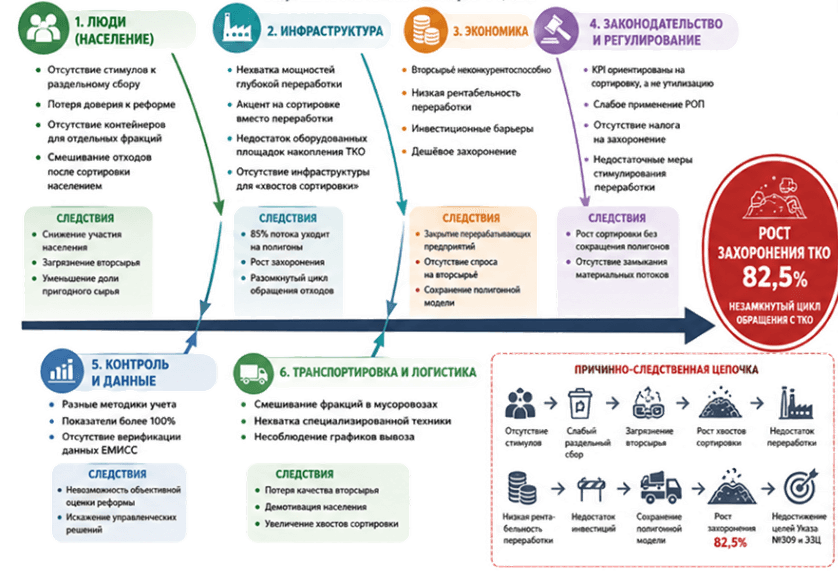
The analysis conducted allows us to formulate five key conclusions about the state and prospects of Russia's waste management reform (Figure 1).
Figure 1. Ishikawa analysis of the causes of MSW landfill growth (compiled by the author using digital tools)
Formally, target indicators for sorting and utilization may be met or even exceeded at the operational level. However, the key environmental goal—reducing landfilling to 50% by 2030—is achievable only on paper under the current trajectory. In reality, over four years the system has not merely failed to reduce but has actually increased the share of landfilling from 73.2% to 82.5%, and actual data for 2025 shows no sign of the required turnaround.
The main systemic barrier is not the absence of sorting, but the gap between processing and deep recycling, as well as the lack of sustainable demand for secondary resources. Each additional percentage point of sorting without comparable growth in utilization only increases the mass of "sorting residuals" that still end up in landfills. Sorting is not equivalent to circularity. It creates a material flow but does not guarantee its return to the economy. In this regard, it may be worth considering the proposed methodological approach based on calculating the ratio of the difference between the share of sorted waste and the share of utilized waste to the share of sorted municipal solid waste. The closer the "gap coefficient" is to 100%, the greater the barriers and factors hindering circular economy development. Based on 2024 data, the calculated value of the circular economy gap coefficient equals 74%.
Regional differentiation is extremely high—ranging from 12.4% to 158% of municipal solid waste landfilling in 2024. Achieving the national goal (≤50% by 2030) is impossible without a sharp reduction in the share of landfilling in most regions, which today stand at 90–100%. The appearance of values >100% in five regions in 2024 is an alarming signal pointing to systemic problems with data quality and/or interregional redistribution of waste flows.
The statistical base requires substantial unification. Various government systems (EMISS, state reports from the Ministry of Natural Resources, federal project indicators) use different calculation methodologies, which complicates comprehensive assessment of reform effectiveness. Some documents use the indicator of the share of municipal solid waste sent for processing, while others use the secondary resource utilization index or the share of waste sent to landfills. The presence of anomalous values (>100%) indicates low data reliability in a number of regions.
Achieving the 2030 goals will require not simply increased investment, but a change in the waste management model itself—from extensive expansion of sorting to creating a full closed loop where recycling and reintroduction of materials into circulation become economically viable. Necessary measures include:
introduction of a landfill tax that increases annually, with revenues allocated to a fund for developing recycling infrastructure;
transition to economic incentives for using secondary raw materials (tax benefits, procurement quotas);
revision of operational KPIs for regional operators with focus on the share of utilization, not just the percentage of sorting, among others. Landfilling of municipal solid waste must become unprofitable. The proposed methodological approach for assessing the "circular economy gap" should be enshrined in regulatory legal acts, strategic documents, and regional operator KPIs.
Based on analysis of cause-and-effect relationships and regulatory legal acts, a RACI matrix of measures aimed at improving the municipal solid waste management system has been developed (Table 2).
For the federal level, within the competencies of relevant organizations:
Conduct urgent verification of EMISS data for indicator G2 for 2023–2024, particularly for regions showing figures above 100%, with requests for clarification.
Develop a methodology for cleaning reporting data from the impact of imported waste, so that the landfill disposal rate reflects the actual efficiency of MSW management within the constituent entity's territory. One option could be to include entries for imported and exported MSW in accounting registers.
Ensure transparency of environmental fee expenditures on MSW management system initiatives.
Introduce a landfill tax or fee that increases annually, with revenues earmarked for a recycling infrastructure development fund. Landfilling municipal solid waste fractions should become economically disadvantageous compared to recycling. Develop economic incentives that make recycling more profitable than landfills.
Develop standards for packaging materials suitable for sorting, including AI-based sorting.
Develop a competitive secondary raw materials market.
Include in regional operators' KPIs requirements for the share of municipal solid waste utilization and recycling, compliance with waste collection schedules, and KPIs for maintaining their own fleet of waste collection vehicles (see negative cases in Sverdlovsk Oblast and other regions) commensurate with the potential volume of waste collection from assigned territories, to reduce risks of contract non-fulfillment with subcontractors due to lack of specialized vehicles.
Include in the performance evaluation of municipal solid waste operators and relevant agencies metrics for water intensity, carbon intensity of waste management, and waste management effectiveness.
Develop incentives for payments to residents who sort their waste. For example, payments for returned plastic bottles. Cases with deposit-refund systems. Fund these payments through the recycling infrastructure development fund and/or environmental fees to avoid double payments by consumers and producers. People who wash plastic bottles to remove organic residue at home incur additional costs. This reduces their motivation to sort waste.
Incorporate into tariff models parameters for economic incentives for waste sorting by households and organizations, with compensation from the recycling infrastructure development fund or environmental fees.
For regional and local levels, within the competencies of relevant organizations:
Regions with landfilling rates exceeding 100% (Bryansk, Rostov, Sverdlovsk, Astrakhan, and Kaliningrad oblasts) should present a balance of municipal solid waste flows by year-end and eliminate accounting distortions, if confirmed.
In regions such as Perm Krai, people express outrage on social media: containers are overflowing, or properly equipped waste collection sites are absent. Yekaterinburg demonstrates even stranger logic. Previously installed equipped plastic collection containers are disappearing from courtyards, replaced by textile collection boxes. "Textile collection boxes are fine, but why can't the plastic bins remain alongside the other containers?" residents ask.
Strengthen oversight of commercial entities dumping solid waste into residential bins. Update data on waste collection volumes for residential buildings. Install additional containers where necessary.
For the five regions with 100% landfilling (Magadan Oblast, Altai Republic, Dagestan, Tyva, Khakassia), develop individual roadmaps for creating basic recycling infrastructure with federal support.
Transitional regions should revise their territorial waste management schemes, emphasizing the introduction of deep processing facilities rather than just sorting operations.
Provide accessible transport vehicles with specialized compartments for collecting sorted waste fractions, with stricter controls on maintaining fraction separation during transport to reduce the risk of contaminating waste sorted by residents and prevent cases where garbage trucks dump everything into a single receiving compartment, thereby negating people's sorting efforts.
Russia's waste management reform stands at a crossroads: either it remains an imitation of a circular economy with growing sorting capacity but persistent landfilling, or a structural transition occurs toward a model where resources genuinely return to the economy. Current figures clearly indicate the first scenario is winning for now. To change this trajectory will require not just additional investment, but a different management logic—shifting from process indicators (how much was sorted) to outcome indicators (how much waste generation was reduced and how much was returned to the economy).
To break the impasse, building new sorting lines isn't enough. We need synchronized development of waste collection point infrastructure, processing capacity, demand creation for secondary raw materials, unified statistics, revised KPIs favoring reduced landfilling, and economic incentives that make recycling more profitable than landfills. Strengthen requirements for financial stability and ownership of vehicle fleets by responsible organizations to reduce the risk of waste collection contract failures. Also factor in sanitary conditions and public health when designing waste management facilities. Otherwise, the reform will remain a project for tidier burial rather than a transition to a closed-loop system.