This text is an automatic translation from Русский. It was generated by AI and may contain inaccuracies.
Read original →The Trans-Arctic Corridor: Transportation Artery of the Future or Project of the Century?
The Trans-Arctic transport corridor: how Russia plans to increase cargo traffic along the Northern Sea Route to 100 million tons by 2030. An analysis of prospects, year-round navigation challenges, and international partners' interest in the Arctic route.
Ambitious Plans
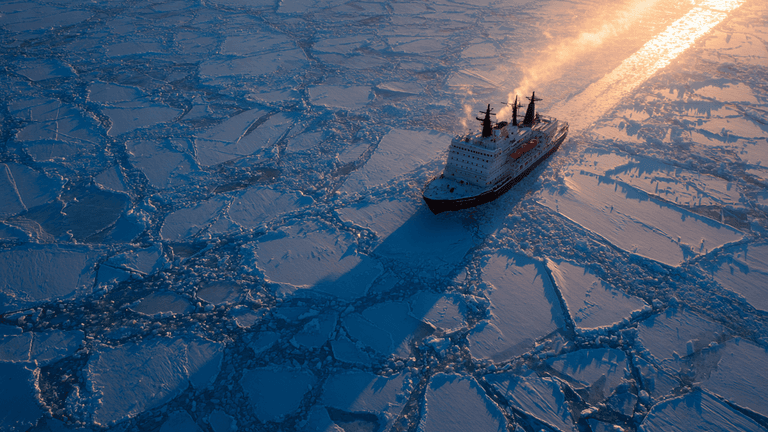
The Northern Sea Route is the shortest maritime passage between European Russia and the Far East. The corridor spans approximately 5,600 kilometers, running along the country's Arctic coast through the waters of the Arctic Ocean. While cargo traffic along the NSR totaled just 4 million tons in 2014, preliminary estimates suggest that in 2025 it will carry 36-38 million tons. By 2030, that figure is expected to double to 70-100 million tons annually.
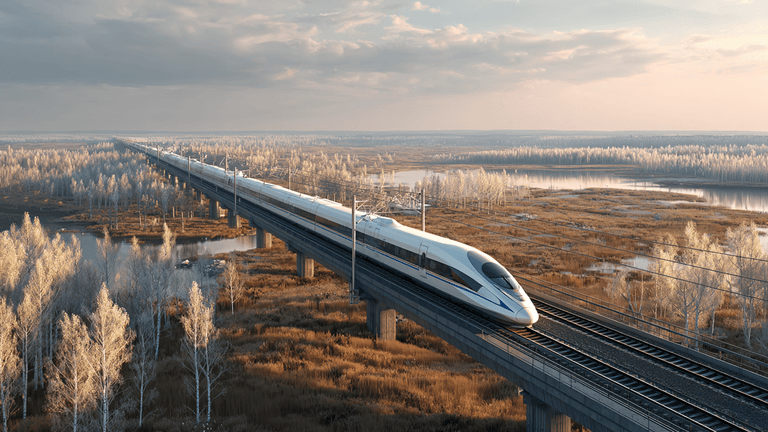
But expanding the Northern Sea Route's capacity is impossible without comprehensive modernization of transport infrastructure in the Far East and the Arctic—which is precisely why the term "Trans-Arctic Transport Corridor" has entered the discourse. This is an integrated system that will unite maritime, rail, and road routes, providing direct access for cargo from Siberia and the Urals to the Northern Sea Route.
During the International Arctic Forum "The Arctic—Territory of Dialogue," held in Murmansk in March 2025, the president placed special emphasis on developing the TTC, instructing officials to develop and approve a financial-economic and organizational model for its formation. And speaking at the plenary session of EEF-2025, the head of state tasked the government and the Maritime Board with assessing the feasibility of proposals for developing this transport corridor.
Who Stands to Gain?
The TTC is designed to cement Russia's pivotal role in global logistics, offering Asian countries an alternative route to Europe and thereby reducing dependence on southern sea routes. As infrastructure along the Arctic route develops, the Northern Sea Route will attract increasing cargo volumes. For instance, Minister for the Development of the Far East and Arctic Alexey Chekunkov, in an interview with Marina Kim, predicts that in 25 years, navigation will reach a new level.
"We will see significantly higher flows of goods across a wide range of categories: not just hydrocarbons and bulk cargo, but containers as well", the minister predicts.
Vitaly Chernov, head of analytics at media group PortNews, told Argument that on the Russian side, practically all importers are interested in the Northern Sea Route, as well as exporters of food products, timber, metals, and fertilizers. In addition, Chinese exporters of industrial goods have shown interest, along with companies from Vietnam, Japan, and South Korea.
The editors of the Telegram channel LOGIST add to this point: Rosatomflot, Russian shipowners in the energy sector, and the port hubs of Murmansk and Arkhangelsk already view the project as an "infrastructure anchor," since for many cargo owners the reduced distance and time savings during summer are critical.
External partners are also getting involved: China is incorporating the Northern Sea Route into its Polar Silk Road concept, while India sees it as part of its strategy to diversify routes alongside the Chennai–Vladivostok corridor. Japan and South Korea see prospects primarily in energy and shipbuilding, with Seoul already planning test voyages in 2026, the expert added.
Can it withstand the competition?
The main question is year-round navigation.
"At present, it's only possible on a limited basis, primarily for energy cargo and when operating in convoys escorted by nuclear icebreakers," notes the editorial team at LOGIST.
For regular container services, the obstacles are serious: severe ice conditions in the eastern sector, a shortage of Arc7-class vessels, and lack of necessary infrastructure.
The financial side also sparks debate. Capital expenditures on icebreakers and port infrastructure run into hundreds of billions of rubles. An Arc7 container ship costs significantly more than a standard post-Panamax vessel, and the construction cycle is lengthy.
Nevertheless, the seasonal advantage is clear: in summer and early autumn, transit time on the Asia–Northern Europe route can be cut by 20–40%, which is especially important for urgent cargo.
"During the 'open water' period, voyages via the NSR are economically justified—savings can reach 25% compared to the southern route", Chernov adds.
Even with development of the Arctic route, the Suez Canal will remain the leader in volume and year-round stability. At the same time, the NSR has advantages: geography and partial political autonomy, especially for the Russian cargo base.
Strategic role
Responding to questions from Argument, State Duma deputy Alexander Terentyev emphasized the strategic role of the initiative:
"Such projects are implemented decades into the future; development of the NSR is necessary as an investment in the future that can benefit all of Russia and the Arctic in particular. That's why we need to start thinking now about how to make it more attractive to participants, and be ready to compete for the global transportation services market."services market."
The editorial team at the LOGIST Telegram channel believes the key to the project's success lies in proper cargo segmentation, seasonal planning, investment discipline, and leveraging capital from both the state and private investors. In that case, the NSR will become a working tool for diversifying foreign trade and enhancing the country's logistics resilience.
On the importance of preparing a detailed business plan for launching the Transarctic Corridor spoke the head of a key region of Russia's North—Murmansk Oblast—Andrey Chibis. In his view, the TTC is not merely a logistics system, but a new economic model in which the Arctic becomes "a fulcrum for the growth of the entire country."
But despite debates about profitability, the corridor's significance extends far beyond economics.
"This is a transport corridor ensuring national security", emphasizes Vitaly Chernov.
In the event the Baltic or Black Sea straits are blocked (which cannot be entirely ruled out), it could become the only maritime route connecting Russia's European part with the Far East and China, and indeed the only maritime "window to the world." Therefore, according to the expert, the Transarctic route must be developed despite purely commercial calculations and projections about future revenues.