This text is an automatic translation from Русский. It was generated by AI and may contain inaccuracies.
Read original →To Borrow or to Print: Why Did the Finance Ministry Exit the OFZ Market?
On July 20, the Finance Ministry announced it was suspending OFZ bond auctions "to help stabilize the market situation." Behind this dry formulation lies a rare occurrence: a government that needs to borrow more than 5 trillion rubles from the market in a year has voluntarily withdrawn from that very market. We examine why the government debt market has shut down and what this means for the budget, the ruble, and the population.
AI summary
The Ministry of Finance suspended OFZ placements for the first time in a long while due to record-high investor yield requirements of 15-16% per annum. The cause of the crisis is the reversal of inflation in summer 2026 and the collapse of expectations for a key rate cut by the Central Bank, which triggered a mass sell-off of long-term bonds.
First, what are these auctions anyway?
Russia currently runs a budget deficit. The government spends more than it collects: in just the first half of 2026, expenditures exceeded revenues by 5.73 trillion rubles. This imbalance is plugged mainly one way—through borrowing on the domestic market. Every week, the Finance Ministry goes to the exchange and sells federal loan bonds (OFZ). Essentially, these are IOUs: an investor (most often a bank or fund) gives the government money now, and in return receives interest (coupon payments) and repayment of the full amount in several years.
The mechanism is routine: a weekly auction where investor demand essentially sets the OFZ interest rates, and then the Finance Ministry selects bids. As long as the balance holds and investors have money for such loans, it works like a conveyor belt—in 2025 the Finance Ministry placed ruble-denominated bonds for a record 7.2 trillion rubles, 1.7 times higher than the year before. That's why the pause is not a technical detail, but a signal that the system is being reconfigured.
What does "stabilization" mean?
Formally, the Finance Ministry talks about "stabilization." In reality, it's a capitulation in the standoff with the market that dragged on all month. First, the ministry spent several weeks in a row canceling auctions, citing "heightened volatility." Then it held a placement that raised about 10 billion rubles instead of the usual hundreds of billions. Finally, on July 15, the Finance Ministry couldn't even sell a floater—a floating-rate bond that investors usually snap up most eagerly. After that, auctions were simply switched off, "until further notice."
And here we see a supply-demand imbalance. The Finance Ministry refuses to borrow at 15–16% annually: locking in such expensive debt for 10–15 years ahead means overpaying interest for years. But the market has stopped offering cheaper rates. The deal isn't coming together—and auction after auction falls through.
Why the market slammed shut
This is the key question, and the answer lies in a chain where one thing pulls another. In brief, it looks like this.
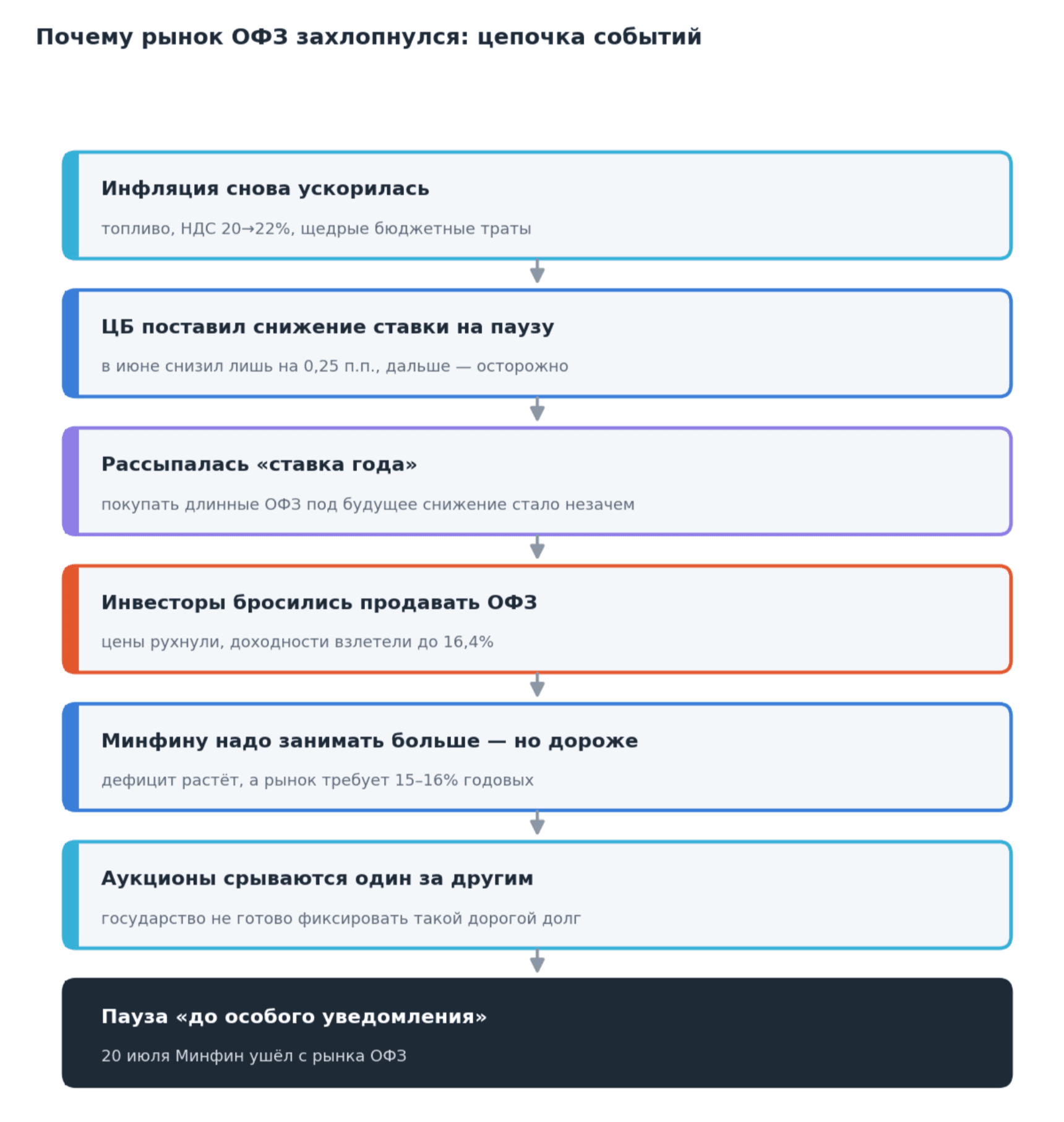
Step one: the key rate, which everyone believed would fall. The Central Bank's key rate (the interest rate at which the government lends money to banks, and the benchmark for all rates in the country) held below 21% in 2025. Then they began cutting it—by June 2026 bringing it down to 14.25%. The market expected the cuts to continue toward 13%. This formed the main investment thesis of the year: buy long-dated OFZ bonds. The logic was simple—if you lock in a bond with a high interest rate now, and rates in the economy later fall, you both secure high returns for years to come and see the bond itself appreciate in value.
Why does it appreciate? A bond's price and its yield are like a seesaw: one goes up, the other goes down. When the key rate in the economy falls, older bonds with high coupons become more valuable, and their prices rise. Investors were snapping up long-dated OFZ bonds precisely in anticipation of this appreciation.
Step two: the trigger—disinflation broke down. Everyone expected prices to continue decelerating and the Central Bank to keep cutting rates. But the situation began shifting over the summer. Inflation in June accelerated to 6.02% year-on-year from 5.31% the month before, while prices rose 0.87% in a single month—five times May's 0.17%.
Annual inflation over the same period accelerated from 5.31% to 6.02%. Source: Rosstat, June 2026
The main culprit is the fuel crisis. Rising prices for gasoline and diesel alone contributed 0.3 percentage points to monthly inflation in June. And fuel prices get baked into all products and goods, since most logistics in Russia rely on road transport.
Step three—the Central Bank hit the brakes. At its June meeting, the regulator cut rates by a symbolic 0.25 percentage points and made it clear it wouldn't be rushing. Experts and institutional investors are increasingly skeptical that the rate-cutting cycle will continue.
Step four—the selloff. Once faith in key rate cuts evaporated, so did the rationale for holding long-dated OFZs. Everyone who had bought them betting on appreciation started selling. The pendulum swung back: OFZ prices collapsed and yields soared. The RGBI government bond index (the price of the entire OFZ basket) fell to 110.89 points by July 18, hitting a one-year low, and only began recovering after the Finance Ministry decided to suspend OFZ placement auctions. Meanwhile, yields on long-dated issues maturing in 2038 broke through a record 16.4% per annum.
Source: Bank of Russia, MOEX, July 2026
And so we've reached an impasse at auction, where seller and buyer can't come to terms. Now at weekly trading sessions, investors are demanding the same 15–16% that already-traded securities are yielding.
The shortfall is twice the plan, and there's nothing to borrow with
The 2026 budget projected a deficit of 3.79 trillion rubles—1.6% of GDP. Reality proved harsher: in just the first half of the year the budget deficit reached 5.73 trillion rubles—already more than was planned for the entire year. CMASF estimates that by year-end the deficit will reach 7 trillion rubles. And if you count the consolidated budget, including the regions, former Finance Minister Mikhail Zadornov expects over 8 trillion—more than 3.5% of GDP.
Source: Ministry of Finance, budget law, CMASF estimate, 2026
Backup plan — print money through banks
The Ministry of Finance has a proven workaround that it resorted to in 2020, 2022, and 2024. Here's how it works: instead of regular bonds, they issue floaters—securities with a floating rate tied to the key rate. These are purchased by major state-owned banks. And the banks get the money for these purchases from the Central Bank itself—through short-term loans (REPO operations). Under this scheme, in November 2025 in a single day approximately 1.8 trillion rubles were deployed.
Essentially, the government borrows from banks, which get the money lent to them by the Central Bank for this purpose. Liquidity that didn't exist before flows into the system. Critics call this "hidden QE"—soft money printing through the banking circuit. But the maneuver comes at a cost: fresh money negatively impacts inflation—the very thing that started all this. It creates a loop: to plug the hole, prices accelerate, the key rate stays elevated, and closing new debts becomes increasingly difficult as a result.
Either the NWF, or autumn, or spending cuts
Besides borrowing, Russia has alternative instruments for covering the deficit, such as a rainy day fund in the form of the National Welfare Fund (NWF). Its liquid portion, as of early July, stands at around 3.6 trillion rubles (this figure is cited alongside the announcement of the suspension). The money is there, but the fund has already "slimmed down" by nearly half since 2022.
Another option is to do nothing. The Ministry of Finance could wait it out and raise the bulk of borrowing at year-end—betting that inflation will stabilize and the key rate will finally move downward by then—making borrowing cheaper. There's precedent: in 2022, nearly the entire annual volume, 96%, was raised in the fourth quarter, after the Central Bank had already lowered the key rate from a peak of 20% to 8%.
What does this mean for the economy?
OFZ yields are the foundation from which the cost of nearly all money in the country is calculated. When the government borrows at 16%, companies borrow at even higher rates, while mortgages and consumer loans aren't rushing to get cheaper: it's unprofitable for banks to lend at a lower rate than what the government itself pays.
For investors, the moment is ambiguous: OFZs have cheapened, yields are at record highs—some see a buying opportunity, but while the market is falling, trying to catch the bottom is risky. For the ruble and prices, here's the fork in the road: if the Ministry of Finance goes into "printing through banks" or starts actively spending the NWF—it will add pressure on inflation, but if it chooses to wait and cut spending—it will slow the economy. There's no easy way out here.