This text is an automatic translation from Русский. It was generated by AI and may contain inaccuracies.
Read original →The Fed's House of Cards: Another Fraud Scandal Erupts
Federal Reserve Board Governor Lisa Cook has been accused of mortgage fraud. Experts see this as Trump's attempt to bring the regulator to heel and oust Jerome Powell. What it means for the dollar and the markets.
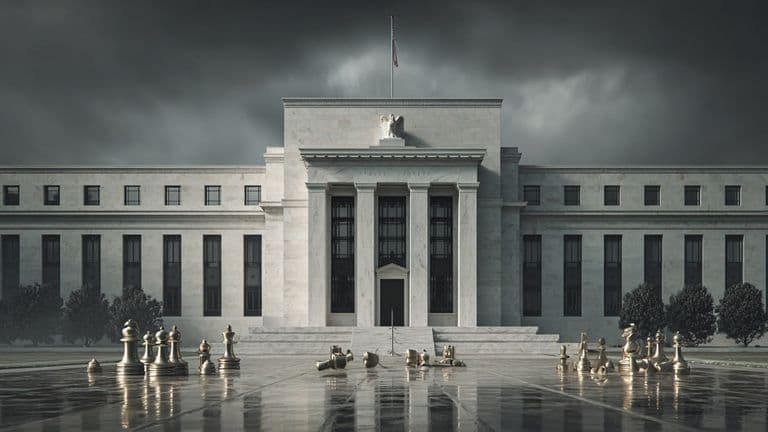
One Rule for Friends, Another for Everyone Else. And What Caught Trump's Attention
Federal Housing Finance Agency Director Bill Pulte recently leveled accusations against Federal Reserve Board Governor Lisa Cook. According to him, the official listed two homes in different states (Michigan and Georgia) as her primary residence in order to secure favorable mortgage terms. Cook denies the allegations, claiming she's being "intimidated," and promises to voluntarily answer any questions.
In the United States, thanks to a robust civil society, such investigations are routine. For example, former House Speaker Nancy Pelosi and her husband were accused of insider trading for years. But in Lisa Cook's case, the situation is intensified by President Trump's attention: she's one of Fed Chair Jerome Powell's staunchest supporters.
Independent analyst and author of the Telegram channel Angry Bonds Dmitry Adamidov is convinced that Trump needs any pretext to replace unwanted Fed members. He's looking for them wherever possible.
Meanwhile, Alexander Belov, founder of the Telegram channel "Sobachye serdce" (Heart of a Dog), emphasizes that subordinating the Fed to the president (fiscal dominance) is Trump's dream. And he can achieve it either through a loyal Board of Governors (7 members) or by replacing the chairman.
Which means Lisa Cook could become a pawn in a gambit aimed at forcing Jerome Powell's early resignation.
Irreconcilable Differences: Liz Cook's Positions
While in Russia members of the Central Bank Board are appointed for 5-year terms (nominated by the president, approved by the State Duma), in the US the term is 14 years with no possibility of reappointment. Liz Cook was appointed by Joe Biden and confirmed by the Senate in 2023. Her term expires only on January 31, 2038. She became the first African American woman on the Board of Governors, and the decision on her appointment passed by the narrowest margin: 50 votes to 50, with Vice President Kamala Harris casting the deciding vote. This means Cook will serve under at least two future presidents.
She's an advocate of classical methods for fighting inflation, including raising interest rates—which is what irritates Trump. In 2024, Cook emphasized that rate cuts would only be possible after inflation sustainably slowed to 2%. In January 2025, she stated that the US economy had demonstrated strong growth in 2024, the labor market remained stable, and inflation was declining but still exceeded the 2% target—meaning there was no need to rush into easing policy.
The final sticking point was her statement that the July labor market report was "cause for concern": slowing employment, rising unemployment, downward revisions to job growth. For Trump, who is pursuing aggressive economic policies and doesn't tolerate dissenting opinions within his team, such statements from the Fed are unacceptable.
Alexander Belov notes: this is a continuation of the Trump administration's attack on the Fed. After failed attempts to pressure Powell directly, the president is going after his allies. Cook's resignation—a staunch advocate of tight monetary policy—will weaken the regulator's independence. And the accusations of mortgage fraud aren't so much about ethics as they are about undermining public trust in the Fed: "If there are fraudsters in the regulator, how can they regulate the markets?"
The reasons: for cause or voluntary resignation
The Federal Reserve Act protects the Fed and guarantees its independence from the White House. A Board member can only be removed "for cause"—in cases of serious violation of law or official misconduct. Such conditions include proven fraud, which is exactly what Trump intends to press on.
In the Fed's history, there have been no early dismissals. Pressure has occurred: Nixon in the 1970s tried to remove Arthur Burns but couldn't; Trump himself during his first term threatened to remove Powell, but also unsuccessfully.
The alternative path is voluntary resignation. A Board member can leave at any time by submitting a letter to the president. This mechanism has been used more than once: in 2014, Sarah Bloom Raskin left for the private sector; in 2023, Lael Brainard moved to the Biden administration. Perhaps now Trump is trying to create a precedent: either prove Cook's guilt in mortgage fraud and fire her legally, or provoke public outcry, forcing her to leave on her own.
Powell can't be removed, but he can be pressured
Although Trump publicly stated that he doesn't plan to fire the Fed chair before the end of his term (May 2026), he has repeatedly called on Powell to leave "voluntarily." In June 2025, the president demanded his immediate resignation several times for refusing to lower rates.
Dmitry Adamidov believes the situation regarding a possible resignation isn't predetermined. But it likely won't happen unless there's another "deal." Powell will stay put.
Alexander Belov assesses the probability of Powell's resignation as minimal: he's a convenient target for the White House in case of economic problems. Even after leaving the chair position, Powell will remain a Board member until January 2028. However, constant pressure is turning him into a "lame duck," which undermines investor confidence and the Fed's authority.
Meanwhile, markets are reacting to such statements about the Fed chair's resignation. Since December 2024, the yield on 2-year Treasury bonds fell from 4.4% to roughly 3.8% after rate cuts. Deutsche Bank forecasts that if Trump does manage to force Powell out, the dollar would drop 4% and Treasury yields would rise 30–50 basis points. Already the dollar has weakened 10%, making imports more expensive and potentially damaging the president's approval ratings. That's why he's proceeding cautiously.
Reading the Fed Tea Leaves
Behind the scenes, meanwhile, possible successors are being discussed. Candidates mentioned include Kevin Warsh (former Fed governor and Powell critic), Kevin Hassett (Trump economist), Christopher Waller (current Fed governor), and even Scott Bessent (current Treasury Secretary). One thing is clear: it will be someone loyal to Trump and an advocate of softer approaches to fighting inflation—and friendly to cryptocurrencies.
Alexander Belov believes: "Markets will explode with volatility. Stocks and risk assets could crash on inflation fears, while bonds may temporarily strengthen amid a flight to safe havens and expectations of looser monetary policy. But the long-term trend is erosion of confidence in the dollar as a reserve currency."
In his view, the U.S. may be headed for stagflation. Trump has already taken control of the Fed: 30-year bond yields have risen despite rate cuts in fall 2024, and the latest CPI and PPI data confirm the inflationary risks of tariffs.