This text is an automatic translation from Русский. It was generated by AI and may contain inaccuracies.
Read original →The Far East Gets Unified Framework
Day three highlights from EEF-2026: agreements worth 6 trillion rubles, a unified preferential regime for the Far Eastern Federal District and the Arctic, technology experiments, and signs of economic cooling. An analysis of the new macroregional development strategy.
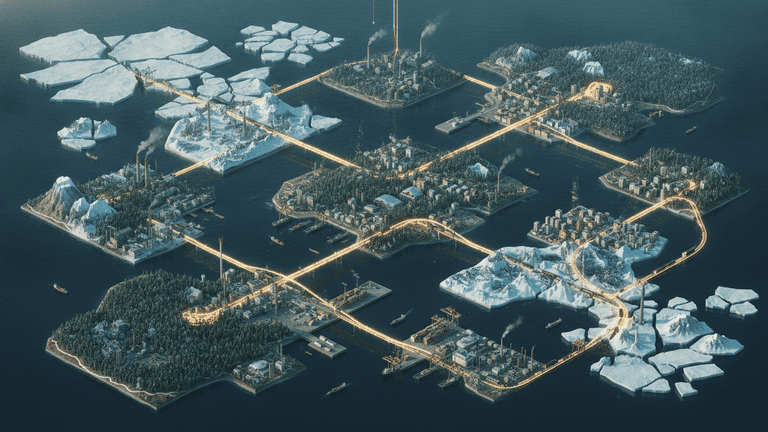
The third day of the Eastern Economic Forum 2026 demonstrated that development policy for the Far East is gradually moving beyond a simple set of individual incentives and investment projects. By the evening of September 3, forum organizers reported agreements worth over 6 trillion rubles.
Authorities presented a more cohesive framework for developing the macro-region: a unified business support regime, city master plans, technology experiments, and new transport routes are intended to connect the Far East and the Arctic with Russia's domestic market and Asian countries.
From Incentives to a Unified Regime
At the plenary session, Vladimir Putin outlined the objective of transitioning to a unified preferential regime for the entire Far East and Arctic. The launch is planned for January 1, 2027. Existing mechanisms, including the Vladivostok Free Port and the regime on Russky Island, are expected to remain in place.
Over the past 11 years, approximately 25 trillion rubles in capital investment has flowed into the Far Eastern Federal District, while gross regional product has more than tripled. The labor market situation has also changed: unemployment in 2026 stands at 2.2%, whereas nearly two decades ago it was close to 8%. Housing construction has doubled over the past six years.
The next phase should focus less on launching individual territories of advanced development and more on developing the cities themselves. Around 300 master plan projects have already been implemented in the Far East, and at least 200 such plans are expected to be prepared by 2030. Putin proposed directing infrastructure loans for the Far Eastern Federal District toward their implementation and expects legislation on city master planning to be adopted by the end of 2026.
However, the current model doesn't cover all settlements. A separate task has been set to develop instruments for small towns, villages, and rural areas. This represents an important shift: the focus is no longer solely on where to locate new production facilities, but also on how to build a sustainable urban environment around them.
The Far East as a Technology Testing Ground
The second pillar of the new policy is creating conditions for rapid technology adoption. Starting January 1, 2027, a special legal regime for testing new solutions is planned for the Far East. One of the first areas will be the low-altitude economy: authorities want to pilot civilian cargo transportation using drones, establish industry standards, and deploy artificial intelligence on the relevant platform.
Quantum infrastructure is being developed separately. By 2030, quantum communications are planned to reach the capitals of Far Eastern regions. An experiment with simplified procurement through marketplaces is scheduled to begin in October.
The industrial component of this program received concrete substance in Primorye. The Ministry of Industry and Trade, the Ministry for Development of the Far East and Arctic, the regional government, and IKS Holding signed an agreement to create Russia's largest complex for manufacturing advanced semiconductors. Financial parameters of the project have not yet been disclosed.
In parallel, Far Eastern Federal University reached an agreement with China's Xinwei AI Group to establish an international educational platform on Russky Island. It will train engineering, IT, and creative professionals with a focus on artificial intelligence. Thus, the technological agenda at the Eastern Economic Forum is gradually shifting from individual production facilities toward forming a complete chain—from education and development to industrial application.
Asia is becoming part of this model
The economic logic of the Far East is directly tied to its geography. In the first half of 2026, trade turnover between Russia and China exceeded $135 billion, up nearly a quarter year-on-year. The portfolio of Russian-Chinese investment projects includes 65 significant and 26 prospective initiatives with a total value of around $240 billion, with more than half already at the practical implementation stage.
Against this backdrop, China at the Eastern Economic Forum appears not only as the largest trading partner but also as a source of joint industrial, infrastructure, and technology projects. On the forum's third day, a meeting of the Russian-Chinese intergovernmental commission on investment cooperation took place.
The circle of partners is also expanding. Indonesian President Prabowo Subianto expressed interest in projects in energy, food, transport, and space, and proposed developing direct connections between Indonesia and Vladivostok. Mongolian Prime Minister Oyun-Erdene Luvsannamsrai noted the positive effect of Mongolia's interim trade agreement with the EAEU on exports and bilateral trade.
What's changing, however, is not just the geography of trade but its infrastructure as well. The forum's agenda includes new transport corridors, including the Mohe-Naiba project in Yakutia, as well as comprehensive development of the Arctic and the Trans-Arctic Transport Corridor.
The Arctic requires different infrastructure
Russia intends to ensure year-round navigation along the Trans-Arctic Transport Corridor, of which the Northern Sea Route is a part, and to connect Arctic maritime terminals with inland waterways. This will require new infrastructure. Rosatom head Alexey Likhachev stated that the Northern Sea Route will need dozens of ice-class container ships, with decisions on their construction expected in early 2027.
The energy component is also expanding. Preparations for the construction of a nuclear power plant in Khabarovsk Territory are planned to begin in 2027. Vladimir Putin announced that the first oil from the Vostok Oil project should soon be shipped to consumers, and called for simultaneous development of solar and hydropower generation.
The day's corporate agenda complemented this infrastructure focus. Rosatom and Kazakhstan Atomic Power Stations LLP signed an EPC contract for the construction of the Balkhash nuclear power plant in Kazakhstan's Almaty Region. The contract covers design, equipment supply, and construction of the facility. Separately, Rosatom confirmed fulfillment of agreements to acquire 51% of Delo Group, continuing the consolidation of assets in port and container logistics.
Gazprom prepares the next stage
A separate storyline on the third day involved Russian-Chinese gas projects. Gazprom and CNPC confirmed that the Far Eastern Route is proceeding on schedule: first deliveries of Russian gas to China are expected in January 2027. In September 2025, the parties agreed to increase planned delivery volumes via this route to 12 billion cubic meters per year.
Meanwhile, Power of Siberia 2 remains at the stage of negotiating commercial parameters. This issue is scheduled for discussion on September 4 at a session of the Russian-Chinese intergovernmental commission. The current stage, therefore, is better viewed as preparation for the next expansion of gas cooperation rather than an already concluded new export deal.
From Semiconductors to Marketplaces
Several other agreements demonstrated that the new Far East model extends far beyond raw materials sectors. In Buryatia, a deal was reached with X5 to support regional producers and bring their products into the Pyaterochka chain. VTB and DNS Group intend to develop financial and payment services, technological solutions for financial management, and project financing for the company.
The financial-digital agenda also touched Wildberries. VTB announced continued negotiations on terms of strategic partnership with RWB. This involves developing financial services for customers and sellers within the ecosystem and potentially expanding the bank's presence in its financial perimeter.
Meanwhile, corporate announcements at the forum are increasingly interconnected: production requires personnel and infrastructure, logistics needs new transportation capacity, and digital platforms require financial services. It's precisely this connectivity that distinguishes the current agenda from the traditional set of regional investment projects.
The Economy Enters a Cooling Period
Despite the scale of the regional program, the third day of the EEF revealed limitations facing the Russian economy as it enters the next phase. Vladimir Putin assessed annual inflation at 6.3% and noted that the task of reducing it is being accomplished, though it's important not to allow the economy to overcool.
German Gref characterized the state of the economy as precisely overcooling. By his assessment, GDP grew 0.6% in the first half against a potential rate of 1.5–2.5%. Sberbank maintains its key rate forecast for 2026 in the range of 13–13.5%, while Gref considers 10–12% a normal market level. This is the bank's forecast and assessment, not a decision by the Bank of Russia.
Another signal concerns oil revenues. Alexander Novak suggested the possibility of lowering the cutoff price in the budget rule from the current $59 to $50 per barrel. The government must make the final decision.
The consumer market situation looks more stable: new car sales for January–August exceeded 940,000 units, up 7% year-on-year. The Ministry of Industry and Trade also expects spring certification of the import-substituted SJ-100 with subsequent delivery launches.