This text is an automatic translation from Русский. It was generated by AI and may contain inaccuracies.
Read original →Social Policy Takes Center Stage in the Economy
Highlights from the conference on Russia's socio-economic development on November 24, 2025: debates on the Central Bank's monetary policy, GDP growth slowing to 1%, regional development, and the role of major corporations under new conditions.
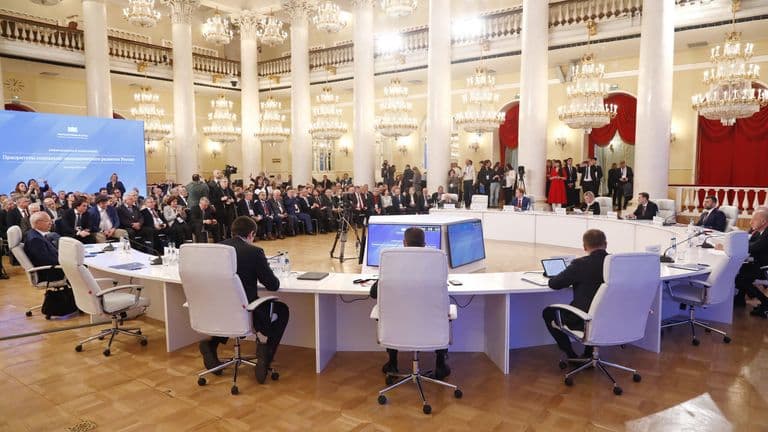
On November 24, 2025, the House of Unions once again became a hub for politicians, experts, and business leaders. It hosted the Inter-Faction Conference "Priorities for Russia's Socio-Economic Development". The main discussion block unfolded across three parallel expert sessions, giving the debate particular momentum.
One of the most discussed sessions focused on monetary policy. The debate centered on key issues: from inflation and interest rates to understanding the very nature of money and the regulator's role under current conditions. Session moderator Andrey Podoinitsyn (economist, director of ANO "Glavintellectplan") immediately set the intense tone of the discussion, stating:
"Money, from our perspective, is a universal economic symbol whose main function is measurement. Money is a brilliant invention that allows us to continuously measure everyday activities and any qualitatively diverse resources."
The effectiveness of coordination between the government and the Bank of Russia also came under scrutiny. Corresponding Member of the Russian Academy of Sciences Albert Bakhtizin, drawing on fresh IMF data, emphasized how sensitive economic growth is to coordination between the two institutions:
"When the monetary regulator doesn't hinder development but instead helps the government take actions to accelerate economic growth, that's when growth rates are maximized. Every dollar invested shows a response in GDP growth."
Executive Vice President of the Russian Union of Industrialists and Entrepreneurs Alexander Murychev attempted to outline a more practical picture for the coming year. He listed sectors that, in his opinion, will drive the economy upward in 2025: food service, agriculture, services, and construction. At the same time, he didn't hide the fact that the debate between the Ministry of Economic Development and the Central Bank regarding actual growth dynamics is far from over: a forecast in the 0.5–2% corridor only underscores the gap in approaches. However, the Central Bank, represented by board member Rustem Mardanov, made it clear that it doesn't intend to change strategy yet: the regulator will continue targeting inflation, considering it the safest way to prevent economic activity from declining.
No less substantive was the session "Spatial Development in the Context of Socio-Economic Challenges." Head of the DPR Denis Pushilin spoke about the scale of road construction:
"Roads are one of the important areas where we've invested our efforts—since 2022, we've repaired and built essentially about 2,400 km of new roads. We've managed to do this thanks to coordinated work between the federal center, supervising specialized agencies, and proper internal regional configuration."