This text is an automatic translation from Русский. It was generated by AI and may contain inaccuracies.
Read original →Low Water Levels Send Freight Costs Soaring
Low water levels on the Rhine have driven river shipping costs up 3.5-fold. An analysis of how drought conditions are affecting logistics in Europe and Russia, new climate surcharges, and the shift to alternative transport.
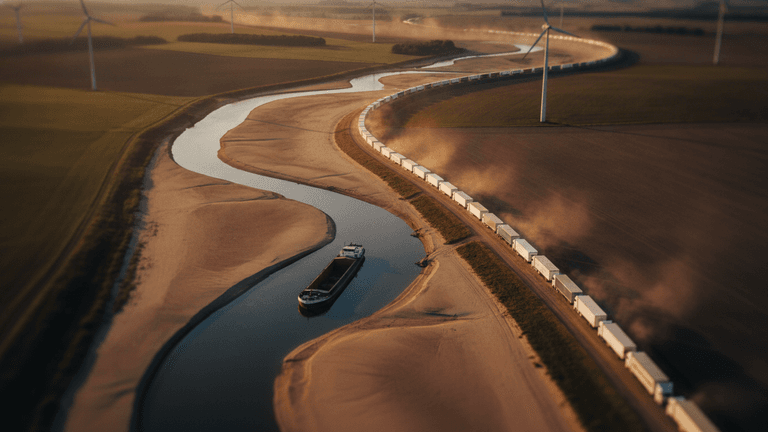
The Rhine Has Become More Expensive Over a Few Centimeters of Water
The Rhine is one of Europe's key transport arteries. It carries grain, fuel, minerals, chemical products, and industrial cargo between the port of Rotterdam and inland regions of Germany and other European countries. That's why changes in water levels quickly affect not only shipping but industry as well.
The problems didn't start in 2026. In the first half of 2025, approximately 135 million tons of cargo were transported on the Rhine, compared to 143.6 million tons the year before—a decline of roughly 6%. Overall, EU inland waterway transport in the first half of 2025 handled about 58.7 billion ton-kilometers, down 4.6% year-over-year. Against this backdrop, another drought period hit an already weakened market.
In 2025, water conditions on the Rhine approached critical levels several times. In April, the level at Kaub stood at 79 cm, with the critical threshold around 77 cm. In late June, vessels on certain sections could operate at roughly half their usual capacity. Carriers had already begun imposing special low-water surcharges by then.
In summer 2026, the situation became significantly worse. In late July, the navigable depth at Kaub dropped to 25 cm, matching the previous record from 2018. At that level, vessels could only pass through with drastically reduced loads: according to Reuters estimates, in some cases at roughly 20% of normal capacity.
The economic impact showed up in rates. In late June, transporting a tanker barge from Rotterdam to Karlsruhe cost around €45 per ton. By July 28, the rate had risen to €130–140, by July 31 to €150–155, and in early August reached €150–160 per ton. In other words, in less than six weeks, delivery costs increased roughly 3.3 to 3.6 times. As conditions deteriorated further, rates climbed even higher: according to S&P Global, by mid-August the cost of transport on the ARA–Basel route reached €276.67 per ton, compared to €35 previously.
The reason for such a spike is simple. A vessel's fixed costs don't decrease proportionally with cargo volume. If a barge can only take on a partial load due to low water, the costs of the voyage must be spread across fewer tons. Moving the same volume requires more vessels and more trips. River transport loses its main advantage—the low cost of moving bulk cargo.
Climate risk is now built into the tariff
The market has gradually transformed water levels from a technical indicator into a distinct pricing factor. Carriers set surcharges that directly depend on gauge readings.
For example, in Hapag-Lloyd's 2026 tariff schedule for a 40-foot container on sections south of Koblenz, the surcharge was €50 when water levels at Kaub were 150–131 cm. When levels dropped to 90–81 cm, it increased to €165; at 80–71 cm—to €380; at 50–41 cm—to €930; and below 40 cm it reached €1,280.
Maersk's tariff policy shows the changing risk even more clearly. In August, the company updated its Rhine transport surcharges, warning that if levels continue to fall, barge transport could become operationally impossible.
For shippers, this means climate risk is now visible directly on the freight invoice. And it's not just about shipping companies' expenses. Rising freight rates gradually ripple through the entire supply chain.
Germany is already seeing consequences for specific industries. Companies are shifting cargo from the Rhine to rail and road, but this requires additional capacity and costs more. For some cargo, replacing a barge with trucks proves especially expensive: compensating for the volume of a single barge can require up to 150 trucks.
Low water creates a double effect. On one hand, river transport itself becomes more expensive. On the other, the cost of alternative routes rises as demand for them increases simultaneously among a large number of shippers.
The Volga showed a different scenario
Russia's situation in 2025 was less clear-cut. In spring, water levels on the Upper Volga and Oka were close to extremely low. The forecast for water inflow into Upper Volga reservoirs for the second quarter was just 200–400 cubic meters per second against a norm of around 1,350 cubic meters. This meant a potential water deficit several times below normal levels.
In March, the Volga's water level at Rybinsk stood at 297 cm—below the low-water mark of 300 cm. Discharges from the Rybinsk hydroelectric plant ranged between 300 and 500 cubic meters per second, and the facility's operating regime had to be adjusted to account for the low water conditions.
Yet the final navigation statistics turned out contrary to what might have been expected from such an extreme hydrological situation. In 2025, the Volga basin transported 37.7 million tons of cargo, up 13.4% from the previous year. The number of trips rose 12.4% to 83,358 thousand.
It's precisely this figure that shows why the relationship between climate and freight transport can't be reduced to a simple formula of "less water equals less cargo." Carriers are able to partially offset the decline in efficiency per trip by increasing their frequency. If a vessel can't carry its usual cargo volume, it has to be dispatched more often. As a result, tonnage is maintained, but the need for fleet capacity, fuel, and time increases.
A similar picture emerged in other Russian basins. In the Moscow basin in 2025, 23.6 million tons were transported, up 8.4% year-on-year. In the Volga-Baltic basin, cargo flow reached 13.2 million tons, rising 7.6%.
In other words, Russian statistics don't yet show the kind of shock being observed on the Rhine. But they demonstrate a different adaptation mechanism: a logistics system can maintain transport volumes even under deteriorating conditions if it has the capacity to increase the number of trips and redistribute flows.
Rising tonnage doesn't negate rising costs
This is the main risk for river transport. Cargo turnover isn't the only measure of efficiency. You can transport 13.4% more cargo while simultaneously facing deteriorating economics per voyage.
When low water forces vessels to carry less cargo, carriers need more trips to deliver the same volume. Fuel consumption rises, fleet utilization intensifies, and crew costs increase. When some cargo has to be shifted to rail or road transport, the entire structure of logistics costs changes.
On the Rhine, this process has already moved beyond individual carriers. German companies report rising delivery costs and shortages of alternative capacity. Chemical manufacturers, metallurgical and energy companies are being forced to adjust their logistics. For example, Salzgitter shifted part of its coal deliveries from river transport to rail due to low water levels, while agricultural trader RWZ in July-August was only able to ship less than 10% of its usual 50,000-ton volume on the Rhine and was forced to rely more heavily on road transport.
For the economy, this is no longer simply a shipping problem. River transport is especially important for cargo that's poorly suited to trucking due to large volumes and low unit value. That's why extreme low water raises costs not only for delivery itself, but also for producing goods that use these raw materials.
Water becomes part of the price of goods
Climate change doesn't necessarily lead to rivers stopping. The economic effect appears earlier—in reduced loading capacity, increased number of trips, freight surcharges, and shifts to more expensive modes of transport.
The Rhine already shows how quickly this mechanism can work. Within a few weeks, rates on a particular route jumped from €45 to more than €150 per ton, with some estimates climbing even higher. At the same time, operators began calculating special surcharges based on water levels, effectively creating a separate "climate tariff."
The Volga and Oka still allow companies to compensate for unfavorable natural conditions by increasing the number of trips and managing water resources. But this doesn't mean Russian river logistics is protected from the climate factor. If periods of extreme low water recur more frequently, maintaining previous shipping volumes will become increasingly expensive.