Waste as a Sociocultural Nexus for Material Flow Construction
Waste isn't garbage—it's a transition point between material flows. How the circular economy, urban mining, and waste-to-raw-material recycling actually work. Examples from art and industry.
8 min read
Share:
From Waste to Material
Waste is not the end of an object's life story, but rather a connecting point in the transition between material flows. A plastic bottle can become a painting, flex material, pellets, or a new product. A metal part may end up in the waste stream, go through separation, and return to metallurgy. Glass can be transformed into an art object, then into cullet and a component of building materials. Organic matter can become compost or biogas. Even what remains after thermal waste treatment is now considered a source of metals. The artist, sorter, metallurgist, and manufacturer all become participants in a single process.
Art and industry, in the process of reflection, call into question the very category of "useless object." One of the most well-known examples is Brazilian artist Vik Muniz (Vik Muniz.) In his series "Pictures of Junk" he arranged garbage and scrap metal so that compositions emerged from the waste. For the project "Narcissus" V. Muniz transformed trash into recreations of paintings by Italian artist Caravaggio (Michelangelo Merisi da Caravaggio). In creating the series, the artist enlisted waste pickers who made their living at the landfill near Rio de Janeiro. In his art studio, Muniz performs "an operation on the very concept of value." From the artist's perspective, waste becomes color, texture, form, and human history.
In the works of African artist El Anatsui, ordinary bottle caps are transformed into enormous metal canvases that resemble fabric. The Metropolitan Museum of Art describes how the artist uses recycled bottle caps, connecting them by hand into large-scale compositions2,3. For the artist, the cap ceases to be a packaging component that has fulfilled its function. It becomes an elementary particle of new matter.
In Russia, this transformation also has artistic examples. Artist Nina Nikiforova is implementing the project "Waste of Civilization — Into Works of Art Without Borders." She uses plastic bags, caps, bottles, and other old items to create collages, interior objects, and landscape forms4.
The works of artist Aristarkh Chernyshev explore the problem of overconsumption. They exist at the intersection of art, technology, and engineering. Chernyshev takes an engineering approach, independently designing objects and turning to discarded items and waste as material for a conversation about contemporary consumption5. While N. Nikiforova demonstrates that waste can be transformed into objects, Chernyshev poses a more uncomfortable question: "Why do we produce so many things that become waste so quickly in the first place?" When rethinking waste management, there's a shift from aesthetics to economics, because the problem of municipal solid waste isn't just about the excessive amount of material left over after consumption. It begins at the product design stage.
A telling example is the project "Culture of Everyday Life. Recycle & Trash to Fashion", which took place in St. Petersburg6. Designers visited waste processing facilities, selected specific recycled materials, and used them to design new products. The exhibition featured items made from recycled plastic, bottle glass, Tetra Pak, automobile tires, textile waste, PET bottles, and other materials.
This reveals how an artist asks "What can I express with this material?", a designer asks "What can I make from it?", an engineer asks "What properties does this material have?", and a manufacturer asks "Can I make a thousand identical products from it?" And this last question turns out to be the most difficult, because art needs only one successful object, while industry needs thousands, tens of thousands, and millions of products of consistent quality. And this is where the real story of recycling begins.
When Waste Becomes Industrial Raw Material
The industrial sector thinks differently. For industry, a bottle is the original form of a polymer. First it must be collected and sorted, then separated from other polymers and contaminants, shredded, washed, prepared, and processed to obtain a material with predictable characteristics. The result is secondary raw material. When a bottle becomes a standardized fraction, raw material for the materials market emerges.
Against this backdrop, the LEGO experiment is particularly telling. In 2021, the company unveiled a prototype brick made from recycled PET obtained from used plastic bottles. More than 150 specialists spent three years testing over 250 PET variants and hundreds of other plastic formulations to achieve the required strength, safety, and ability for pieces to connect reliably with one another7. Meanwhile, research by Asharf N. et al notes that optimal strength indicators can be achieved with plastic content at 30-40%, with a mixture of polyethylene terephthalate (PET) and sand demonstrating high compressive strength up to 76.85 PA8. Recycling a bottle is relatively easy, but making a component from secondary material that must connect with precision to another component for decades is an entirely different challenge. Here we discover the main paradox of the circular economy: the more complex the product, the harder it is to return its material to production without loss of quality. Waste must stop being merely "recycled"—it must become predictable in its characteristics for subsequent use.
In Nairobi, materials engineer Nzambi Matee created "Gjenge Makers a company that manufactures construction paving blocks from a mixture of recycled plastic materials and sand. UNEP reported that the facility produced around 1,500 tiles per day, and the technology was developed specifically as a solution to plastic waste problems and the shortage of affordable building materials9. Packaging no longer necessarily returns to packaging—it can transition into an entirely different material stream, into construction materials. In this case, we're seeing a cross-industry transfer of raw materials. The circular economy isn't about infinitely returning an object to its original form, but rather the ability of a material to move from one production system to another while retaining economic value.
Secondary raw materials seek their consumer
The secondary raw materials economy begins precisely with the separation of material streams. In the "Culture of Everyday Life" project, designers experimented with bottle glass. It was ground into fine particles and used to create products using the pâte de verre ("glass paste") technique.
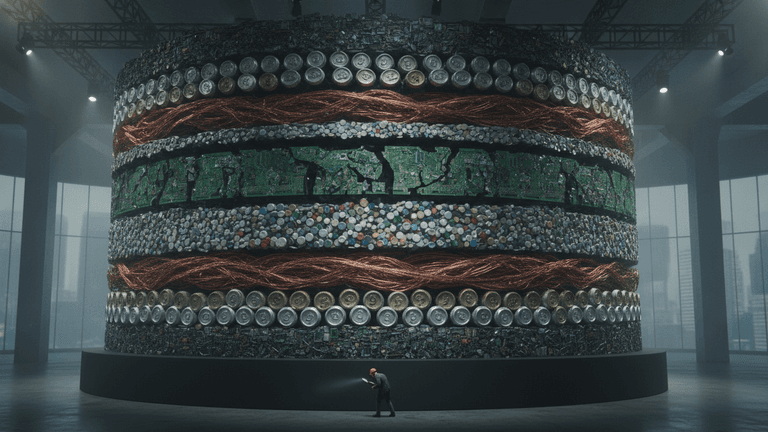
One of the most striking moments comes when waste begins to resemble "ore." After thermal treatment of municipal waste, what remains is bottom ash slag residue— incinerator bottom ash (IBA). Previously, organizations asked: "Where should we bury it?" but today the question sounds different: "What else can we extract from this?" And the answer includes metals. Modern sensor-based sorting systems allow for the separation of complex metal streams. For example, in July 2026 TOMRAannounced an expansion of its technology "Dynamic LIBS" for bottom ash residue from waste incineration. The system can separate various aluminum alloys, copper, brass, and other metal fractions from complex waste streams10. In this context, the metaphor of "urban ore" ceases to be a metaphor—a sorting facility equipped with specialized technology becomes an "enrichment plant."
The very concept of a "deposit" is changing. If metal can be extracted from an old car, computer, packaging, or bottom ash, then where is the deposit located? A deposit can be found in an abandoned industrial zone, at a landfill, in a municipal waste container, in old electronics, in a city, at an enterprise that yesterday was called a "waste facility." This reveals the logic of "urban mining" (with its characteristic "metabolism")11. The city becomes an accumulated stock of materials. In a linear economy, economic actors discard materials whose production has already consumed energy and resources.
According to official data from Rosprirodnadzor, 46.4 million tons of municipal solid waste were generated in Russia in 2025. Of this, 25.48 million tons were sent for processing, 4.6 million tons for recycling, and 37.75 million tons for landfilling12. The country generates tens of millions of tons of municipal waste annually. The problem lies not only in the volume of waste, but in the fact that material flows are still insufficiently separated, cleaned, standardized, and connected with industrial consumers. This observed phenomenon corresponds to one of the key concepts of social anthropologist Douglas M., who noted that waste is "matter out of place"13.
The Circular Loop Begins with Design
At this point, it's easy to draw the wrong conclusion: we need to build more recycling plants. But a plant is just part of the system. That's why the circular economy doesn't begin at the plant—it starts with product design, collection systems, sorting infrastructure, and quality requirements for secondary raw materials. This is precisely why a designer, a sorter, and a technologist are actually solving the same problem—they're just looking at it from opposite ends.
Regional specialized reports often include a line stating "n thousand tons of plastic recycled." But the next question should be more pointed: "What exactly was it recycled into?" If the recycling process yields a material no one wants to buy, the economic cycle hasn't closed. If recycled polymer can only be used in low-quality products that end up in landfills again, that's not a "cycle." If metal is extracted from ash but isn't pure enough for metallurgy, another technological stage is needed. If glass is sorted but virgin material is more economically viable, you have a market problem.
The manufacturer becomes both the last link and the first simultaneously. A motivated manufacturer should say: "I need material with specific characteristics that can actually generate profit," and the sorting system must learn to deliver it. The technologist needs to learn how to "purify" it, the recycler must make the raw material "consistent" with a defined set of characteristics, the designer must create a product suitable for subsequent processing, and the consumer needs both the ability and the desire to buy it.
The future of waste isn't in the trash bin. The circular economy doesn't simply mean more efficient waste recycling. It means changing the route materials take. At each stage, what changes isn't just the material itself, but its potential function and economic status. And that's precisely why the waste management problem extends far beyond the environmental agenda. It touches on the question of rethinking how civilization handles matter after it no longer needs its original form.
Behind a single black garbage bag lie dozens of possible routes. One leads to a landfill, another to a sorting line, a third to an incinerator, a fourth to metallurgy, a fifth to the construction industry, a sixth to an artist's studio, a seventh to a new product. And the question for the future isn't just how much waste is produced, but how many material flows economic actors have identified and created from that black bag of waste. We need to learn to see not an ending at the end of consumption, but the next growth points and branching potential production chains.
11. Wolman A. The Metabolism of Cities // Scientific American. 1965. Vol. 213. P. 179–190.