The 2026 Iran Crisis: Timeline of Events and Economic Market Impact
A comprehensive analysis of the March 2026 oil crisis: Brent's 44% surge to $103, the release of 400 million barrels from reserves, the reshaping of global trade flows, and implications for the world economy. Data, charts, and forecasts from the EIA and IEA.
12 min read
Share:
As of March 16, 2026, international sources typically date the start of the current escalation to February 28, 2026. That was when U.S. and Israeli strikes on targets in Iran pushed the conflict into a more acute phase. The subsequent escalation led to the closure of shipping through the Strait of Hormuz and became one of the key factors destabilizing the oil market.
The shock was caused by physical degradation of logistics: falling insurance coverage and rising risk of attacks on tankers and infrastructure led to a sharp contraction in export flows and forced shutdowns of oil production and refining due to storage capacity overflows. All of this helped transform the conflict into a large-scale commodity and macroeconomic shock.
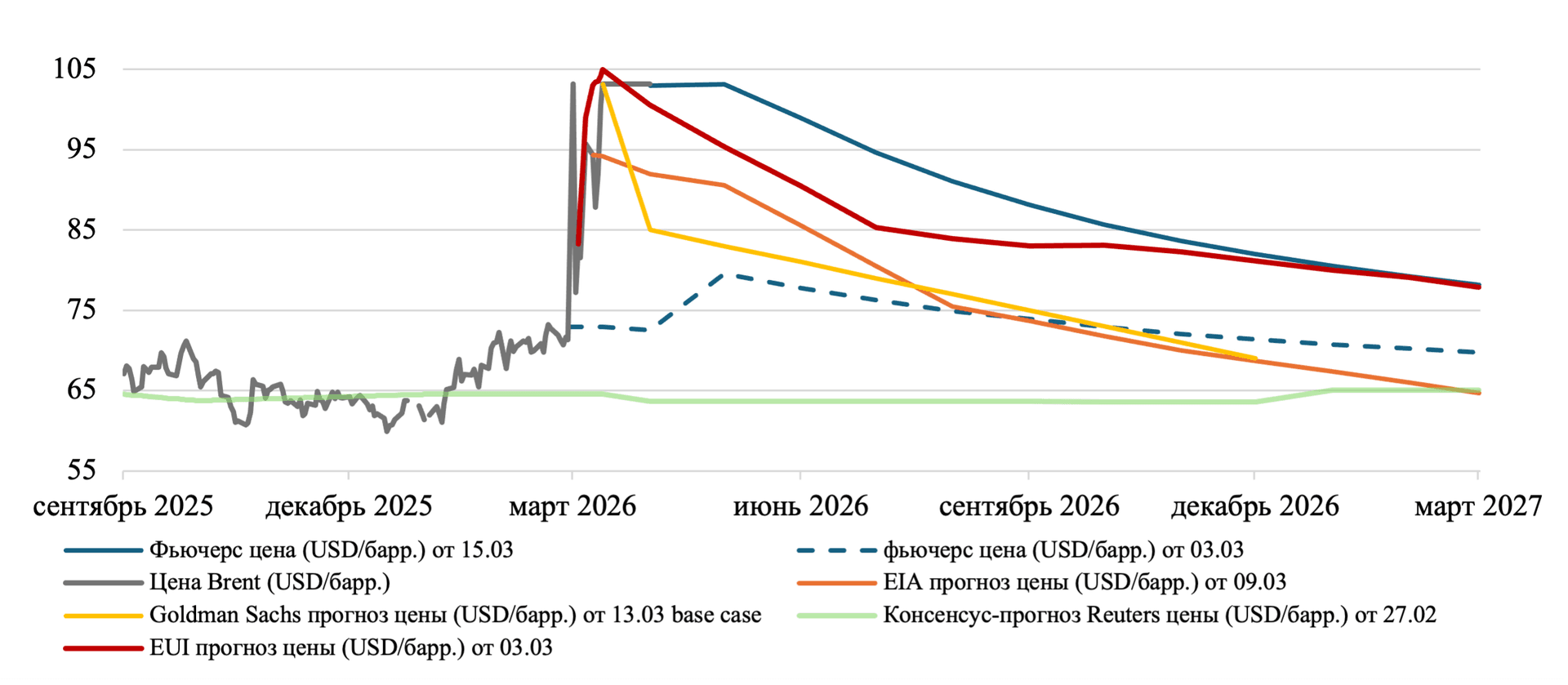
The day before the Middle East escalation began, the oil market was in relatively stable condition: (Figure 1) on February 27, 2026, Brent was priced at $71.32 per barrel and WTI at $66.96 per barrel. After the conflict began and risks of supply disruptions from the Persian Gulf increased, the market quickly repriced the geopolitical premium. As of March 16, 2026, Brent reached approximately $102.7 per barrel, representing growth of around 44% compared to pre-conflict levels. WTI rose to around $95.9 per barrel, up approximately 43% from late February levels.
The EIU believes the current energy shock will be painful for Asia but manageable under the base scenario: average oil prices in 2026 will be around $80/bbl, which will raise inflation and slow growth, but should not by itself push the region into stagflation if the conflict does not drag on much beyond the baseline 4–6 weeks.
Investors' initial reaction in the first days of escalation was restrained: equity markets for major oil companies barely tracked the rise in oil prices, as expectations of a quick restoration of logistics and price normalization prevailed—reflected, in particular, in the weak response of distant futures contracts. As the conflict deepened, risk assessments became more severe: the futures curve took on a more pronounced downward slope and shifted upward, banks and agencies successively raised their risk assessments and price scenarios, and governments and the IEA announced the largest coordinated strategic reserve release in history. The overall direction of forecasts points to expectations of gradual market stabilization and a return of prices to lower levels.
Figure 1 Change in Brent oil price during 01.01-15.03, forecasts. Source: compiled by the author based on data from investing.com, www.eia.gov, Goldman Sachs, Reuters
The distribution of damage is uneven. Persian Gulf exporting countries are losing not only price revenue but also suffering direct losses from the physical impossibility of shipping product; in the extreme, this looks like an actual collapse of the export model. On the benefits side are primarily exporters and producers outside the direct strike zone, while Asia's largest importers and parts of Europe bear large losses through inflation and deteriorating trade balances.
Timeline of Key Events
Below are events in chronological order that changed physical oil flows/insurance/logistics or triggered revisions of investor expectations (reserves/forecasts/ratings).
February 28, 2026. Start of the open military phase following joint U.S. and Israeli strikes on Iran; initial market reaction—oil price rise and increased volatility expectations, though baseline scenarios from several analysts in the first days assumed a limited conflict and Brent around $80 with containment.
March 1–2, 2026. Deterioration in market participants' assessment of Strait of Hormuz navigability.
March 3, 2026. VIX posts one of the largest single-day spikes at the start of the conflict, reflecting rapid repricing of geopolitical risk.
March 6, 2026. Intensified equity sell-offs amid oil price spike.
March 9, 2026. A key fork in investor expectations: oil prices surge sharply, but equities react moderately. The market is pricing in expectations of a swift restoration of strait passage, while the far end of the price curve does not confirm a prolonged deficit.
March 10, 2026. Official energy analytics update: the EIA publishes forecasts and emphasizes that prices depend on the duration of the strait disruption.
March 11, 2026. An official representative of Iran's Khatam al-Anbiya Central Headquarters warned that if the U.S. and Israel continue attacks on Iran's energy infrastructure, oil prices could rise to $200 per barrel.
The United States announces the release of 172 million barrels from the U.S. Strategic Petroleum Reserve, with deliveries beginning next week over a roughly 120-day period, while Japan plans to start releasing approximately 80 million barrels from government and private stockpiles as early as March 16. The report emphasizes, however, that tapping reserves can only temporarily smooth the price shock and cannot substitute for restoring normal shipping and supply logistics.
March 13–15, 2026. Risk of further escalation around critical export infrastructure, which sustains elevated risk premiums in prices and insurance rates.
Change in Brent futures curve since March 3, 2026
The shape of the Brent futures curve as of March 15, 2026 (Figure 1) has changed substantially compared to the configuration observed in the early days of geopolitical escalation. Whereas the market previously displayed moderate backwardation with a relatively smooth decline in prices across distant contracts, under current conditions the curve has acquired a significantly steeper downward profile. With spot prices around $103 per barrel, the nearest monthly contracts remain close to current levels (the May 2026 contract at $103.14), but starting with summer contracts there is a steady decline in prices: $94.67 by July, $88.11 by September, and around $78–80 per barrel on the horizon of early 2027.
The current shape of the futures curve indicates that the market interprets the observed price shock as acute but predominantly short-term, not pricing in a sustained structural oil deficit over the long-term horizon. The bulk of the geopolitical premium is concentrated in the nearest contracts, while the far end of the futures curve reflects expectations of gradual market stabilization and a return of prices to lower levels.
Volatility: OVX as an indicator of risk repricing
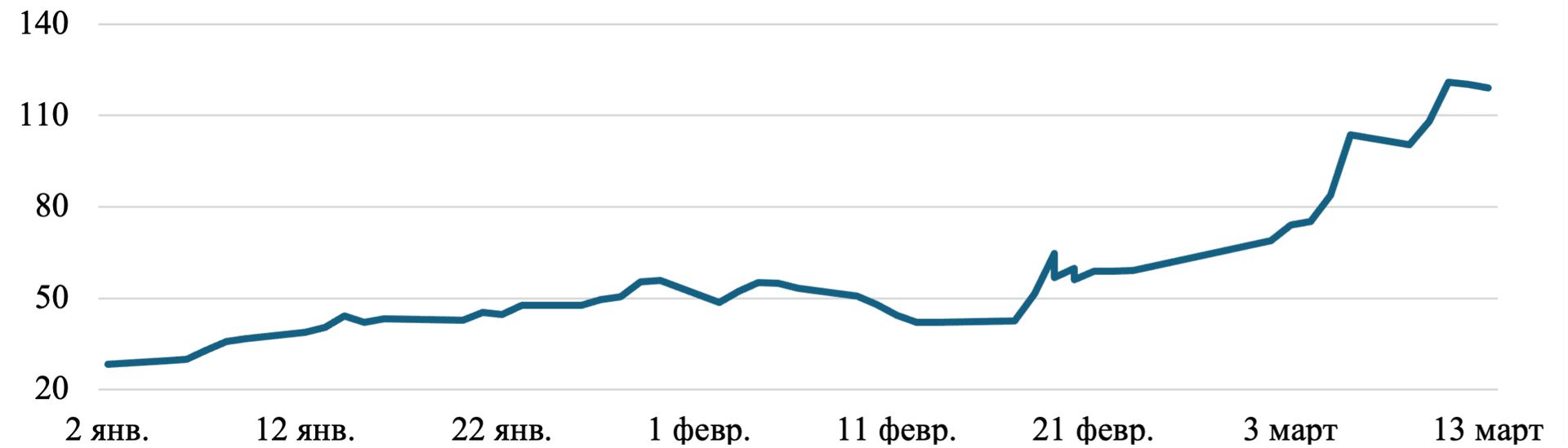
The OVX oil market volatility index shows a substantial increase in uncertainty and risk repricing by market participants. While in mid-February the index stood at around 40–50 points, early March saw a rapid rise that pushed OVX above the 100-point mark and close to 120—a historical high since 2020. Thus, OVX dynamics indicate the oil market's transition into a regime of heightened volatility and increased risk premium in oil prices.
Figure 2 Oil market volatility index OVX January 2, 2026 – March 13, 2026. Source: FRED; author's calculations.
Evolution and comparison of forecast estimates
In the initial phase of the crisis, a short-term escalation scenario prevailed, after which a relatively quick restoration of normal oil market functioning was expected. The baseline scenario was interpreted as limited to several weeks, with shipping restored and price pressures easing.
Prior to the current escalation, EIU's baseline view for 2026, judging by the logic of the new note, remained relatively moderate: oil was not seen as a source of systemic macro shock, and the overall forecast for the global and Asian economies remained rather "cautiously favorable." At the very beginning of the escalation, EIU issued an initial analytical note dominated by a scenario of limited conflict and milder consequences. However, in the note dated March 11, the tone noticeably hardens: EIU explicitly states that the risk of a larger energy shock has increased, with the new baseline assumption being an average oil price of around $80/bbl in 2026. That said, the baseline scenario is still not catastrophic: according to EIU's assessment, the conflict should last 4–6 weeks, after which oil and gas prices will gradually decline, though they will retain a significant geopolitical risk premium. At the same time, the risk structure is also changing: most Asian central banks will be able to accept moderate inflation acceleration without a sharp policy shift, while in a more severe scenario, prolonged high energy prices, rate hikes, pressure on currencies, import and capital restrictions, as well as negative secondary effects through global financial markets and the investment cycle are already anticipated. Thus, the overall shift in EIU's position can be described as follows: from a moderately calm assessment of a short-term conflict in which the forecast remains manageable, to one where the risks of adverse scenarios become substantially heavier and economically more significant.
According to EIA's assessment, the current crisis has already moved beyond an ordinary price shock and has taken on the character of the largest disruption to physical logistics in the history of the global oil market. Flows of crude oil and petroleum products through the Strait of Hormuz have declined from approximately 20 million bbl/day to minimal levels, and Gulf countries have been forced to reduce production by at least 10 million bbl/day. In March, global supply, according to the agency's calculations, will decrease by approximately 8 million bbl/day, though part of the lost volumes will be offset by increased production outside OPEC+, strategic reserves, and alternative logistics. This is precisely why, despite Brent's spike to nearly $120/bbl, the market subsequently corrected to $92/bbl, with investors beginning to perceive the situation not as an instant collapse but as a severe yet partially mitigable shock. An additional consequence of the shock has been a deterioration in demand forecasts: growth in global oil consumption in 2026 has been reduced from 850,000 bbl/day to 640,000 bbl/day, as high prices and a worsening macroeconomic backdrop begin to destroy demand.
Market reaction to reserve releases
The coordinated release of strategic reserves became a key instrument for market stabilization after the sharp disruption of supplies through the Strait of Hormuz. On March 11, IEA member countries announced the release of 400 million barrels of oil from emergency reserves. Among the largest participants in the intervention, the United States accounts for the greatest volume—172 million barrels; followed by Japan—around 80 million barrels, South Korea—22.46 million barrels, Germany—19.51 million barrels, France—approximately 14.5 million barrels, and the United Kingdom—13.5 million barrels. The scale of the measure was unprecedented: for comparison, during the 2022 crisis following the start of the Russia-Ukraine conflict, the total release amounted to approximately 182.7 million barrels, meaning the current intervention is more than twice as large.
The market perceived this move as an important signal that the physical supply deficit would not immediately translate into an uncontrolled price spike. According to IEA's assessment, immediately after the escalation, Brent briefly approached $120/bbl, but then corrected to approximately $92/bbl, while remaining roughly $20/bbl above early-month levels. This dynamic shows that the reserve release did not eliminate the risk premium entirely, but significantly reduced the probability of an instant market collapse scenario.
Quantitatively, the stabilizing effect of the reserve release should be assessed in the context of the scale of the disruption itself. According to IEA's estimate, in March global oil supply is contracting by approximately 8 million bbl/day, whereas around 20 million bbl/day of crude oil and petroleum products passed through Hormuz before the crisis. Consequently, even such a large intervention cannot fully replace the lost flows over an extended horizon: 400 million barrels is a significant but temporary buffer, capable of providing time for logistics reconfiguration, flow redistribution, and the deployment of commercial inventories.
Market reaction was uneven across segments. While the reserve release contained extreme price growth for crude oil itself, tension in refining and petroleum products remained noticeably stronger. Reserve releases work more effectively against crude oil deficits than against instant imbalances in diesel, jet fuel, and LPG markets, where logistical constraints and regional shortages may persist longer.
The market's reaction to the reserve release can be characterized as a partially successful stabilization: the intervention reduced the severity of panic, limited the amplitude of further Brent growth, and provided time for trade flow adaptation, but did not eliminate the structural source of risk itself.
Countries and sectors: distribution of losses and gains
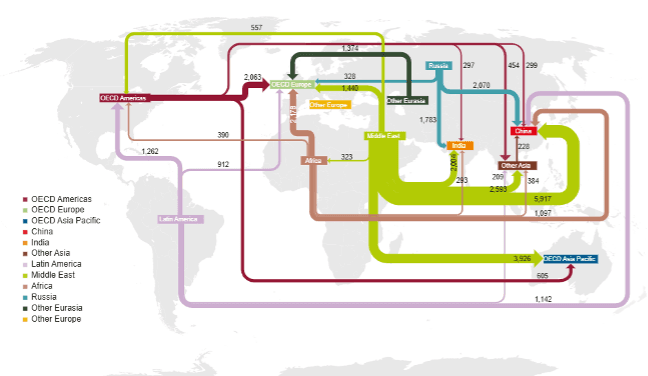
According to EIA data, the main consequences of transit disruptions through the Strait of Hormuz are concentrated in the Asian direction of global supplies. According to the agency's data, in 2024 approximately 84% of crude oil and condensate passing through the strait was destined for Asian countries. The largest importers were China, India, Japan, and South Korea, which collectively accounted for around 69% of crude oil and condensate flows transported through this route. A separate zone of greatest vulnerability is formed by economies where the oil sector is a key source of export revenue and budget income. In such countries, an energy shock quickly transforms from a price factor into a fiscal and balance-of-payments problem. A characteristic example is Iraq: according to Reuters, amid conflict escalation and export restrictions, production in certain regions of the country could have declined by approximately 70%, directly threatening the sustainability of public finances, since oil provides the overwhelming share of export receipts and a significant portion of budget revenues.
Figure 3 Global oil flows in 2024, thousand barrels per day. Source: OPEC Annual Statistical Bulletin 2025.
In the short term, the main importers of Middle Eastern oil—China, India, Japan, and South Korea—are forced to diversify supplies, increasing purchases from alternative export regions. First and foremost, this involves the United States, Brazil, Norway, and Canada, where oil production remains stable and export infrastructure is oriented toward the global market. Additional volumes are also coming from West African and Latin American countries, partially offsetting the potential decline in supplies from the Persian Gulf.
Simultaneously, a shift in the geography of trade flows is occurring. European and Asian consumers are intensifying competition for alternative crude grades, leading to the redirection of some export flows and increased transportation distances. As a result, exporting countries with flexible logistics and access to multiple sales markets gain the opportunity to redistribute supplies in favor of the most premium destinations, extracting additional price rent.
The current energy crisis is producing an asymmetric distribution of consequences across countries. For major oil importers and economies dependent on supplies from the Persian Gulf, it means intensifying inflationary pressure and rising energy risks, while for a number of oil producers it becomes a source of additional export revenues and a redistribution of oil rents in their favor.
Russia's Role in the Current Oil Market Configuration
With the partial loss of Middle Eastern supply, Russia's importance as one of the major external oil suppliers to the Asian market is growing. That said, talk of a formal easing of the Western sanctions regime is premature: the European Union's official position remains oriented toward further limiting Russian energy revenues. At the same time, the price and logistics shock itself is objectively increasing demand for Russian supplies among importers outside the sanctions bloc. According to Reuters, in February 2026, Russian oil deliveries to China reached 2.07–2.08 million barrels per day, reflecting Russia's strengthening role in the Asian configuration of oil flows. Before the escalation, average delivery levels to China held at roughly 1.8–1.9 million barrels per day; current figures represent a notable increase in purchases against the backdrop of rising logistics risks for Middle Eastern routes. Similar dynamics are observed in the Indian direction. In 2024–2025, average volumes of Russian oil deliveries to India stood at around 1.7–1.8 million barrels per day. In early 2026, purchases temporarily declined—to about 1.1 million barrels per day amid sanctions pressure and adjustments to trade flows. However, the worsening situation in the Middle East and transit risks through the Strait of Hormuz led to renewed growth in purchases: according to vessel tracking data, India's imports of Russian oil increased, reaching approximately 1.5 million barrels per day. Under current conditions, Russia plays an important role in supplying feedstock to Indian refineries and serves as a key element of supply diversification for Asian importers.
At the same time, the crisis is amplifying the importance of overland energy infrastructure, which is less sensitive to maritime logistics risks. In this context, Russian-Chinese negotiations on the Power of Siberia 2 project take on additional significance, as it is viewed as an element of long-term diversification of energy supply routes to Asia. That said, at the current stage it's more accurate to speak not of finalized agreements, but of continued project advancement and sustained mutual interest from both parties in its implementation.
Oil and Gas Company Stock Performance
Rising oil prices quickly impacted the performance of oil and gas company stocks. The energy sector benchmark—the Energy Select Sector SPDR ETF (XLE), which tracks companies from the S&P 500 Energy index—rose approximately 25% since the start of 2026, significantly outpacing the broader market. Major oil companies also posted notable gains: ExxonMobil shares increased roughly 29%, Chevron by 21.9%.
The combined market capitalization of the largest oil and gas companies increased by more than $130 billion. Energy companies emerged as one of the main beneficiaries of the current price shock, as higher oil prices directly improve production profitability metrics and increase expected cash flows for sector companies.