This text is an automatic translation from Русский. It was generated by AI and may contain inaccuracies.
Read original →Russia's Budget After the Oil Era
An analysis of Russia's federal budget deficit in 2026: how declining oil and gas revenues and rising expenditures are affecting fiscal sustainability. Ministry of Finance data, forecasts, and risks.

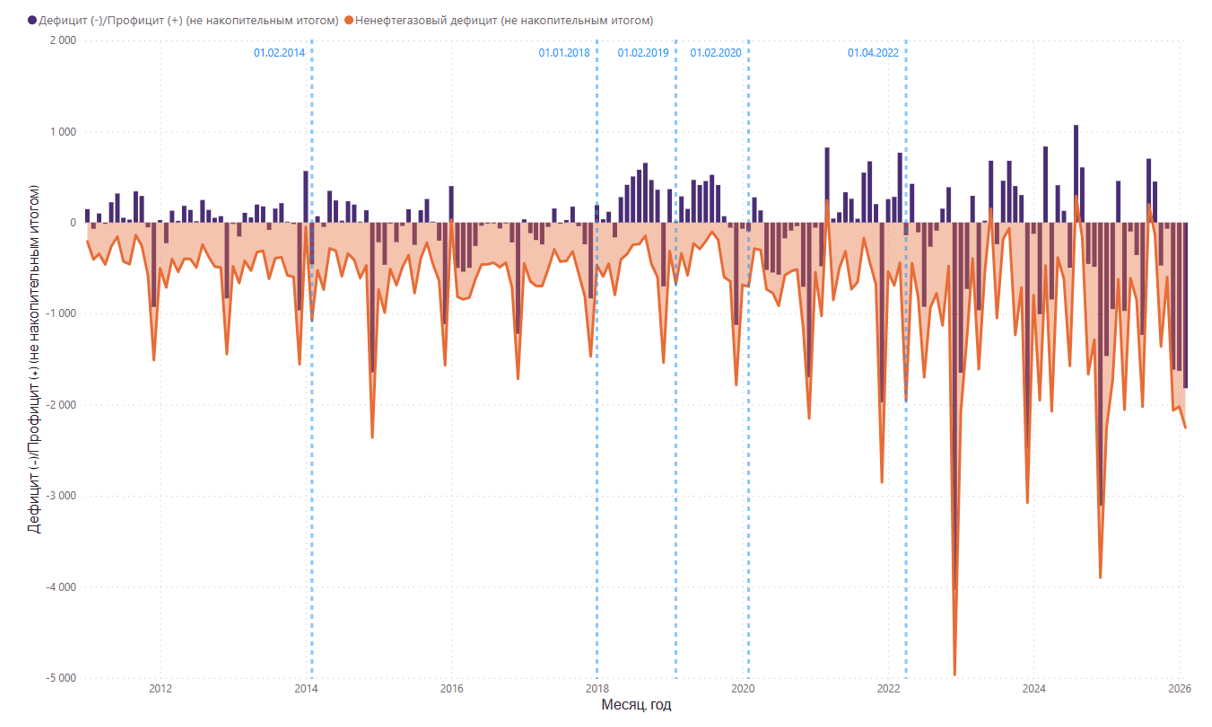
Since the beginning of 2026, reports concerning budget adequacy have been appearing with increasing frequency in the information space. To cut to the chase: in just the first four months of 2026, the federal budget deficit has grown to 5.9 trillion rubles, against a planned annual target of 3.8 trillion rubles.
Against this backdrop, interest in the topic has naturally intensified. A budget deficit is an ambiguous phenomenon, so it cannot be assessed as purely positive or negative. What matters are the specific parameters and the reasons behind its formation. The current federal budget indicators have, not without reason, raised concerns among a number of experts.
It's no secret that oil and gas revenues constitute a significant share of federal budget income. According to Finance Ministry data, from 2011 through the end of 2014, the gap between oil-and-gas and non-oil-and-gas revenues remained within 20%, with the largest deviations recorded predominantly only in individual months (Figure 1).
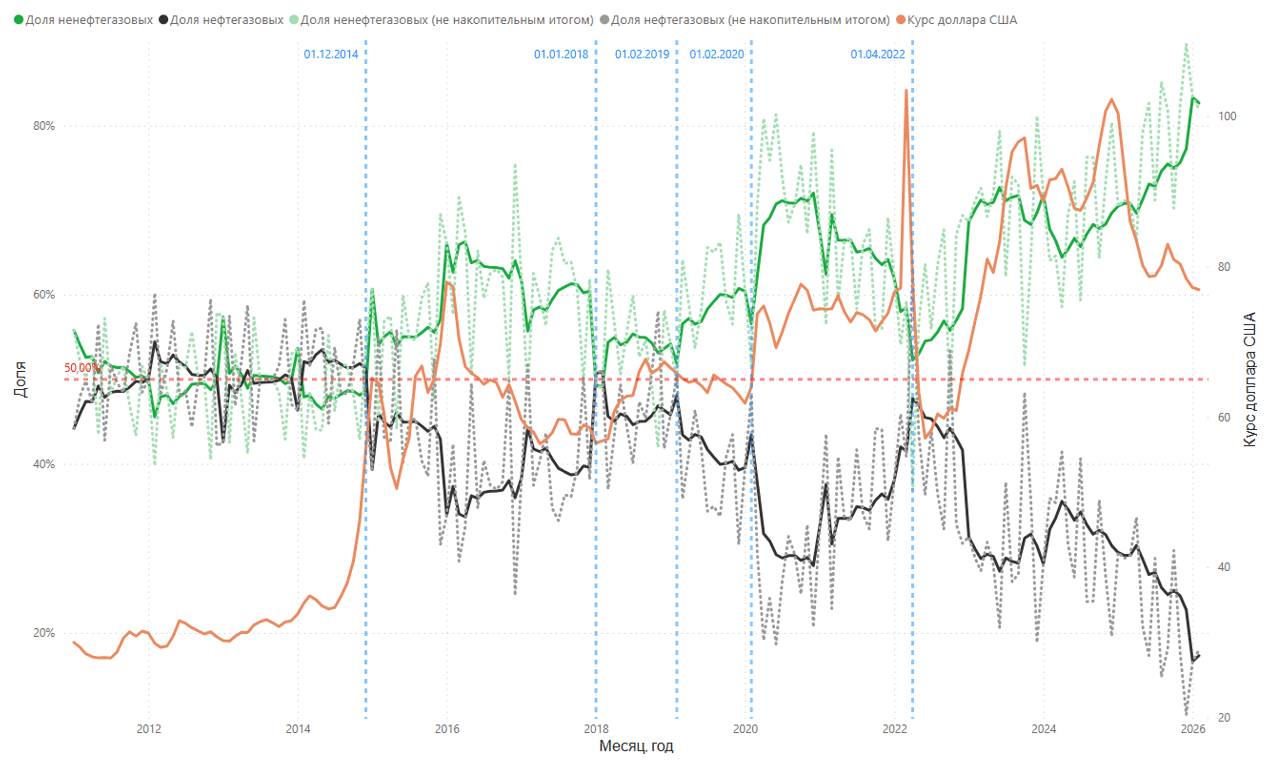
More substantial changes begin in 2015. Intensified sanctions pressure and a new wave of uncertainty in relations with Western countries led to a widening gap between oil-and-gas and non-oil-and-gas revenues. Around the same period, Russia began pursuing a course of import substitution and economic sovereignization. From 2018 through 2019, the geopolitical situation became less acute, despite the persistence of the conflict factor itself—this can also be clearly traced on the chart. Already in 2020, another "dive" in the share of oil and gas revenues begins, triggered by the COVID-19 pandemic. In 2021, the global economy started recovering from COVID restrictions, and energy supplies resumed. In turn, the sharp escalation of the geopolitical situation in 2022 led to a new steep decline in the share of oil and gas revenues.