This text is an automatic translation from Русский. It was generated by AI and may contain inaccuracies.
Read original →
This text is an automatic translation from Русский. It was generated by AI and may contain inaccuracies.
Read original →Oil market review for March 2026: why Brent surged 10% to $78-82, what futures and options are indicating, how the Strait of Hormuz blockade is affecting logistics, and what price forecasts analysts are offering. Risk and scenario analysis.
As of March 2, 2026, the oil market entered emergency risk reassessment mode following military escalation around Iran after U.S. and Israeli strikes. The key factor is the risk of an effective shutdown of shipping through the Strait of Hormuz: according to official U.S. energy market statistics, approximately 20 million barrels per day passed through the strait in 2024 (roughly 20% of global liquid hydrocarbon consumption), with the bulk of flows heading to Asia.
Over the weekend (February 28–March 1, 2026), when exchange-traded futures were closed, over-the-counter estimates indicated Brent rising to approximately $80/barrel (around +10% from the last close), reflecting a sharp repricing of geopolitical risks. After trading opened, the price impulse was confirmed: Brent quotes climbed intraday into the $78–82/barrel range, accompanied by heightened volatility amid uncertainty surrounding supplies. Meanwhile, the baseline fundamentals for 2026 prior to the escalation remained moderately surplus, with supply growth and inventory accumulation expected, which continues to cap the far end of the futures curve.
Derivatives signals as of the last close (February 27, 2026) point to a combination of: steepened backwardation and high implied volatility. At the same time, distant months remain substantially below "crisis" levels, which is interpreted as the market betting that the shock will not be permanent (or will be partially offset by inventories/rerouting/OPEC+ response), even if the coming weeks may be accompanied by sharp spikes.
The probability embedded in option prices of Brent closing above $100 by the nearest expiration works out to around ~2%, meaning the market, despite all the nervousness, still treats an extreme price as unlikely, but not zero.
The operational picture is characterized by a divergence between the "formal" status of the strait and actual vessel behavior. At the level of statements and media reports, Tehran's declarations about restricting commercial/shipping regimes are recorded; Russian and international sources simultaneously publish signals about passage remaining open for individual vessels, which is typical of "formally open, effectively disrupted" regimes. Critically, what matters to the market is not the legal formula but operational transit feasibility: insurance, shipowner willingness, attack risks, and port restrictions.
As of March 1, it was reported that dozens/hundreds of vessels took up anchorage: at least ~150 tankers (crude oil and LNG) dropped anchor outside the strait, with another ~100 or so on approaches off the UAE and Oman coasts; collectively, figures of "200+ vessels" in the waiting zone were mentioned. The data align with tracking and MarineTraffic reports and Joint Maritime Information Center warnings about increased naval activity and likely insurance cost increases.
Bypass capacity is fundamentally limited relative to Hormuz flow. According to EIA data, approximately 20 million barrels per day passed through the strait in 2024, while alternative overland corridors from the Persian Gulf can only "relieve" a portion of the volume. In market estimates, even accounting for rerouting some flows through Saudi Arabian and UAE pipelines, the potential loss of accessible exports in the event of serious disruption to the strait regime could amount to ~8–10 million barrels per day.
A separate layer of shock is logistics and delivery costs. According to Reuters, VLCC freight rates on the Middle East–China route exceeded $170,000/day, corresponding to a jump to "six-year highs"; simultaneously, Middle East exports were noted to exceed 19 million barrels per day in February 2026 (the highest since 2020), which itself intensifies pressure on the tonnage market. Rising freight rates amplify the "effective price" for the end buyer of oil even with unchanged paper prices.
In container logistics, direct surcharges are being recorded: Hapag-Lloyd announced the introduction of a War Risk Surcharge, and major lines reported service suspensions/reroutings due to deteriorating security in the Middle East corridor.
Prior to the escalation, official closing levels on February 27 stood at approximately $72.48/barrel for Brent and $67.02/barrel for WTI. Following military events in the Middle East and increased risks to shipping through the Strait of Hormuz, the market faced a sharp repricing of geopolitical risks. With exchange trading closed over the weekend, over-the-counter transactions indicated Brent rising to approximately $80/barrel, representing a jump of around 10% from the last official close.
After markets opened in early March, the price impulse was partially confirmed: intraday Brent values climbed to the $78–82/bbl range, while WTI rose above $70, reflecting market participants' reaction to the threat of supply disruptions and rising insurance and logistics risks.
A significant portion of the "risk premium" formed during a period of absent exchange liquidity, which historically increases the likelihood of subsequent sharp price movements and volatility after full trading resumes. In effect, the market first repriced the probability of supply disruptions in the OTC segment, then began repositioning under conditions of an open futures market.
Below are the curve reference points (based on February 27 quotes; data published March 1 as "delayed/last") and corresponding spreads:
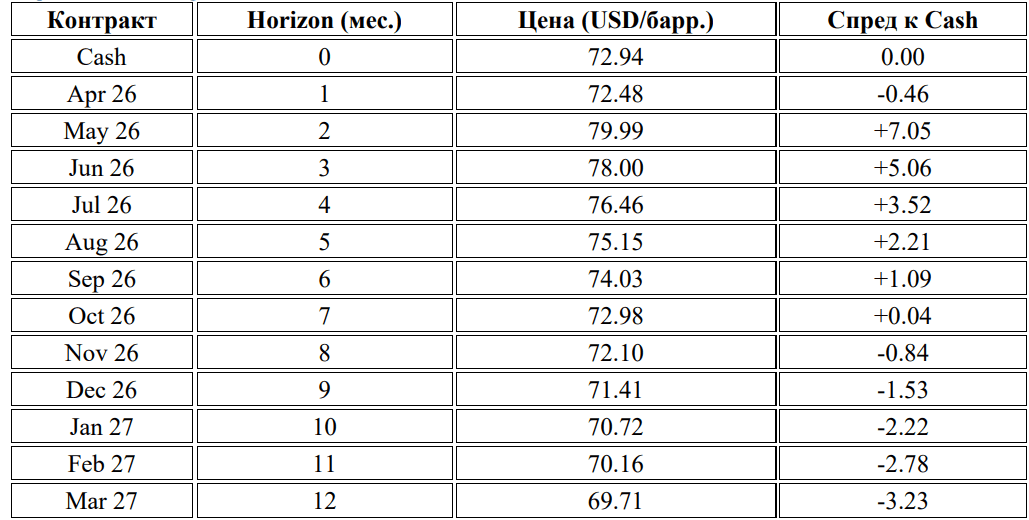
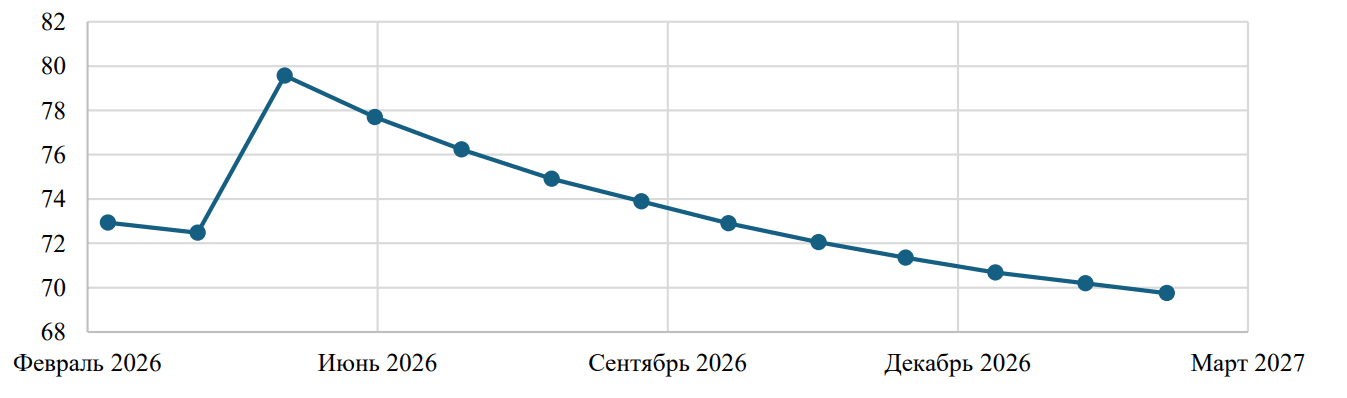
Backwardation means the market pays a premium for "a barrel today/in the coming months" compared to "a barrel a year from now." In the current data, the monthly structure of the futures curve shows a pronounced price peak on the short horizon (May–Jun 2026 contracts), followed by a consistently downward price profile extending to roughly the one-year horizon.
This curve shape (Figure 1) points to a concentration of risk premium in the near term and corresponds to the market's typical response to a geopolitical and logistics shock: the nearest months carry maximum risk of physical deficit and supply disruptions, while more distant contracts reflect expectations of gradual normalization in the supply-demand balance.
The far end of the curve (early 2027 contracts), sitting in the range of roughly $69–71 per barrel, remains substantially below near-term levels, which aligns with two dominant market participant expectations: (i) possible inventory builds and easing of the deficit under the base case scenario for 2026, and (ii) a likely supply response, including logistics adaptation and gradual production increases as the situation stabilizes.
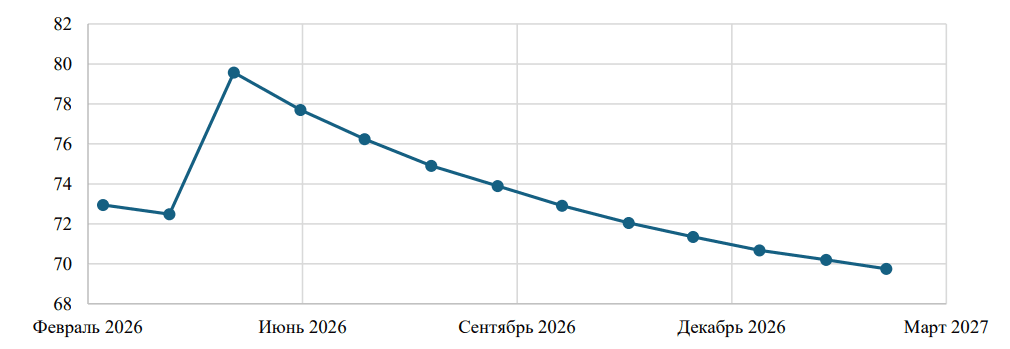
Consequently, the shape of the futures curve indicates that the market interprets the current shock as acute but potentially temporary, not pricing in a sustained long-term structural oil deficit.
Dynamics in expected volatility indicators confirm rising uncertainty in the oil market at the end of February 2026. The OVX oil volatility index is used as a proxy indicator, reflecting expected 30-day WTI price variability based on option quotes (Figure 2).
As the data shows, the index value rose from levels around 30–40 points in December 2025–January 2026 to the 60–65 point range by late February, indicating a sharp increase in the cost of hedging price swings. The strongest spike occurs in the second half of February, coinciding with intensifying geopolitical tensions and rising oil prices.
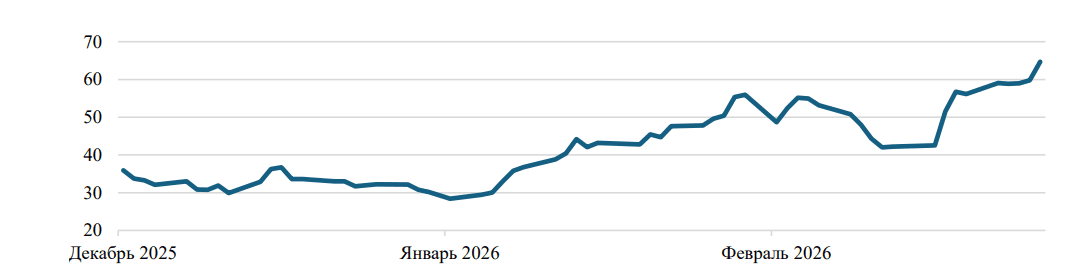
Rising expected volatility is interpreted as increased demand for protection against extreme price scenarios. Thus, the derivatives market is signaling not so much the formation of a sustained upward price trend, but rather participants' desire to insure against a possible sharp price spike in the near term.
Additionally, open interest in the nearest Brent contract runs into the hundreds of thousands, raising the likelihood of sharp position reshuffling.
Before the escalation, the consensus through 2026 was mixed but generally allowed for supply growth and a possible surplus: the IEA projected global demand growth in 2026 at roughly 0.85 million barrels per day, while simultaneously expecting global supply growth and substantial inventory swings. The U.S. EIA, in its short-term outlook, pointed to a continuation of the global inventory build trend in 2026. At the macro level, the IMF in its fall 2025 baseline assumptions pegged the average oil price in 2026 at around $65.84/bbl (as a working hypothesis), while the World Bank expected Brent at around $60 in 2026 against a backdrop of supply "surplus."
However, geopolitics has added a measurable risk premium. Analyst estimates at Reuters before the escalation pointed to a premium on the order of $4–$10/bbl, while Goldman Sachs separately assessed the current geopolitical premium at roughly $6, anticipating its gradual fade.
In logistics, signs of flow redistribution are mounting:
The debate over supply response centers on OPEC+ moves: on March 1, an output increase of roughly 206,000 barrels per day from April was agreed—a modest increment relative to potential transit losses, with significant spare capacity concentrated primarily in Saudi Arabia and the UAE.
From an "operational stress" standpoint, the market is taking a double hit: the risk of reduced available barrels from Persian Gulf export terminals, and rising delivery costs, which amplifies the balance of "apparent deficit" even with oil afloat or in storage.
The concept of a "comfortable price" is not a single figure but rather a range in which inflation among importers remains manageable, exporters' budgets and investment cycles are not disrupted, and the price provokes neither a sharp drop in demand nor an accelerated compensatory supply response.
For major importers, the "comfort" benchmark often lies closer to a range that implies slowing inflation, which in 2025–2026 was reflected in baseline forecasts from international institutions (roughly $60–70 for Brent as a working macro backdrop). At the same time, fiscal breakeven estimates are relevant for some exporters: for instance, according to various public indicators, Saudi Arabia's breakeven levels in recent years have been around $90/barrel (estimate based on FRED data for 2025), implying heightened budget sensitivity to prolonged price declines.
Consequently, in a "normal" (non-war) environment, the compromise range often lies between $70–90, whereas sustained consolidation above $100 raises the risk of secondary effects: tightening financial conditions, political pressure to release strategic reserves, accelerated demand destruction, and stronger incentives to ramp up production or ease restrictions.
Amid rising geopolitical risks and uncertainty surrounding supplies through the Strait of Hormuz, Russian export flows remain a significant element in the global oil market's adaptation. Following the structural reshaping of global oil trade in 2022–2025, Russia redirected a substantial portion of its supplies to Asian markets, primarily India and China, creating an alternative supply channel for the region's largest importers and increasing the flexibility of the global distribution system. As a result, when logistical risks emerge on Middle Eastern routes, part of the demand can be relatively quickly redirected to Russian barrels, reducing the likelihood of a sustained physical deficit.
The economic significance of this factor lies not so much in increasing global supply as in changing the structure of oil availability. Under current conditions, the market reacts primarily to delivery, insurance, and transportation risks rather than to absolute production levels. The presence of alternative flows cushions supply shocks and explains why long-term price expectations remain more restrained compared to the short-term reaction in derivatives markets. At the same time, sanctions constraints, longer routes, and rising freight and insurance costs increase overall trading expenses, supporting short-term risk premiums in prices and heightened volatility.
Thus, Russian supplies act as a partial market stabilizer: they reduce the likelihood of a prolonged structural oil deficit but do not eliminate logistical uncertainty, which is why current price dynamics reflect the redistribution of flows and rising operational risks rather than a fundamental contraction in global supply.