In Search of Shock Resistance: How Do Regions Overcome External Shocks?
An analysis of how Russia's 85 regions have weathered sanctions-related shocks. Economic resilience factors, sectoral trends, the role of diversification and entrepreneurship. A study with maps and recommendations.
6 min read
Share:
What is shock resilience?
How economies react to various external shocks (pandemics, global crises, sanctions, etc.) and their subsequent transformation are significant subjects of research worldwide [3]. As the global economy becomes increasingly interconnected, such shocks are becoming more frequent for countries.
In academic literature, the term shock resilience 4, or resilience (from English resilience) is typically understood as the ability of an economic system to withstand external changes, adapt to them, recover, and return to a trajectory of sustainable development.
A popular and frequently used alternative term is antifragility 5, and less frequently elasticity. At the same time, the concept of shock resistance often refers to individual short-term shocks, while adaptation to long-term changes is often called resilience, or persistence.6.
Three approaches to defining shock resistance can be distinguished:
Engineering — as the speed at which a system returns to its pre-crisis state.
Ecological — as the stability of structure amid external changes.
Sources (11)
Земцов С.П. Санкционные риски и региональное развитие (на примере России) // Балтийский регион. 2024. Т. 16. №. 1. С. 23–45.
Земцов С.П., Волошинская А.В. Устойчивость к шокам экономик регионов России в условиях санкций // Журнал Новой экономической ассоциации. 2024. № 3(64). С. 54–83.
Martin R., Sunley P. Regional economic resilience: Evolution and evaluation. In: Handbook on regional economic resilience. Cheltenham: Edward Elgar Publishing, 2020, 10–35.
Жихаревич Б. С., Климанов В. В., Марача В. Г. Шокоустойчивость территории: концепция, измерение, управление // Региональные исследования. 2020. №. 3. – С. 4-15.
Талеб Н.Н. Антихрупкость. Как извлечь выгоду из хаоса. – Азбука-Аттикус, 2023.
Belitski M., Tsareva Y., Zemtsov S. Geography and persistence of entrepreneurship in Russia // Regional Studies. 2024. Т. 58. №. 5. С. 1076-1095.
Boschma R. Towards an evolutionary perspective on regional resilience // Regional Studies, 2015, 49, 733–751.
Земцов С.П. Источники роста деловой активности в регионах России в условиях внешних шоков // Журнал Новой экономической ассоциации. 2025. № 1 (66). С. 291–300.
Термин обозначающий способность предвидеть для менее развитых экономик дальнейшие изменения исходя из опыта стран, уже прошедших аналогичные этапы.
Землянский Д.Ю., Чуженькова В.А. Производственная зависимость от импорта в российской экономике: региональная проекция // Известия РАН. Серия географическая. 2023. T. 87. № 5. С. 651–665.
Бобровский Р.О. Роль уходящих иностранных компаний в экономике регионов России // Федерализм. 2023. Т. 28. № 2 (110). С. 197–219.
Adaptive — as the system's ability to transform by changing its structure and functions.
Under sanctions restrictions, it's important to assess not only the economy's short-term reaction (decline and recovery), but also its long-term resilience—that is, its ability to develop under prolonged constraints.
Literature review: What do scholars say about the causes of shock resistance?
Academic literature identifies several key factors that influence the resilience of regional economies to shocks 7:
Level of diversification and technological development. Regions with a greater number and variety of non-commodity sectors prove more resilient to external shocks. This stems from their ability to quickly pivot between industries and offset decline in one sector with growth in another.
Ability to participate in global chains. On one hand, high economic openness to external ties (exports-imports, foreign investors) can make a region vulnerable to external shocks, for instance when trade links are severed. On the other hand, it enables faster discovery of new markets and external resources for adaptation.
Human capital, including entrepreneurial. Regions with high concentrations of skilled workers find new niches faster and launch import-substituting production; more technologically competent residents have greater opportunities to undergo retraining, master and create new products, and so on. Meanwhile, economies with accumulated entrepreneurial capital—that is, residents' ability to create and develop businesses—adapt better to external changes, since entrepreneurs are naturally equipped to act decisively in shifting conditions.
Proactive government policy. Improving the business climate and budget investments often play a crucial role in economic recovery after shocks.
The impact of the sanctions shock after 2022: who weathered it, and who didn't?
A number of experts predicted a substantial decline in Russia's GDP for 2022, but according to updated Rosstat data, the contraction amounted to just -1.2%, with growth observed in subsequent years. In our view, understanding the reasons behind such resilience in the Russian economy is impossible without examining its spatial and sectoral characteristics.
1. Sectoral trends: which economic sectors thrived?
Rosstat data allows us to assess changes in output dynamics across key sectors during the most acute phase of the crisis in 2022–2023:
Construction emerged as the growth leader, explained by the lengthy investment cycle of projects and substantial government support (infrastructure, subsidized mortgages).
Consumer services also demonstrated steady growth. Contributing factors here included the development of domestic tourism (replacing foreign travel) and rising household incomes since 2022.
Agriculture grew in most regions thanks to stable domestic demand. The leaders were major agro-industrial centers, such as Bashkortostan, Tatarstan, and Bryansk Oblast.
Mining and Extraction suffered serious damage in 2023 due to the sanctions-imposed price cap on oil and other restrictions. This particularly affected mono-specialized resource-dependent regions oriented toward European markets: Yamalo-Nenets, Nenets Autonomous Okrug, and the Komi Republic. Subsequently, trade flows were partially redirected to Asian markets.
Manufacturing experienced a downturn due to broken supply chains and the departure of foreign investors (especially in automotive manufacturing—Kaliningrad and Kaluga Oblasts). However, recovery began already in 2023 thanks to increased government orders and import substitution. Timber industry centers suffered as a result of investor departures and the ban on sales to EU countries: Karelia, Arkhangelsk Oblast, and the Komi Republic. Among the growing regions: Vladimir, Novosibirsk, Ryazan, Tula, Yaroslavl, and Kurgan oblasts, Udmurtia, and the city of Moscow.
Retail trade took a hit in 2022 due to the departure of foreign brands and declining demand for durable goods. But by 2023, most regions showed growth thanks to pivoting to new suppliers and parallel imports.
2. Integrated Resilience Index: Which Regions Came Out Ahead?
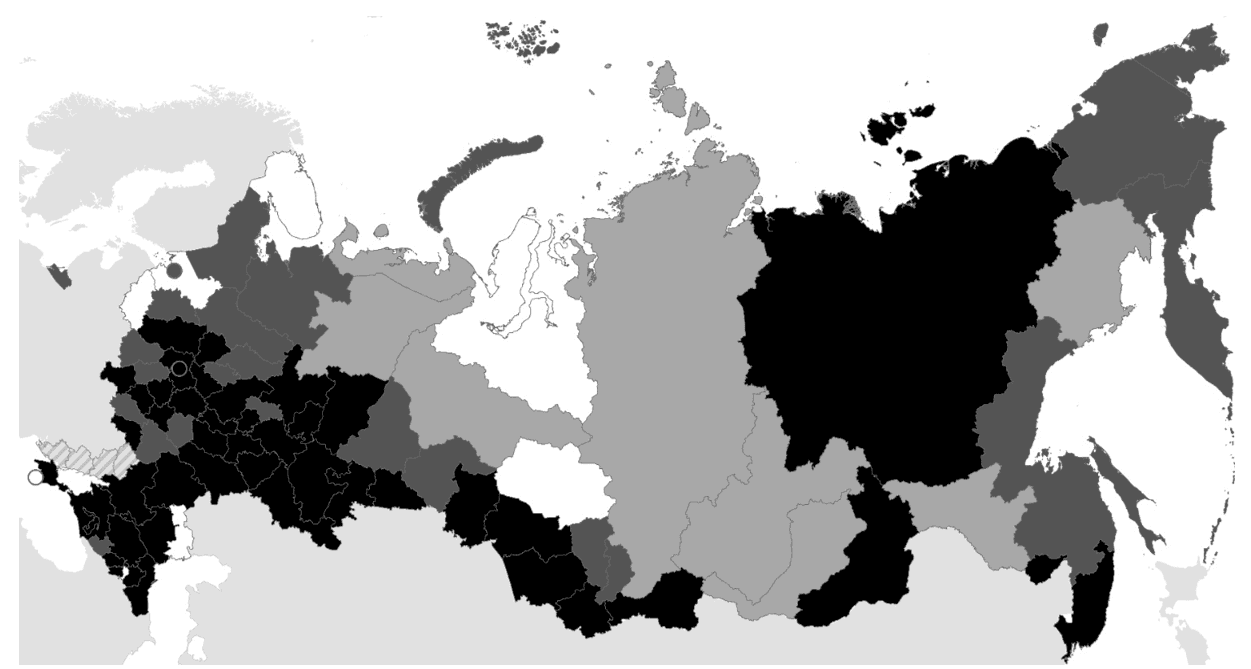
If we construct an integrated index across all the sectors examined, accounting for aggregate dynamics in regional economies, then out of 85 regional economies analyzed, 55 proved relatively resilient to stress (65%), including the largest: Moscow, Tatarstan, Novosibirsk, Rostov, Nizhny Novgorod, and Chelyabinsk oblasts, and Krasnodar and Primorsky krais. Large metropolitan areas, thanks to the size and diversity of their domestic markets, were able to adapt more quickly.
On average across the country, the most stable turned out to be regions with complex economic structures and external connections: Moscow, Tatarstan, Sverdlovsk, and Chelyabinsk oblasts.
Greater shock resistance (resilience) was observed in regions with high entrepreneurial activity, especially in 2023, when small and medium-sized businesses partially filled the market niches left by departing foreign companies 8, for example in Moscow and the Moscow region.
Northwestern regions suffered more severely (Leningrad Oblast, Kaliningrad Oblast, St. Petersburg), which were previously closely tied to the EU, as well as commodity-dependent centers with low diversification (Yamalo-Nenets Autonomous District, Murmansk Oblast).
The "advantage of backwardness" worked in a peculiar way9 for some less developed regions: their low integration into the global economy helped them avoid a sharp downturn. Parallel imports and domestic tourism grew, for example in Kabardino-Balkaria.
Figure – Types of Russian regions by shock resistance in 2022–2023. Note: black color shows regions where the shock resistance index is above 0 in both periods, i.e., economic activity on average did not decline; dark gray color shows regions where the index was below 0 in 2022 but above in the first half of 2023; gray color shows regions where the index was above 0 in 2022 but below in the first half of 2023; white color indicates regions where the index was below zero in both periods.
3. Shock Resistance Factors: What Did the Econometric Analysis Confirm?
To identify patterns within the framework of so-called evidence-based (scientifically grounded) policy, describing the situation and trends is not enough—it's essential to use precise methods that account for the diversity of intersecting factors. Multifactor modeling confirmed several hypotheses:
Hypothesis 1: Regions with close ties to unfriendly countries suffered more during the sanctions shock 10. Supply chain disruptions led to a decline in economic activity. However, by 2023 the negative effect had weakened thanks to the reorientation of flows eastward.
Hypothesis 2: The departure of foreign companies led to a downturn in certain industries (such as automotive manufacturing)11, but simultaneously opened up niches for Russian entrepreneurs. Therefore, the impact has been more positive than negative.
Hypothesis 3: The complex structure of the economy contributed to its resilience, but technologically sophisticated industries suffered from import disruptions during the initial shock period in 2022.
Hypothesis 4: High entrepreneurial activity became a factor in the rapid recovery in 2023 thanks to the expansion of online commerce (marketplaces) combined with the authorization of parallel imports and robust growth in domestic tourism.
Hypothesis 5: Government economic policy aimed at improving the business climate in the regions and increasing investment had a positive effect on resilience. Investment stimulus (budgetary support) from the state played a major role in maintaining economic activity.
In this way, regions with a higher density of business agents, more developed SMEs, and more complex economic structures managed to adapt more quickly to the external shock, compensating for broken production chains through parallel imports and partially replacing foreign owners and investors with Russian ones.
Conclusions and Some Recommendations
Russia managed to leverage its unique geographical advantages as a large, expansive country with relatively developed infrastructure, numerous neighbors, and access to the world's oceans, and restructure its economy by increasing engagement with friendlier and rapidly developing countries. At the same time, the country avoided the mistaken path of greater isolation and reduced diversity, particularly the nationalization of the economy.
Based on the analysis conducted, several recommendations can be proposed for overcoming shocks in the future:
Stimulate economic diversification and external connections of regions, especially those that proved least resilient.
Establish various types of advanced development institutions — agencies with broad authority to support investment and scientific-technological projects.
Expand investment policy measures: develop public-private partnerships, support startups and import substitution, and improve the business climate.
Stimulate entrepreneurial activity: improve business conditions, support cluster initiatives, and promote business education.