How Companies Can Optimize Their Electricity Costs
Rising electricity tariffs in Russia during 2025-2026 demand fresh approaches to energy efficiency. A review of external and internal pricing tools for optimizing industrial enterprises' costs.
7 min read
Share:
This article examines the problem of rising electricity costs for Russian industrial enterprises in 2025–2026. Company expenses are being simultaneously affected by sanctions restrictions, declining demand for domestic products, and a significant increase in fuel and energy tariffs. Under these conditions, improving energy efficiency is becoming one of the key factors in industrial competitiveness.
Traditional energy-saving methods—such as equipment replacement or energy audits—are no longer sufficient. They need to be supplemented with tools that enable management not only of consumption volume but also of electricity costs. To this end, we propose dividing such solutions into four groups: external volume-based—fuel switching and technology changes; internal volume-based—implementation of energy-efficient equipment; external price-based—tariff selection, wholesale market participation, and supplier payment controls; internal price-based—demand management, cogeneration, storage systems, and verification of connection schemes and electricity metering.
Primary attention is devoted to the latter two groups, which have been insufficiently developed in Russian practice until now. The article examines in detail 6 external price management tools and 12 internal ones. Their application enables reduction of electricity expenses not only through decreased consumption but also through more effective management of procurement costs.
Sources (10)
1. Дзюба А.П., Конопелько Д.В. Повышение энергетической эффективности регионального энергоснабжения промышленных территорий на основе систем комбинированного теплоснабжения: монография / А.П. Дзюба, Д.В. Конопелько. – Челябинск: Издательский центр ЮУрГУ, 2024. – 169 с.
2. Шведов Г. В., Васильева Е. Н. Ценозависимое управление нагрузкой и накопители энергии на промышленных предприятиях // «Энергоэксперт» № 1 (87), 2025. С. 34–41.
3. Литвак В. В., Сидоренко Г. И. Энергосбережение и энергоаудит: практическое руководство для промышленных предприятий. — Томск: Изд-во ТПУ, 2022. — 340 с.
4. Дзюба, А.П. Управление спросом на энергоресурсы в глобальном экономическом пространстве: монография / А.П. Дзюба, И.А. Соловьева. – Челябинск: Издательский центр ЮУрГУ, 2021. – 260 с.
6. Башмаков И. А., Мышак А. Д. Российская политика повышения энергоэффективности: результаты и новые вызовы // «Энергосбережение» № 6, 2021. С. 12–19.
7. Воропай Н. И., Стенников В. А., Стенников А. В. Управление спросом на электроэнергию в России: агрегаторы и ценозависимое потребление // «Электрические станции» № 3, 2024. С. 2–9.
8. Короков В. Р., Окороков Р. В. Развитие распределенной генерации и когенерации в России: экономика и регулирование. — М.: Издательский дом МЭИ, 2023. — 280 с.
9. Грибков А. М., Кириллова Н. А. Потери электроэнергии и оптимизация системы учета на промышленном предприятии // «Промышленная энергетика» № 4, 2023. С. 24–30.
Changes in the Russian electricity market are creating new opportunities for improving enterprise efficiency. The proposed classification and toolkit can be used by energy managers at industrial companies when developing energy conservation programs for 2027–2030.
Why electricity is becoming increasingly expensive for industry
Russian industry in 2025–2026 has faced several factors simultaneously that complicate enterprise operations. On top of sanctions restrictions and declining demand for domestic products, there has been a significant increase in fuel and energy prices. In 2025, the average cost of electricity across Russian regions rose by 14%, with further substantial growth expected in 2026.
Electricity prices are influenced by a range of factors. Resources that the power sector itself uses for energy generation are becoming more expensive, primarily coal and natural gas. Transportation costs are rising, including rail and road freight. The cost of repair materials and components is increasing, including products from the metallurgical, machine-building, electrical engineering, and chemical industries. Additionally, enterprises must account for rising personnel wage requirements.
Higher electricity costs directly impact the production costs of industrial goods and service prices in other economic sectors. Therefore, under sanctions pressure, improving energy efficiency is becoming one of the key directions for reducing costs and enhancing the efficiency of the Russian economy.
From energy conservation to cost management
Since 2009, Russia has pursued a large-scale state policy in energy conservation and energy efficiency improvement. Despite notable results, government measures have become less intensive over time. One reason was relatively low energy tariffs, which did not create strong incentives for consumers to reduce their usage. The situation is now changing: rising energy prices make a return to active energy efficiency policy more relevant.
Why is it important to discuss electricity separately? It is a universal energy resource. Its production uses primary fuels—gas, coal, fuel oil, and other resources extracted by fuel and energy complex enterprises. At the same time, electricity can replace many other energy carriers and be used to generate thermal, mechanical, light, and other forms of energy. Therefore, more efficient electricity consumption means not only reduced spending on it but also more rational use of primary fuel and energy resources.
During the first wave of state energy conservation policy—in 2009–2016—the main emphasis was on reducing the quantity of energy resources needed to produce a unit of output or provide a service. To this end, enterprises conducted mandatory energy audits, identified major losses, and developed measures to reduce them. Simultaneously, more energy-efficient equipment was implemented, including energy-saving lamps and consumption regulation systems. Metering of all types of energy resources expanded—hot and cold water, thermal energy, and other resources. Special attention was paid to household consumption and the utilities sector. Enterprises were also required to monitor energy consumption, develop and implement energy-saving measures, and report their results to relevant authorities.
These measures produced notable results. First and foremost, metering coverage expanded significantly, especially among households and utility companies. Most industrial and residential lighting was modernized: less efficient incandescent and mercury vapor lamps were replaced with LED systems equipped with monitoring and control sensors.
That said, the first wave of energy conservation was built primarily on relatively simple solutions. They required modest investment and delivered results quickly.
Today, opportunities for improving energy efficiency have broadened. It's no longer just about consuming less electricity, but also about paying less for it while maintaining the same consumption levels. Procurement costs can be reduced through more effective use of wholesale and retail electricity and capacity market mechanisms, as well as related instruments.
Four approaches to reducing electricity costs
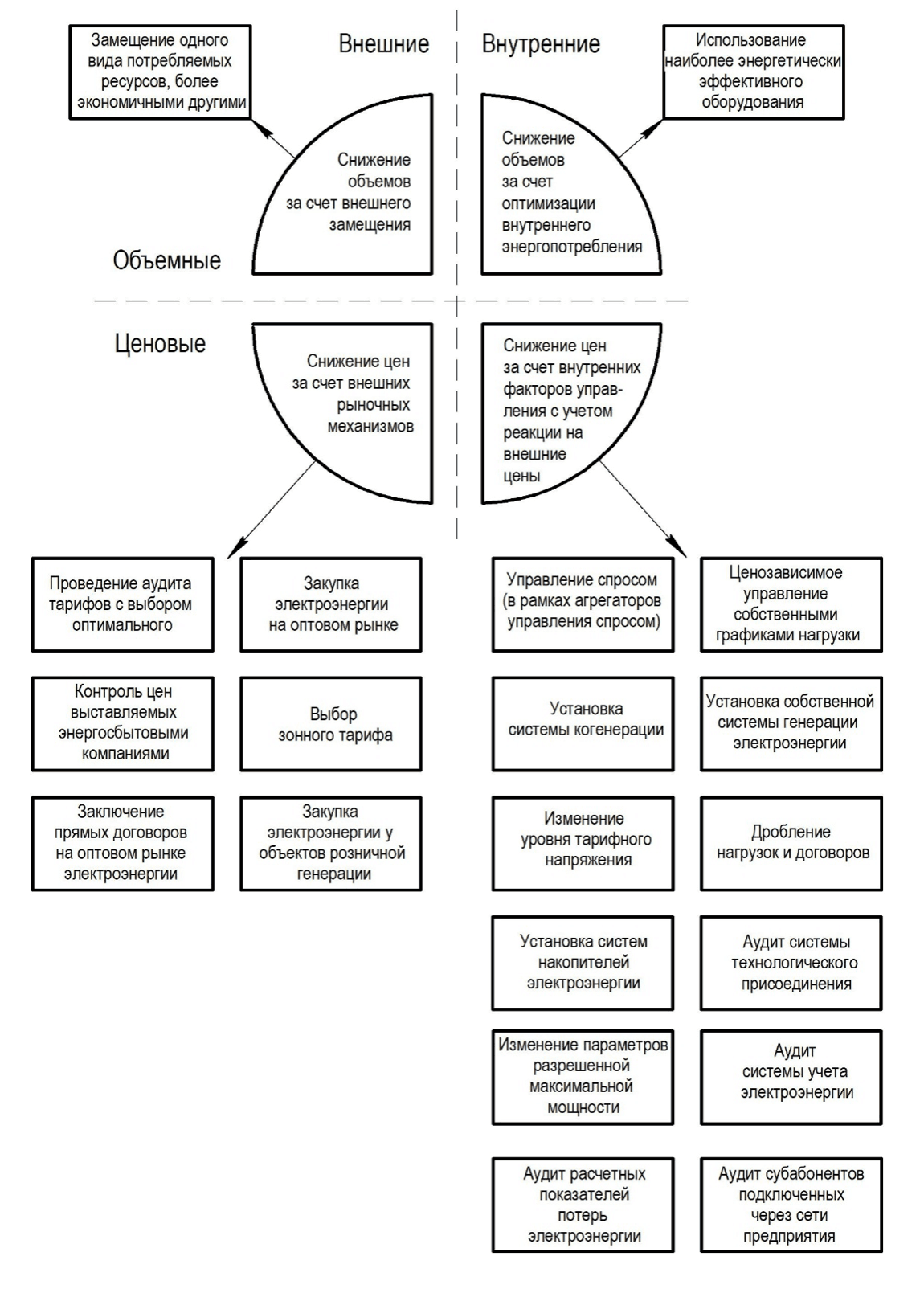
Figure 1 presents the main directions for improving electricity consumption efficiency at Russian enterprises. They can be divided according to two criteria. The first is where the source of potential savings lies: inside the enterprise itself or beyond its boundaries. The second is what drives the result: reducing consumption volume or managing electricity costs.
This yields four categories:
External volume measures — reducing energy costs through changes in energy sources and flows external to the enterprise. For example, one type of fuel may be replaced with another.
Internal volume measures — reducing consumption through changes within the enterprise itself: equipment modernization, operational optimization, and other energy-saving solutions.
External price measures — reducing costs through external pricing and tariff opportunities: selecting the appropriate tariff, electricity procurement terms, and other market mechanisms.
Internal Price Measures — managing consumption within the enterprise based on electricity costs. This includes, for example, demand management, storage systems, and cogeneration.
An example of an external volume measure would be fuel switching. For instance, a coal-fired boiler facility can be converted to natural gas, which in this case improves energy efficiency and reduces environmental impact.
Internal volume measures include classic energy efficiency improvements — primarily the installation of more modern energy-saving equipment. This allows optimization of the enterprise's internal systems and thereby reduces the volume of energy resources consumed.
Figure 1. Directions for improving the efficiency of electricity consumption for Russian enterprises
The other two approaches — external and internal price measures — deserve special attention. These allow energy costs to be viewed not only from the perspective of how much electricity the enterprise consumes, but also from the perspective of how much it pays for it.
Table 1 presents the tools related to external price measures. Analysis of these shows that an enterprise can achieve significant economic benefits through more effective use of external pricing opportunities. The table notes provide approximate estimates of potential savings.
However, such benefits are not available to every consumer. The actual savings potential depends on the specific enterprise and whether it has room to reduce electricity costs.
Table 2 presents tools for improving electricity consumption efficiency that fall under the "internal pricing" category. They enable cost reduction through management of internal energy consumption processes while accounting for external pricing factors. In other words, an enterprise can adjust its consumption patterns depending on electricity costs and thereby tap into available reserves to reduce expenses.
The table notes provide potential economic effects from applying these tools. These are achieved when they are used fully and systematically. The figures cited are based on actual results that the author obtained through practical work.
What's Changing in the Approach to Energy Efficiency
With electricity prices rising steadily and ongoing sanctions risks facing Russian industry, the simple organizational energy-saving measures that were actively applied from 2009 to 2016 are no longer sufficient. Improving efficiency requires a broader approach: it's important not only to reduce consumption volumes but also to manage the cost of electricity.
In certain cases, potential savings can reach 30–50%. The main reserves, however, are tied not so much to replacing equipment or light bulbs as to optimizing tariff loads, auditing metering systems and grid connections, participating in demand management through aggregators, and developing in-house generation and cogeneration.
External pricing tools—including supplier selection and wholesale market participation—allow companies to reduce retail markups and avoid billing errors. Internal pricing mechanisms—such as adjusting contracted capacity, load separation, and using storage systems—give enterprises greater flexibility to adapt to changing market prices.
Between 2027 and 2030, the approach to energy efficiency must evolve. The main focus should shift from purely technical solutions to comprehensive energy management, tariff optimization, and active use of competitive electricity market opportunities.
Article reprint: Dzyuba A.P. Classification of Cost Optimization Strategies for Electricity Consumption by Industrial Enterprises / Tekhnologiya i energetika. 2026. No. 2. pp. 42-48