This text is an automatic translation from Русский. It was generated by AI and may contain inaccuracies.
Read original →The AI Dilemma in the Labor Market: A Perfect Storm Everyone's Calling Calm
Why unemployment sits at 2.3% while businesses cry out about labor shortages. Gen Z is setting the rules. AI is quietly taking jobs. And no one is prepared for what comes next.
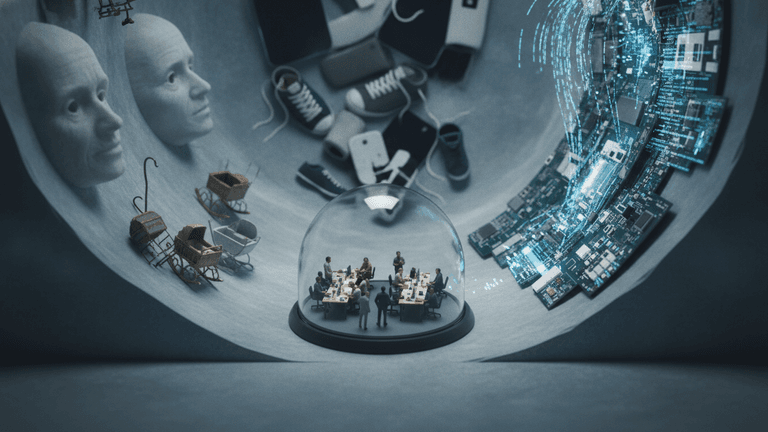
"Unemployment in Russia stands at 2.3%. Sounds like a triumph. Now look beyond the number."
Picture the sea. A smooth surface. No waves, no ripples. Sailors know: perfect calm is not a blessing but a harbinger. There's no wind, the sails hang limp, and you're going nowhere. And somewhere beyond the horizon, a storm is already brewing that will upend everything. This is precisely what's happening now with Russia's labor market. The statistics paint a rosy picture: unemployment has fallen to a record low of 2.3–2.4%, 74.7 million people are employed in the economy, and employers are fighting over every candidate. But dig a little deeper—and the picture falls apart into pieces that don't fit together into a coherent puzzle. Because simultaneous with the labor shortage, quiet, "bloodless" layoffs are underway. Simultaneous with the battle for talent—the replacement of living people with algorithms. Simultaneous with the shortage of workers—an entire generation that doesn't want to work by rules invented before they were born. This isn't a paradox. It's a dilemma. And it has no simple solution.
Numbers That Lie
Unemployment at 2.3% isn't just a statistic, it's a political declaration. The market is healthy, the system works, we're moving in the right direction. But what lies behind this figure?
First, the demographic pit. We're passing through the nadir of the 1990s: the small generation born in the era of collapse now forms the backbone of the workforce. According to Rosstat projections, the number of people employed in the economy could shrink by another 1.4 million in 2026. There are physically few people—hence the "low unemployment." This isn't an achievement, it's arithmetic.
Second, structural fracture. At one pole—couriers, sales consultants, sales managers: here there's an ocean of vacancies and a desert of job seekers. At the other—office professions, HR, project management: here a single vacancy draws 300–400 responses. The market isn't just heterogeneous—it's split in two.
Third, the quiet AI revolutionDemand for HR personnel has plummeted 27%, in manufacturing by 29%, and in raw materials extraction by 31%. These aren't seasonal fluctuations. This is structural transformation, and it's only gaining momentum.
Do you still think 2.3% unemployment is good news?
AI: Not a Robot with Eyes, but an Excel Spreadsheet That Thinks Faster Than You
Forget Hollywood scenarios. Artificial intelligence doesn't show up at the office as a humanoid robot and shut down the accountant's computer. It operates more subtly—and that's precisely what makes it more dangerous.
AI starts with routine tasks: handling calls, sending emails, drafting standard documents, checking reports, screening candidates. Then it takes over analytics. Then forecasting. Then decision-making. And at each stage, someone becomes redundant. Not immediately. Not loudly. Their function simply gets "optimized."
In the first quarter of 2026, the global IT industry laid off 73,200 specialists across 95 companiesThe average scale of cuts per company has grown from 221 people in 2023 to 770 now. Fewer companies—but each cutting deeper. This isn't panic among small players. These are surgical operations by corporations that know exactly which functions are now performed by algorithms.
Here's a paradox worth pondering: 57% of executives responsible for AI investments expect headcount to increase in 2026. Yet those rehired for "automated" positions receive significantly lower salaries. AI isn't so much destroying jobs as devaluing labor.
In Russia, 44–49% of companies already use AI in HR processes, with another 29% planning implementation in 2026. Meanwhile, as economist Dmitry Cherneyko notes, "AI doesn't create human values." We risk falling into a trap: technology that should free people from routine work instead makes people themselves routine—easily replaceable, interchangeable, optional.
Generation Z: Those Impossible to Hire and Impossible to Retain
Now let's add the human factor to the equation—the most unpredictable element of all.
Zoomers—people born between 1997 and 2012—are the first true "digital natives," for whom the smartphone came before their first word. They're flooding into the labor market en masse. And they're dictating terms that make HR directors' eyes twitch.
They don't want to work "for the man". They switch not just jobs but entire fields—easily, without drama, without the "but I spent ten years building this career" hand-wringing. They're dissatisfied with salaries, schedules, authoritarian management and, it seems, the very format of employment itself. 25% of working Russians already work fully or partially from home—six percentage points more than in 2022. And this is largely thanks to zoomers, who ask a simple question: "Why waste three hours commuting when I can solve the problem from bed?"
And here's where the irony emerges, worthy of its own novel. The generation raised in the digital world is romanticizing... 1980s office culture. The office core trend—the aesthetics of "The Wolf of Wall Street," suits, skyscrapers, status symbols—has become the visual identity of the young professional. They don't want to be in the office, but they want to look like they work in an office. Style without substance? Or a new format of self-identification?
For business, this is a catastrophe at the business-model level. Turnover among zoomers is systemic, not incidental. And no amount of corporate fruit baskets, office ping-pong, or Thursday yoga sessions will help. Because the problem isn't the conditions. The problem is that the very concept of "work" means something fundamentally different to this generation.
The perfect storm: three waves at once
So what do we have by mid-2026?
Wave one: demographics. The workforce is physically shrinking. The demographic pit, youth outflow, population aging. A shortage of 1.5 to 3.1 million workers by the end of the decade—and this isn't a scenario, it's a forecast from the Ministry of Labor and the Bank of Russia.
The second wave: technology. AI and automation are reshaping the employment structure. Routine office functions are disappearing, production processes are being robotized. But the new jobs that are supposed to emerge in their place require competencies that most workers don't have—and that no one is teaching them.
The third wave: values. The new generation of workers is rejecting the outdated model of "lifetime employment," linear careers, and corporate loyalty. They're not "lazy." They're different. And a market built for Generation X and millennials simply cannot absorb them.
These three waves don't offset each other. They resonate. And together they create that perfect storm, which for now looks like a calm—because we're looking at the surface, not the depths.
What to do? (The uncomfortable answer)
There is no comfortable answer. But there is a direction.
Stop treating symptoms. Raising salaries doesn't solve the labor shortage problem—it only fuels inflation. Bringing in migrants doesn't close the structural gap. "Training" in the form of two-day workshops doesn't create new competencies. What's needed is a systemic overhaul: from education to regulation of platform employment.
Learn to work with AI, not against it. In 90% of cases, implementing AI in business isn't about replacing humans, but augmenting them. But to be "augmented," you need to understand how the technology works, where its limits are, and what makes humans irreplaceable. AI literacy isn't an elective—it's a basic skill, like reading and arithmetic.
Rebuild HR models for the new reality. 69% of companies plan to invest in employee training. But the investment shouldn't go into "training" as such—it should go into adaptive systems that understand in real time which skills are becoming obsolete, which are emerging, and how to guide workers through transformation without breaking them.
Stop being afraid of Gen Z. Start listening to them. When an entire generation says the work format is outdated, perhaps it's the format that's outdated, not the generation. Flexibility, purpose, autonomy, balance—these aren't whims, they're the evolution of labor relations. Companies that grasp this first will gain a competitive advantage for decades.
Science must move faster than catastrophe
Everything described in this article is not journalistic hyperbole. It's the subject of serious scientific research.
Under Russian Science Foundation grant No. 25-28-01469 "Neural Network Solutions for Managing Social and Labor Relations in the Digital Economy of Megacities," a research team at Peter the Great St. Petersburg Polytechnic University is developing tools that allow us not to guess about the future of the labor market, but to model it. The project Neurolabor Solutions (neurolabor.ru) is a platform of AI tools for assessing competencies, building career trajectories, creating digital twins of experts, and forecasting labor market changes. What's being created is something desperately needed: a bridge between labor science and real business.
What's being done specifically: assessing the risks of riskogenic displacement—situations where AI doesn't simply automate functions but latently degrades the competencies of those nearby. Building a Human Capital Vulnerability Index that shows which professions, industries, and regions are in the highest risk zone. Developing compensatory enhancement mechanisms—a system that doesn't just predict problems but offers concrete adaptation pathways. The research extends beyond Russia's borders: work is underway with partners from China (Harbin Polytechnic Institute, Hainan Normal University), India, Vietnam, and other BRICS+ countries. Because the AI dilemma in the labor market is global. And the solutions must be global too.
Epilogue: before the storm
2.3% unemployment. Talent shortage. AI in every other HR department. Gen Z rewriting the rules. A platform economy worth 239 billion rubles. And a demographic pit we won't climb out of for another twenty years.
This isn't a crisis—crises are loud and obvious. This is transformation—quiet, deep, and irreversible. Those who accept it as reality and start adapting now will ride the crest of the wave. Those who continue staring at the smooth surface, delighting in the calm—will drown.
The choice, as always, is ours. But time to deliberate— has run out.
This research was supported by the Russian Science Foundation (RSF), grant No. 25-28-01469 "Neural Network Solutions for Managing Social and Labor Relations in the Digital Economy of Megacities," Peter the Great St. Petersburg Polytechnic University.