Waste Loses Its Appeal: Why Investment in the Trash Industry Has Plummeted
Investment in the waste industry has dropped from 72.6 billion to 12.6 billion rubles. We examine the reasons behind the decline: high central bank rates, lack of a secondary materials market, and project profitability issues.
8 min read
Share:
Investors Are Pulling Out
Russia's waste management industry is facing a sharp cooling of investor interest. According to analysts at TenderPro, investment in waste processing and disposal projects during the first half of 2026fell nearly sixfold compared to the same period last year—from 72.6 billion to 12.6 billion rubles. At the same time, the number of new projects dropped 68%—from 69 to 22.
In recent years, the government has actively promoted development of a circular economy, investing in the construction of waste sorting and processing facilities, with the industry itself considered key to achieving the country's environmental goals. In practice, however, investor interest has noticeably waned. Private business has become far more cautious about launching new projects, despite continued government support and ambitious plans from authorities.
Against this backdrop, a question arises: are we seeing merely a temporary slowdown after the rapid growth of recent years, or has the industry encountered problems that make waste processing investments less attractive than anticipated just a few years ago?
What Russia's Waste Industry Looks Like Today
Since the waste reform launched in 2019, the industry has changed noticeably. Dozens of modern waste processing facilities have appeared across regions, the regional operator system has been updated, and infrastructure for sorting and recycling has begun taking shape.
Russiagenerates approximately 50 million tons of municipal solid waste annually. Currently, about 56% of this volume undergoes sorting. By 2030, authorities aim to bring that figure to 100%, reduce waste disposal to 50%, and ensure at least 25% of waste enters the secondary cycle.
Yet behind the outward successes, old problems persist. The industry still largely survives on tariffs and government support. Companies derive their main revenue from collection and processing fees paid by residents and businesses. Sales of recyclable materials have yet to become a serious income source for most market participants.
The importance of landfills hasn't changed either. Although sorting volumes are growing, a significant portion of waste is still being sent for burial. The result is that new facilities are being built, but a full-fledged recycling market is developing noticeably slower.
Over the past few years, the industry has become much more modern from a technological standpoint. But the question of how to make recycling an economically viable business without constant government support remains unanswered.
What happened in 2025: peak investment activity
It would be wrong to assess the current investment decline without looking back at last year. For the industry, 2025 turned out to be a record year in terms of new projects and investment volume.
This was largely due to the launch of the national project "Environmental Wellbeing." Regions began more actively building waste sorting facilities, recycling and waste disposal facilities. The Russian Environmental Operator expanded industry financing through preferential loans and green bond issuance. At the same time, the number of concession agreements grew—these remain one of the main mechanisms for attracting private investment.
New projects were launched most actively in Moscow Region, Tatarstan, Krasnodar Territory, Bashkortostan, and Nizhny Novgorod Region. The main funds were directed toward construction of municipal solid waste processing and recycling facilities, as well as waste disposal facilities.
In August 2025, it was reported that the Russian Environmental Operator planned to finance 11 waste recycling facility construction projects in eight regions by year-end. Total financing was estimated at approximately 50 billion rubles. Later, in early 2026, the picture became broader. According to new data, regions plan to commission 87 waste management facilities by the end of 2026. Their total capacity will be around 8.74 million tons for processing and 3.66 million tons for disposal per year. Additionally, the commissioning of 14 waste management infrastructure facilities in 11 Russian regions is already planned for 2026, with total investment exceeding 93 billion rubles.
Part of the current decline is indeed explained by the fact that the largest projects were launched earlier, while new investment decisions are being made much more cautiously.
Why money stopped flowing into the industry
The main reason cited by market participants is expensive money. Due to the high key rate, loans have become noticeably more expensive, while waste projects are almost always built with borrowed funds and require large upfront investments.
One modern waste recycling facility can cost around 10 billion rubles. Under such conditions, the cost of credit directly affects whether a project will "pencil out" economically or not. The situation is complicated by rising construction costs. In recent years, metal, building materials, logistics, and equipment have all become more expensive. Many budgets had to be revised and increased. But it's not just about construction costs. These projects fundamentally take a long time to pay back—often 10–15 years or more. For an investor, this means money is "tied up" for a long time, and many risks accumulate over that period.
A separate problem is tariffs. Companies' revenues depend on regional authorities' decisions, and it's not always possible to quickly compensate for rising expenses through tariff increases.
Equipment adds another layer of complexity. After some foreign suppliers left the market, companies had to rebuild supply chains, find alternative equipment, and set up service networks from scratch. This has also driven up project timelines and costs.
Legislative changes and new requirements
In recent years, the government has significantly tightened regulation in waste management and the circular economy. One key area is the overhaul of the extended producer responsibility system. The idea is that companies producing goods and packaging must either organize their disposal themselves or pay an environmental fee.
At the same time, new requirements for using recycled materials are being introduced, support measures for recyclers are emerging, and industry funding through the Russian Environmental Operator is becoming more systematic. Yet the targets remain quite ambitious. By 2030, the plan is to achieve 100% waste sorting and substantially increase recycling rates. But the main question remains unresolved: can this entire system create a sustainable secondary materials market that functions on its own, without constant budget support?
The main problem: who will buy the recycled materials?
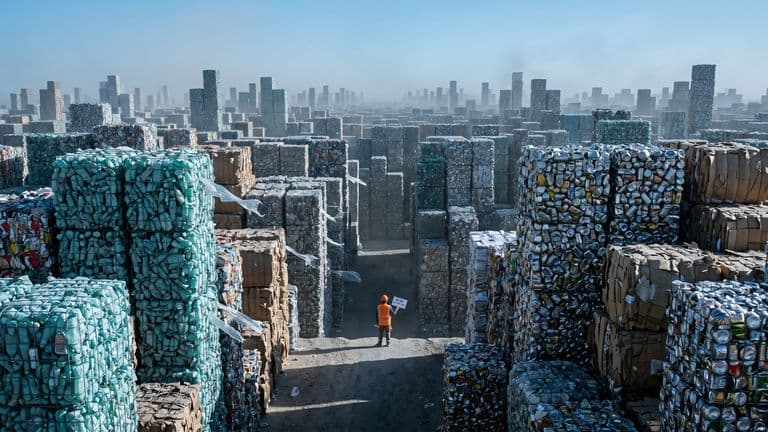
Many point to this as the key issue for understanding the industry's problems. Waste sorting has grown noticeably in recent years, capacity is coming online, but demand for secondary materials isn't keeping pace. As a result, recyclers often face a situation where sorting material is easier than selling it afterward.
This is especially evident with plastics, waste paper, and certain packaging. Often virgin materials end up cheaper than recycled ones. So manufacturers find it simpler and more profitable to work with virgin materials. The situation is made worse by the fact that many sectors have no mandatory requirements to use recycled materials. As long as this remains at businesses' discretion, stable market demand won't materialize.
The result is an imbalance: recycling capacity is growing faster than the sales market is forming. Against this backdrop, investors are questioning whether the industry can generate stable long-term returns.
The price of falling behind: environmental and economic risks
If the investment decline drags on, the consequences will extend far beyond the industry itself. On the environmental side, the main risk is clear: existing landfills may simply be unable to handle the load. If new recycling capacity isn't brought online on schedule, most waste will continue going to landfills. This will make it harder for the country to meet its stated environmental goals.
There's also an economic dimension. Tens of billions of rubles have already been invested in the industry in recent years. If the facilities built operate below capacity, the return on these investments will fall short of expectations.
At the same time, private sector interest may wane. If the market becomes established as low-margin and heavily dependent on government support, attracting new investors will become more difficult.
We shouldn't forget about the social consequences either. A shortage of modern facilities typically leads to conflicts over new landfills and processing plants. Such stories have already repeated themselves in the regions more than once.
The most famous example remains the story of Shies station in Arkhangelsk Oblast. From 2018 to 2021, protests continued there against the construction of a large landfill for waste disposal, including waste that was planned to be transported from Moscow. During this time, dozens of rallies and pickets took place, a permanent tent camp of activists was organized, and the issue itself reached the federal level.
In January 2020, the Arbitration Court of Arkhangelsk Oblast ruled that some of the structures at Shies station were illegal. In the fall of that same year, the appellate court upheld this decision. After that, the project was effectively halted, and in January 2021, the "Clean Urdoma" movement announced the end of the protest campaign, which had lasted more than two years.
The Shies story showed that problems with developing modern waste management infrastructure can escalate from an environmental issue into a serious social conflict. That's why the question of building processing facilities today is connected not only with meeting environmental targets, but also with public stability in the regions.
Is the industry really in decline?
Despite weak statistics, many market participants aren't rushing to call the situation a crisis. In this industry, it's important to account for the long project cycle. From concept to facility launch often takes three years or more. So a drop in investment in a particular year doesn't always mean construction has stopped.
There's another factor: large projects can "distort" the statistics. A single complex worth 10–15 billion rubles can sharply raise or, conversely, drag down the total investment volume for the year. Meanwhile, development continues. New facilities are being commissioned in 2026, previously launched concessions are operating, and REO continues to finance infrastructure.
So the current decline looks less like a crisis and more like a normal pause after a period of active growth.
What comes next
The industry's future largely depends on the overall economic situation and whether the government can build a functioning secondary raw materials market. If credit becomes cheaper, some projects will become attractive to investors again. Additional impact could come from expanded support through REO and public-private partnership mechanisms.
But that's not even the key question. What matters more is whether stable demand for secondary raw materials will emerge. If mandatory use becomes more active, recycling will become more economically sustainable. For now, though, the system remains fragile. And with the current market structure, meeting the 2030 targets will be harder than it looked a few years ago.
Ultimately, the problem is no longer about building new sorting capacity. The main thing is creating a functioning secondary raw materials market where it has a clear price and guaranteed demand. Without this, even with government support, the influx of private investment will be limited.