This text is an automatic translation from Русский. It was generated by AI and may contain inaccuracies.
Read original →The Parking Equation That Doesn't Add Up
The Ministry of Transport has expanded parking benefits for large families to cover two vehicles. How a growing fleet of 47.45 million cars is creating a parking shortage in Russian cities—and why redistribution won't solve the problem.
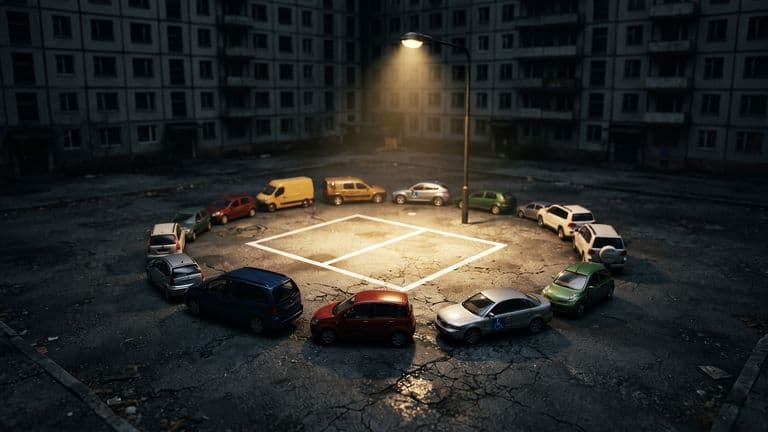
A Benefit as a Pretext: Expanding Free Parking for Large Families
Russia's Ministry of Transport has decided to expand the free parking benefit for large families—it can now apply to two vehicles instead of one. This applies to families with four or more children.
At first glance, this is a minor change affecting relatively few people. But it actually raises a broader question—how cities allocate limited parking space, and whether it's possible to support social benefits while avoiding system overload.
In recent years, Russia's parking policy has evolved in two directions. On one hand, more and more zones are becoming paid. On the other, benefits for certain categories of residents are expanding. The result is that available spaces aren't increasing, while the distribution system is becoming more complex and strained.
The Scale of Motorization: The Fleet Is Growing Faster Than Infrastructure
According to Autostat Info, as of January 1, 2026, Russia had registered 47.45 million passenger cars. Over six months, the fleet grew by 1.33 million vehicles—roughly a 2.9% increase.
Looking at the overall trend, growth continues at a fairly rapid pace. Russia remains one of the countries with the largest number of cars in Europe in absolute terms. In major cities, this is already quite visible: cars are multiplying faster than urban infrastructure can absorb them.
For comparison, the vehicle fleet was noticeably smaller in the early 2010s. In 2010, the country had around 34 million passenger cars. By 2015, that figure reached approximately 40 million, and by 2020 it exceeded 45 million.
In other words, over 10 to 15 years, more than 10 million cars were added. What's more, the bulk of this growth occurred in recent years, when the number of vehicles increased faster than the development of roads and parking infrastructure.
As a result, the gap has become systemic: there are more cars than the city can physically accommodate. The situation is further complicated by the fact that around 68% of the vehicle fleet is over 10 years old. Many of these cars sit idle for longer periods and often occupy parking spaces unnecessarily.
Yet there are no unified statistics on the number of parking spaces in Russia. The data is scattered across cities, regions, and private operators, and no one consolidates it in a single format. But the common problem in major cities is the same: there are more cars than legal parking spaces.
In Moscow, according to city services estimates, more than 10% of parking capacity is allocated to preferential spaces, including disabled parking. This means that a portion of spaces is unavailable for general use from the outset and doesn't participate in the "free" circulation.
At the same time, a significant portion of vehicles aren't parked in organized lots at all. Cars are left in courtyards, along roads, in makeshift spots. The result is a situation where parking technically exists, but in reality it's either occupied or not located where people actually need it.
In city centers, paid parking partially alleviates the situation. At least there are clear rules and oversight, and cars don't sit unmoved for months. In Moscow, the paid parking system has been operating since 2012 and has expanded significantly since then—from the center to more outlying districts. Currently, the city has more than 130,000paid parking spaces. Occupancy rates in central districts hold at around 80–85% — this is considered a normal level, when spaces are still in circulation, but they're consistently occupied and turn over quickly.
But this system has a flip side. The center becomes freer and more orderly, but some cars simply migrate to neighboring districts. And where paid zones are fewer or nonexistent, the burden on courtyards and streets becomes even heavier.
Disabled parking and towing: strict rules and uneven enforcement
Parking spaces for people with disabilities are among the most strictly regulated areas in the city. In Moscow, tens of thousands of vehicles are towed each year for improper parking in these spaces. In 2025 — more than 27 thousand, the year before — around 32 thousand.
The fine for this violation is 5 thousand rubles, and it's almost always accompanied by towing. But even with such measures, violations continue. This shows that the problem isn't just about enforcement, but also the overall shortage of parking spaces.
The system operates through cameras and patrols and generally compels drivers to follow the rules. However, it doesn't work uniformly everywhere. In the city center, enforcement is noticeably stricter than in residential districts, where inspections happen less frequently.
This creates an imbalance: formally the rules are uniform, but in practice the risk of getting fined depends heavily on exactly where the car is left.
Distributing scarcity instead of solving the problem
Looking at the situation as a whole, parking in cities today is allocated not by fairness or actual need, but according to a principle of constant scarcity. First, some spaces go to paid parking, then exemptions are carved out from that same pool, then prohibitions and zones where you can't leave cars at all are added. In the end, the total number of spaces doesn't grow — they're simply redistributed.
Benefits, including support for large families, also come from this same "common pot." And we're not talking about a small group: according to 2026 data, Russia has nearly 3 million large families, and some of them use two cars—roughly one in five families owns two vehicles. Against the backdrop of an overall parking shortage, even these numbers start to matter, because there's almost no spare capacity left in the system.
So cities find themselves in a situation where they have to solve two problems simultaneously: maintain social support measures while keeping the system from overloading. And in practice, this is almost always a conflict—without increasing the number of parking spaces, it's impossible to reconcile the two.
But the problem is that you can't rapidly expand parking capacity. In dense urban development, it's expensive, time-consuming, and often there's simply nowhere to build new parking facilities. So the system ends up working not as development, but as constant redistribution of a limited number of spaces among different groups of people.