This text is an automatic translation from Русский. It was generated by AI and may contain inaccuracies.
Read original →Soaring Gas Prices in the US — Are Russian Export Restrictions Really to Blame?
An analysis of what's driving US diesel prices to their highest levels since January 2025. The role of sanctions against Russia, geopolitical risks surrounding Venezuela and Nigeria, dependence on oil imports, and the political risks for Trump.

Not Just Russia — Trump's Geopolitics and Provocation
Last week, Bloomberg reported that diesel fuel prices at U.S. gas stations had risen to their highest level since January 2025 ($3.868 per gallon). The agency attributes the fuel price increase to restrictions on Russian diesel exports, Ukrainian drone strikes on Russian refineries, and sanctions against Rosneft, LUKOIL, and their subsidiaries. However, the situation is far more complex and tied to broader nervousness in the oil market. And beyond Russia, there are numerous other factors at play. In a conversation with Argument Media, this point is emphasized by Igor Yushkov, lead analyst at the National Energy Security Fund and expert at the Financial University under the Government of the Russian Federation.Igor YushkovAccording to him, there is a direct correlation in the U.S. between oil prices on the global market and diesel or gasoline prices on the domestic market.
"When oil prices fall on the global market, their fuel costs decline, and vice versa. That's why their historic record for fuel prices was in June 2022, during the first wave of sanctions against Russia".
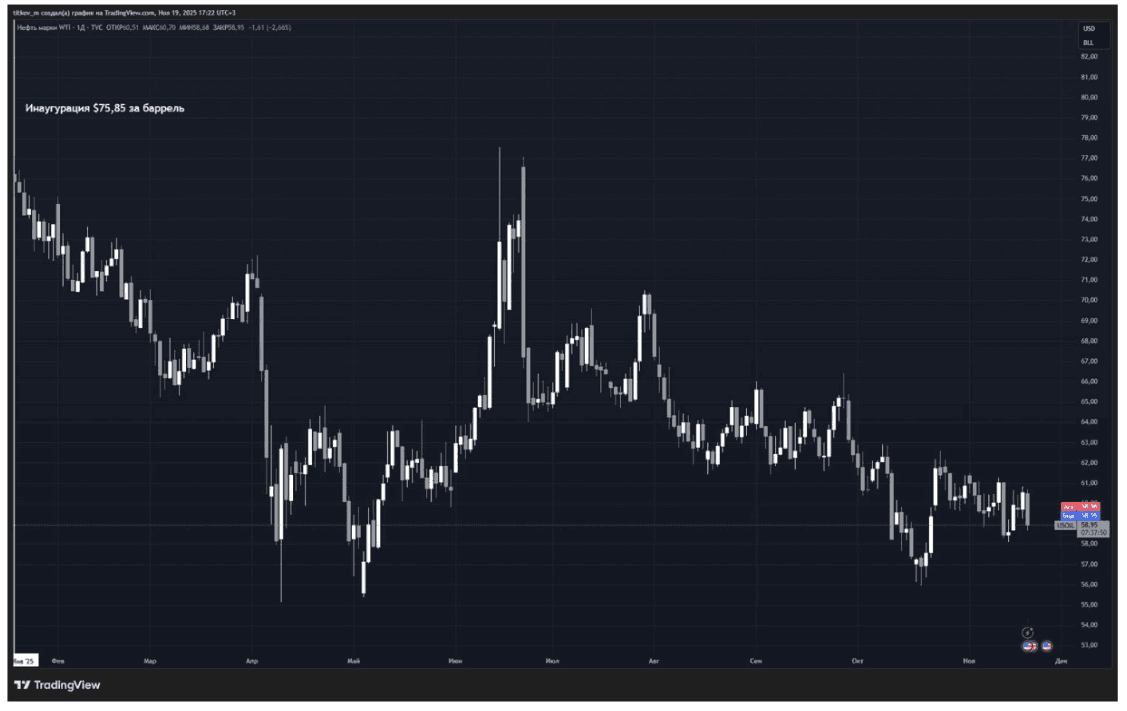
Oil today is significantly cheaper than when Donald Trump took office in January—American WTI crude was trading at $75.85 per barrel, while prices have now fallen to $58.95.
The U.S. is simultaneously one of the world's largest oil importers and exporters. In 2024, the States exported approximately 4.1 million barrels of oil, predominantly light grades. This oil has a higher-quality composition, is used in petrochemicals, and is consequently more expensive than heavier grades used for fuel production. At the same time, in 2024 the U.S. imported about 8.4 million barrels of oil and petroleum products per day, primarily for processing at refineries adapted for gasoline and diesel production. Imports include heavy crude from Canada, Mexico, Saudi Arabia, Nigeria, Venezuela, and other countries.
So right now, the key drivers of price increases are potential geopolitical conflicts with suppliers of heavy crude oil, which is precisely what diesel fuel is synthesized from. In recent months, Donald Trump has made several statements about major oil suppliers to the global market.
In particular, in early November the U.S. president raised the possibility of deploying troops and conducting airstrikes against Nigeria over "killings of Christians," and earlier the country was added to the list of nations "of particular concern." Nigeria is currently a member of OPEC+ and ranks among the top 10 leaders in the global oil market in 2025, exporting approximately 1.4–1.7 million barrels per day.
An even greater threat to the market comes from the escalating situation around Venezuela: roughly 15,000 American troops, seven warships, and an aircraft carrier are currently deployed around the country. Trump accuses Venezuela of aiding drug cartels, threatens military action, and vows to overthrow the current president, Nicolás Maduro. Venezuela exports about 700,000 barrels per day and is also an OPEC member.
Potential conflicts and disruptions in oil supplies are now being "priced into" fuel costs. Igor Yushkov confirms this:
"The market is nervous. Every time the price of oil jumps, gasoline and diesel will get more expensive in the U.S. Unlike Russia, the U.S. has a clear correlation between oil prices and petroleum product prices in the domestic market. So if the U.S. launches some kind of military operation in Venezuela now, or if they cut their exports, that will of course push prices up again".
The Price of Sanctions — Why the U.S. Isn't Interested in Imposing Sanctions Against Russia
Dependence on imported oil amplifies fuel price increases in the domestic American market. The U.S. government has no interest in seeing the global oil market experience shocks (since that would affect their imports too)—they'd rather simply lower prices. That's why supplies from Russia weren't banned completely (and the latest sanctions are targeted, against Lukoil and Rosneft), but were merely restricted by a price cap of $60 per barrel (the European Commission lowered its cap to $47.6 per barrel). Igor Yushkov confirms this, emphasizing that the fuel issue in the U.S. is politicized and could pose a threat to the Trump administration personally:
"If you really throw a wrench in Russia's works and prevent it from exporting, that will lead to a supply shortage in the market, which means—to a significant price increase. And if prices rise, that means fuel in the U.S. will become more expensive. There's also this particular dynamic where voters immediately start blaming the current administration. Ultimately, this would inflict political damage on Trump personally. That's why the U.S. is imposing sanctions that don't affect the overall volume of Russian oil exports".