This text is an automatic translation from Русский. It was generated by AI and may contain inaccuracies.
Read original →This text is an automatic translation from Русский. It was generated by AI and may contain inaccuracies.
Read original →88,000 elevators must be replaced in Russia by 2030. The industry has achieved 80% localization, but replacement costs have doubled, and a specialist shortage is hindering modernization. An analysis of the elevator fleet's condition and upgrade prospects.
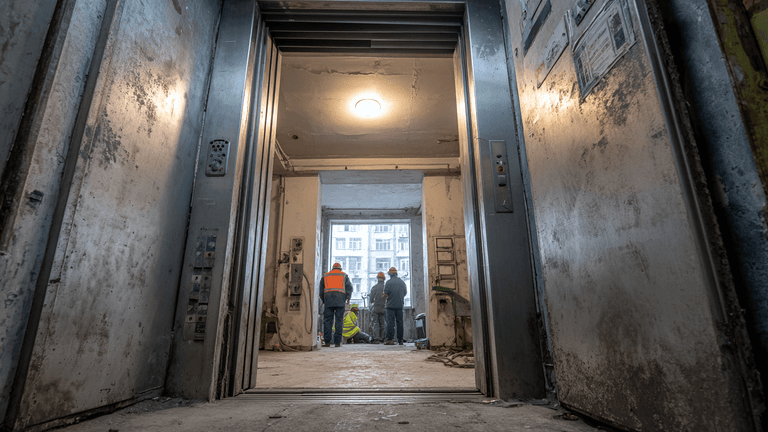
According to the PPK Fund for Territory Development, 632,000 elevators are installed in apartment buildings. By 2030, 88,000 elevators must be replaced—14% of the total. Of these, regional operators plan to replace 47,800, while 40,200 will be replaced through special accounts.
The Fund's press service explains:
"Elevator replacement in apartment buildings is carried out within the framework of regional capital repair programs. To date, all 79 regions with outdated elevators in apartment buildings have approved five-year replacement plans. These plans contain information on the number of elevators and funding sources for their replacement, including elevators in apartment buildings with special accounts."
In 2025, more than 18,550 elevators were replaced—higher than in previous years. The main funding source is homeowners' capital repair contributions (80%), with another 20% coming from budget support, including through the mechanism of writing off budget loans.
According to the Fund, the share of elevators requiring replacement decreases annually. However, the scale of accumulated wear remains significant.
The elevator industry was traditionally considered dependent on foreign technologies. However, in recent years, Russia's production base has strengthened substantially.
As noted by the head of the Russian Elevator Association (RLO) Pyotr Kharlamov: about 30 manufacturers operate in the country: 10 large ones, around 15 medium-sized producers, and 5 in the small segment.
"We are one of the industries that has advanced the most and can achieve up to 80% import substitution in production."
In conversation with Argument Media, Pyotr Kharlamov said that despite the high level of localization, the industry still maintains dependence on imports for several technologically complex components. This primarily concerns frequency converters, which ensure smooth cabin movement and door operation, as well as certain types of winches—especially gearless systems, which still require further import substitution. Additionally, bottlenecks remain even in basic components: for example, bearings for elevator equipment continue to be supplied from abroad.
Alexey Zakharov, First Vice President of the National Elevator Union, adds:
"The most critical items are high-speed elevators with speeds above 4 m/s and lifting heights above 100 m. Domestic models have just completed certification tests and are preparing to enter serial production."
Thus, the industry remains vulnerable in the electronics and complex drive systems segment.

Manufacturers in Russia and Belarus currently supply the market with about 35,000–36,000 elevators per year and are operating at 60–70% capacity. With sufficient solvent demand, output could be increased to 60,000 elevators annually. However, accelerated replacement runs into financial constraints and labor shortages.
As Alexey Zakharov notes:
"The main driver of accelerated replacement is the availability of financing for elevator replacement and access to credit to provide working capital for manufacturers."
Pyotr Kharlamov emphasizes that the industry has developed an accelerated replacement mechanism with installment payments over 3–5 years for buildings with insufficient savings. However, the high refinancing rate—even after reduction from 21% to 15.5%—complicates the implementation of such projects.
A separate pressure factor for the industry remains tax administration and growing tax burden. According to the expert, whereas previously tax payments were distributed more evenly throughout the contract execution period, companies now face the need to remit significant amounts immediately, which exacerbates cash flow gaps. Additional burden is created by increases in certain taxes, including VAT.
In conditions where elevator replacement projects are often implemented with installment payments over several years, such requirements for lump-sum tax payments complicate financial planning and increase the cost of work.
Additionally, there is an acute shortage of installers and elevator equipment maintenance specialists—without them, even funded replacement and modernization projects cannot be implemented. This problem is not unique to elevators, but reflects a broader shortage of skilled workers in housing and utilities and related sectors.
"All this, though tertiary, cumulatively leads to some projects now being delayed in execution," summarizes the RLO head.
Since 2020, the production and replacement costs for elevator equipment have risen noticeably. The price increase has affected both the cabins and mechanical components themselves, as well as installation work, without which elevator fleet renewal is impossible.
Alexey Zakharov told Argument Media that under capital repair programs, the cost of the complete work package has nearly doubled:
"If we look at the cost of replacing standard elevators under capital repair programs—the full package of work in 2020 started from 2 million rubles, in 2025 the average price is 3.8 million rubles."
Pyotr Kharlamov emphasizes that the increase in elevator replacement costs has been even sharper: by his estimate, over the past five years the price has more than doubled—from 1.5 million rubles to over 4 million.
Several factors have influenced the price increase: more expensive metal and components, pandemic consequences, logistics restructuring, increased tax burden, and high cost of credit resources. Meanwhile, today's total replacement price consists roughly equally of the equipment cost itself and the cost of dismantling and installation work, making the modernization process especially sensitive to labor shortages and rising costs in the construction sector.
A separate issue remains the practice of extending elevator service life, which is applied in conditions where replacement is postponed due to lack of funds or organizational constraints. Formally, such decisions are made after technical inspection and when safety requirements are met.
Notably, elevators that had completed their normative 25-year service life were initially supposed to be replaced or modernized by February 2025, but the Council of the Eurasian Economic Commission extended this deadline to February 2030. This decision effectively provides additional time for fleet renewal, but simultaneously underscores that extended operation is becoming a forced measure.
In fact, this is about deferring infrastructure debt: wear does not disappear but accumulates, increasing maintenance and control requirements. With continued labor shortages and rising work costs, the risk is that service life extension may become not a temporary exception but an established practice, cementing modernization lag.
The main question for the coming years is whether the financial and organizational system of capital repair can ensure fulfillment of approved plans in the necessary volumes. In this sense, elevator facilities are becoming one of the key indicators of how successfully urban infrastructure renewal will proceed in Russia.