Route Unavailable: Which Straits Control the Global Oil Trade?
An analysis of key maritime chokepoints in the global oil trade in 2026. How the closure of the Strait of Hormuz, the blockade of Bab el-Mandeb, and Panama Canal disruptions are affecting prices and logistics. Data on volumes, insurance premiums, and alternative routes.
16 min read
Share:
On July 29, a drone damaged two LNG carriers in an Egyptian port at the Mediterranean exit of the Suez Canal. No one claimed responsibility, but the strike hit the only route that had remained a safe bypass around the closed Strait of Hormuz for the past five months. And maritime "chokepoints" are becoming the main threats to global trade.
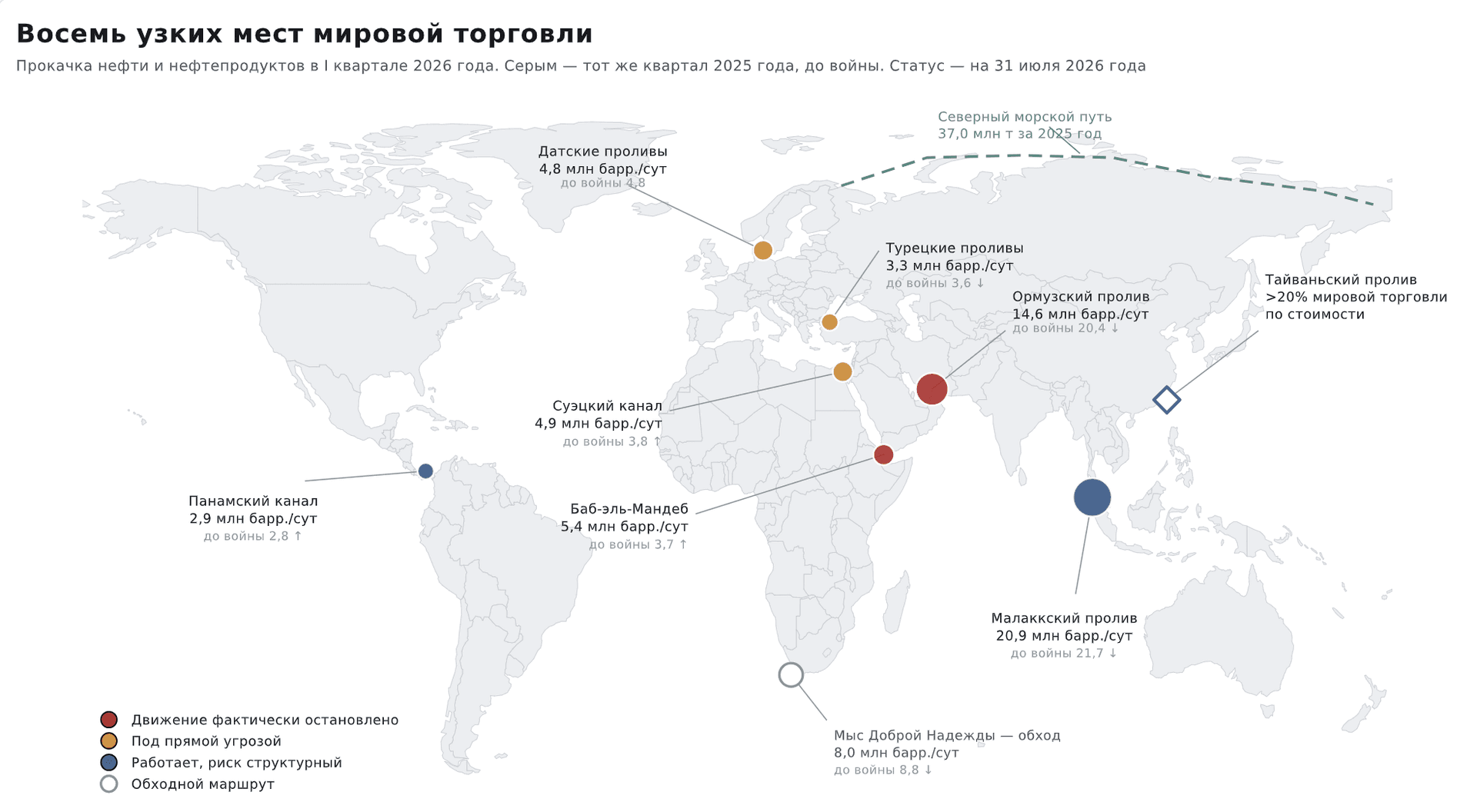
Sources: EIA, Global Energy Security Data (May 13, 2026); Ministry of Transport of the Russian Federation
By the end of July 2026, of the eight nodes that underpin seaborne oil trade, three are operating with disruptions. Hormuz has been closed by war since February 28, Bab el-Mandeb by the Houthi blockade since July 20, and Panama has never returned to its previous rhythm due to water shortages. Modern trade has never experienced the simultaneous failure of three chokepoints.
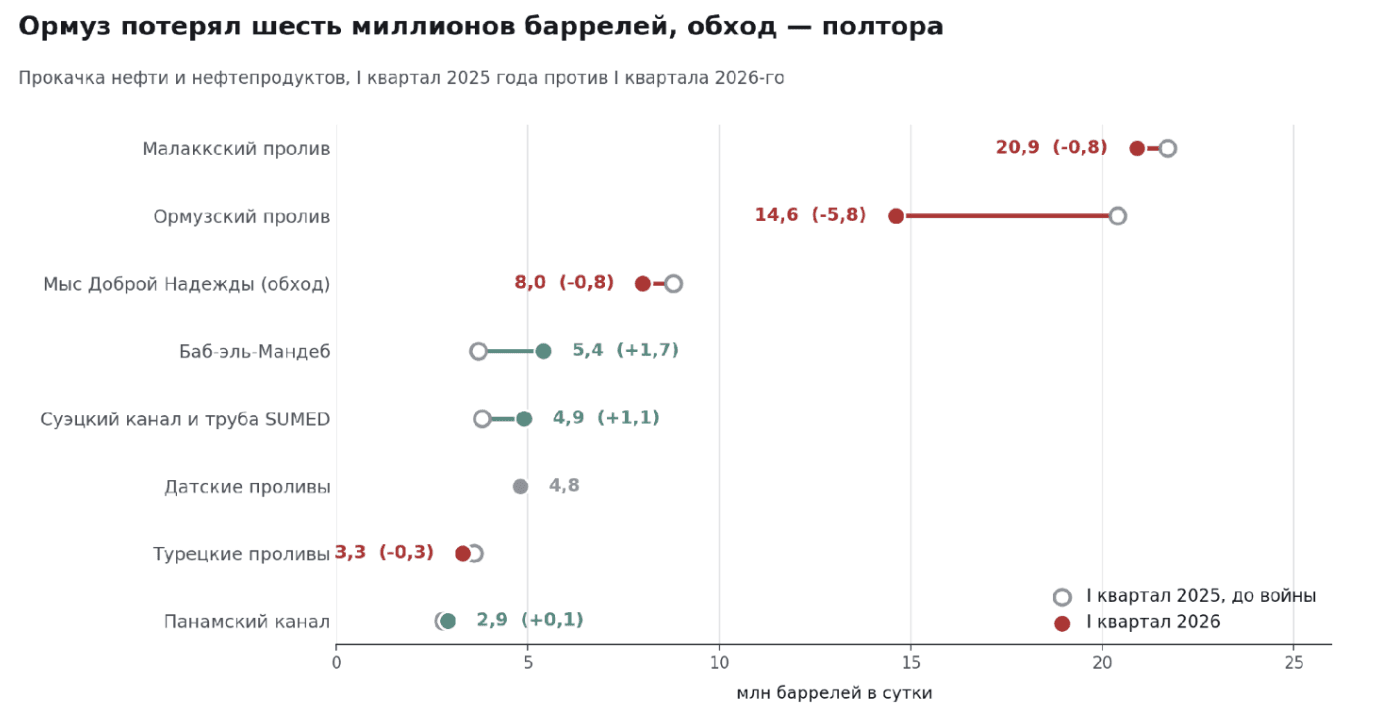
The scale is easier to see in figures from the U.S. Energy Information Administration (EIA). In the first quarter of 2026, 14.6 million b/d passed through Hormuz versus 20.4 million in the same quarter a year earlier. The Strait of Malacca, which lives on transit of the same Middle Eastern oil further east, dropped from 21.7 to 20.9 million b/d. Liquefied gas flows through Hormuz fell from 11.7 to 7.3 billion cubic feet per day—a fifth of the global LNG market.
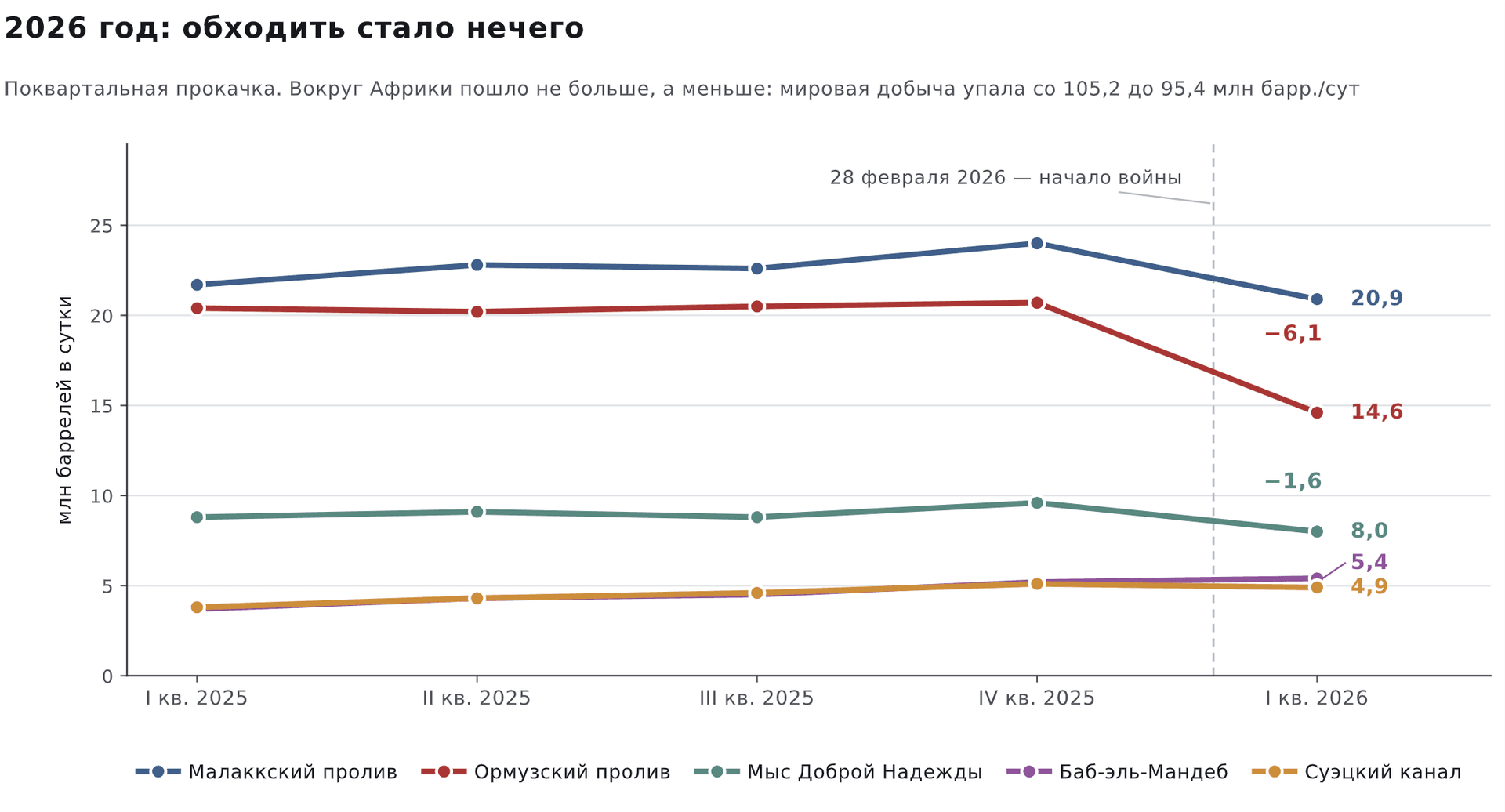
Then things get unpleasant. Nearly every node has a bypass, but bypasses are always longer and more expensive: closing Suez and SUMED adds about 15 days to a tanker's journey from the Arabian Sea to Europe around Africa. Well, the bypass also shrank in 2026. Through the Cape of Good Hope in the first quarter, 8.0 million b/d flowed versus 8.8 million a year earlier. There was nothing to reroute: Gulf countries halted production, and global oil supply fell from 105.2 million b/d to 95.4 million.
About 80% of global trade goods travel by sea, and nearly all of this flow is pushed through a dozen passages, each of which can be physically blocked. What follows is a breakdown of each node: how much passes through it, who depends on it, and what would have to happen for it to shut down.
Sources: EIA, Global Energy Security Data, May 13, 2026
12% of global trade and not a single way to protect it
Suez is the only major node that profited from this war. In the first quarter of 2026, 4.9 million b/d flowed through the canal and SUMED pipeline versus 3.8 million a year earlier—nearly a third more. LNG carriers returned, which the Red Sea hadn't seen since 2023: LNG transit grew from 0.9 to 1.8 billion cubic feet per day. Egypt recouped its losses precisely when Hormuz shut down.
Hence the cost of the July drone strike on LNG carriers near Suez. Flows through SUMED increased to 28.79 million barrels in July versus 19.52 million in April, around 30 vessels accumulated at the anchorage off Port Said at the Mediterranean end of the canal instead of the usual 20. The drone strike in Damietta didn't hit a random point—it targeted a route that had absorbed traffic diverted from two other chokepoints this year.
In calmer years, approximately 12% of global trade and roughly 1.5 billion tons of cargo passed through Suez. The peak came in 2023: 26,000 vessel transits, averaging 72 ships per day, with Egypt earning a record $10.25 billion. The canal ranks among the country's four main sources of foreign currency alongside remittances from emigrants, tourism, and gas exports. The SUMED pipeline, with a capacity of 2.5 million barrels per day, pumps oil from Ain Sokhna on the Red Sea to Sidi Kerir on the Mediterranean and serves as the only way to deliver crude to the Mediterranean for tankers too large to fit through the canal itself.
Suez has been closed before, and for longer than a week. After the Six-Day War in 1967, the canal remained shut for eight years, only reopening in 1975. A more recent episode: in March 2021, the container ship Ever Given blocked the canal for six days. Hundreds of vessels queued at both entrances, with Lloyd's List estimating the value of halted traffic at approximately $9.6 billion per day.
Houthi attacks since November 2023 produced an effect comparable to closure, even though the canal technically remained open. Vessel transits collapsed from 26,000 in 2023 to 13,000 in 2024 and 12,700 in 2025. Revenue plunged from $10.25 billion to $3.9 billion, while in 2025 it only recovered to $4.2 billion. According to Egypt's president, cumulative losses from October 2023 through March 2026 totaled approximately $10 billion. In July, the government raised domestic fuel prices by an average of 17%, citing geopolitics and the closure of Hormuz as the reason.
The hardest hit are not the global shipping companies, but the coastal economies. Djibouti and Sudan depend on Suez for roughly a third of their foreign trade, and they have no alternative route whatsoever. For them, the canal's closure doesn't mean more expensive logistics—it means no logistics at all.
Hormuz has bypass pipelines for a quarter of the volume
On July 21, ten vessels passed through the Strait of Hormuz ten vessels. Not per hour, but per day: before the war there were around 130. In the first quarter, throughput fell to 14.6 million b/d from 20.4 million in the same quarter of 2025, with crude oil dropping more sharply than products, from 14.3 to 10.7 million.
The closure wasn't continuous, however, which explains much about prices. From May 18, ceasefire negotiations pushed Brent down by more than a dollar per barrel daily. On June 17, the U.S. and Iran signed a memorandum on resuming navigation, and by June 26 a barrel stood at $72 versus the $118 it had been on April 29. During three weeks of relatively free passage from the Gulf, more than 200 million barrels managed to exit, giving the market a temporary surplus. In July, strikes resumed and the strait closed again. The swing is easy to calculate: average daily fluctuations in Brent during April and May came to $4 per barrel versus $1 in the same months of 2025.
The Strait of Hormuz is the only maritime outlet for Saudi Arabia, Iraq, the UAE, Kuwait, and Iran. In peacetime, roughly 20% of global oil consumption passed through it, a quarter of all seaborne oil trade, and more than 20% of the global LNG market. The geography of buyers explains why the war in the Gulf is primarily an Asian crisis. Some 89% of oil and condensate from Hormuz went to Asia, with China, India, Japan, and South Korea together accounting for 74% of total flows. The United States imported just 0.4 million b/d through the strait—about 2% of its own liquid hydrocarbon consumption.
Hormuz can be bypassed, but not entirely. Saudi Aramco's East-West pipeline and the Abu Dhabi pipeline together provide roughly 4.7 million b/d. The UAE plans to add another 1.5 million b/d by 2027 from the Jebel Dhanna terminal to Fujairah. Iran's Goreh-Jask pipeline operates at around 0.3 million b/d. Even in the most favorable scenario, this amounts to about a quarter of what moves by sea.
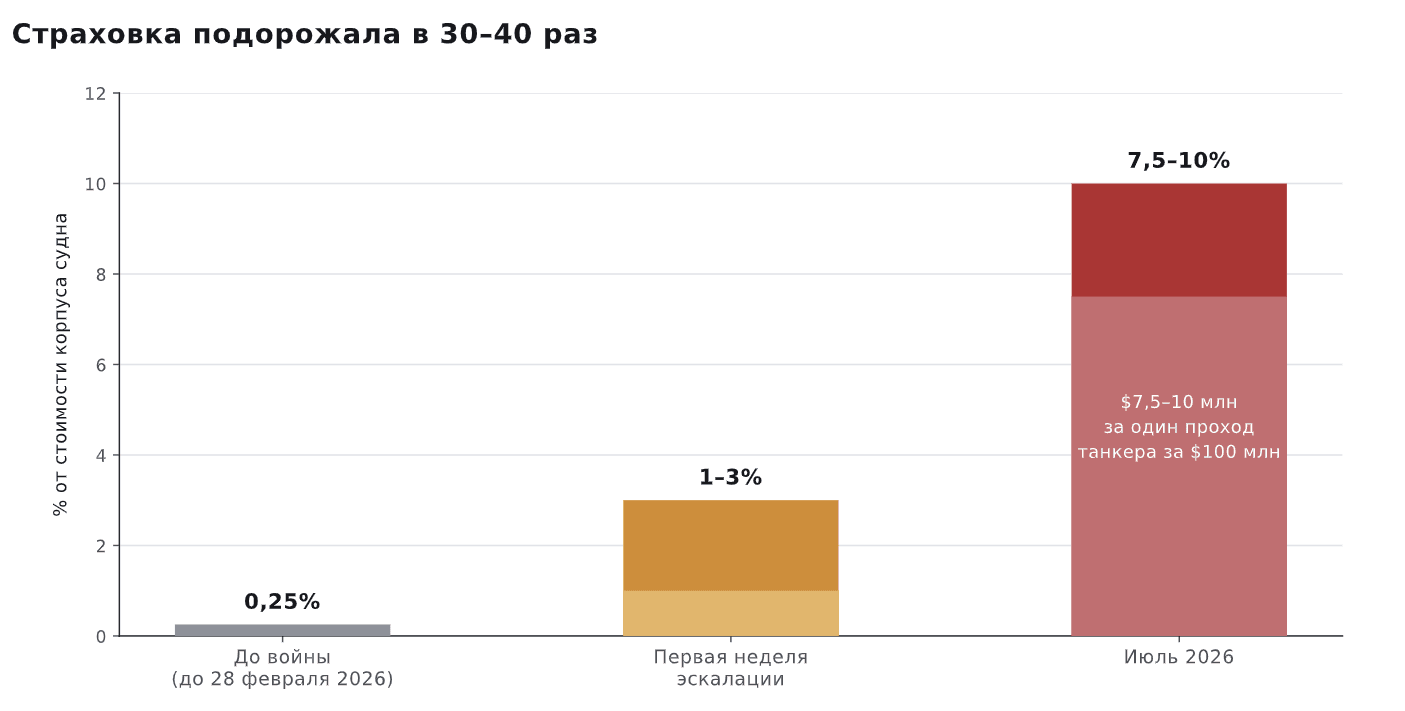
Today's voyage economics are determined not by freight rates but by insurance. The war risk premium for hull insurance on the Hormuz passage rose from 0.25% of vessel value before the war—first to 1–3%, then by July 22 to 7.5–10%. For a $100 million tanker, this means $7.5–10 million per single passage instead of $250,000. Broker Marsh notes that once rates exceed 3%, the route around the Cape of Good Hope becomes cheaper than Hormuz even accounting for three extra weeks at sea.
Source: Marsh (data for S&P Global Platts, July 22, 2026)
Bab el-Mandeb is the second half of the same crisis, and here 2026 played a cruel trick. Since 2023, oil transit through the strait fell from 9.3 to 4.1 million b/d, while LNG shipments dropped to zero entirely: for two years not a single gas carrier passed through. By the first quarter of 2026, the strait had nearly recovered its losses. Oil returned to 5.4 million barrels per day, gas started flowing again at 2.9 billion cubic feet per day. The Red Sea was recovering precisely during the months when Hormuz shut down, functioning as a compensator. On July 20, the Houthis declared a blockade of Saudi shipping, Riyadh joined American strikes against Iran-linked forces for the first time, and the compensator ran out.
The historical parallel isn't quite accurate here, and that's the whole point. During the Iran-Iraq tanker war of 1980–1988, hundreds of vessels were attacked, but Hormuz was never completely closed—Iran itself depended on exports through the strait. In 2026, with Tehran under an American naval blockade, that incentive no longer exists.
The bill for disruptions comes due all along the chain. According to freight platform Xeneta, spot container rates from China to the U.S. East Coast were expected in June to be up 75% above pre-war levels, to Northern Europe by 51%, and to the Mediterranean by 45%. Around a hundred container ships were stuck in the Persian Gulf, while the International Maritime Organization was engaged in evacuating approximately 6,000 sailors.
Malacca was left untouched, yet it still declined
The second most important chokepoint is located in Asia, and nothing happened in its waters in 2026. But throughput still dropped: 20.9 million b/d in the first quarter versus 21.7 million a year earlier. The reason isn't the strait itself. The same Middle Eastern oil flows through Malacca, just further east, and when Hormuz closes, Malacca automatically dries up without a single shot fired in its waters.
In normal years, this is the busiest shipping lane on the planet. In 2025, the Malacca and Singapore Straits saw 102,000 vessels with displacement over 300 gross tons pass through, breaking the hundred-thousand mark for the first time. For oil, it's also the world's number one: 23.2 million barrels per day before the war, nearly 30% of all seaborne oil trade, plus 9.2 billion cubic feet of LNG daily. Yet at its narrowest point, at the Phillips Channel near Singapore, the fairway is just 2.8 kilometers wide, and depth in some places doesn't exceed 25 meters. Fully loaded supertankers simply can't fit through.
China depends on Malacca for roughly 80% of its oil imports, and Beijing has a special term for this—the "Malacca Dilemma," coined back in 2003. Alternatives exist, but each is partial: the Sunda and Lombok straits in the Indonesian archipelago, a pipeline from Myanmar to Yunnan. The pipeline can transport oil but not containers, and containers are the strait's main cargo—an average of 74 vessels daily versus 60 tankers.
Moreover, China's trade is tied to the Taiwan Strait, which connects directly to Malacca, and storm clouds are gathering there too. The width at its narrowest point is about 130 kilometers, meaning it's physically harder to block than any other chokepoint on this list. But more than 20% of global trade by value passes through it, and nearly half the world's container fleet transits here. This is also where advanced chip production is concentrated: Taiwan's TSMC posted record revenue of $40.2 billion in the second quarter of 2026.
The key development at Taiwan in 2026 was a change of instrument. In July, PRC coast guard vessels operated east of the island for five days, requesting routes and cargo details from commercial ships. Beijing called it a "special maritime law enforcement operation." Tamkang University analyst Ying Yu Lin, in a June analysis for the Jamestown Foundation, proposed the term "quasi-quarantine" for this. Not a single vessel changed course, but systematic inquiries are enough for insurers to reassess war risks. The strait becomes more expensive without a single shot fired.
Panama Closed by Water, Not Missiles
Panama—in 2026 saw increased flows: 2.9 million b/d in the first quarter versus 2.8 million a year earlier. Substitution is at work, since while the Gulf was shut down, American refiners hit a record: in the second quarter, U.S. diesel exports reached 1.56 million b/d, kerosene — 356,000 b/d, double the five-year average. Part of this flow heads to Asia precisely through the Panama Canal.
The canal's problem is different. It's the only chokepoint on the list that can stop working without any politics involved: the locks are fed by fresh water from Lake Gatún, and when there isn't enough, the canal physically cannot pass ships. In November 2023, drought forced the administration to lower the limit to 25 transits per day from a normal capacity of 36.
Formally, the crisis has passed. In fiscal year 2025, the canal handled 13,404 vessels versus 11,240 the year before and earned $5.705 billion (+14.4%). But it never returned to its former rhythm: the canal last maintained an average of 36 daily transits in 2022; in 2024 the average was 30.9, and for 2026 the administration forecasts 33. This is now a consequence not of low water levels but of water conservation policy.
Certain segments haven't recovered at all. LNG transit through the canal in fiscal 2025 fell below 0.3 billion cubic feet per day versus roughly 2.5 billion in 2021 — nearly a ninefold drop. LNG carriers that once went around Africa or through Suez haven't come back even with the lake at full capacity. Alternate routes around South America add up to 8,000 miles to the journey, while the Trans-Panama Pipeline, with capacity of 864,000 b/d, actually pumps around 400,000.
For Panama itself, the stakes are higher than for carriers. According to canal administrator Ricaurte Vásquez Morales, the waterway's revenue provides 20% to 25% of all Panamanian government income. Insurance against the next drought is supposed to come from a reservoir on the Río Indio at a cost of up to $1.6 billion, but construction won't begin until 2027 and will take about four years. In April, the U.S. National Oceanic and Atmospheric Administration (NOAA) announced an El Niño watch with likely development by mid-year.
The second Panama story is legal. About 40% of U.S. container traffic passes through the canal, and Donald Trump's administration has been pushing since the start of his second term to squeeze out companies with Chinese ties. On January 29, 2026, Panama's Supreme Court ruled unconstitutional the concession held by Hong Kong's CK Hutchison for the ports of Balboa and Cristóbal on either side of the canal. Port management passed to Denmark's A.P. Moller-Maersk; CK Hutchison threatened lawsuits. A separate story involves the stalled deal for $23 billion for the sale of 43 ports to a consortium led by BlackRock, which Beijing blocked.
Europe Closes the Straits Without Closing Them
The Danish straits are the only point on the map where nothing has shifted during the war year: 4.8 million barrels per day in Q1 2025 and in Q1 2026. Meanwhile, the Turkish straits dropped from 3.6 to 3.3 million. Here, the straits are being squeezed not with missiles but through a vessel's legal status, and while it works more slowly, it's more reliable.
By volume, the Danish straits are comparable to Suez and account for about 6% of seaborne oil trade. The trend is telling: this is nearly 60% higher than in 2021. There's one reason—after 2022, Russian exports from the Baltics pivoted from Europe to Asia, and tankers from Ust-Luga and St. Petersburg began sailing farther and more frequently.
The Danes themselves once profited from these exports. The Sound Dues operated for nearly four centuries and were abolished only in 1857, when European powers bought out the right of free passage with a one-time payment. Today the instrument is different, but the logic is the same: control over the strait is either monetized or politicized—it's only a question of form.
On January 26, Denmark together with thirteen other coastal countries of the Baltic and North Sea announced that a tanker sailing under the flags of two or more states, or without valid documentation, is considered a vessel without nationality under Article 92 of the UN Convention on the Law of the Sea. Such a vessel can be inspected on the high seas by a warship of any country. This concerns roughly 1,500 shadow fleet tankers exporting oil from Russia, Iran, and Venezuela. Sweden after seizing three tankers, managed to get these vessels to start avoiding its waters, while Copenhagen itself isn't stopping anyone, citing freedom of navigation through the straits.
Even the threat works. After then-British Prime Minister Keir Starmer's statement in March about pursuing sanctioned tankers, some vessels exporting oil from Baltic ports began heading to the Mediterranean not through the English Channel but around the British Isles from the north. The route lengthened by roughly two days—about a quarter longer.
The Turkish Straits are the narrowest of the major chokepoints. The Bosphorus stretches for 17 nautical miles and at its tightest point is less than half a mile wide, while the Dardanelles span 37 miles. In 2024, more than 45,000 vessels passed through the straits, making them one of the busiest routes on the planet. The legal framework here is stricter than anywhere else: the 1936 Montreux Convention gives Turkey control over the straits but requires it to allow merchant vessels through in peacetime. Ankara uses what room for maneuver remains, and doesn't allow LNG carriers through the Bosphorus at all, citing safety concerns. The largest exporter through the straits is Kazakhstan, whose oil flows through Russian Black Sea ports, while alternative routes like the Baku-Tbilisi-Ceyhan pipeline cover only part of the volume.
From 2026 onward, physical constraints have been added to the legal ones. On May 28, unmanned boats attacked three tankers off Turkey's northern coast, roughly 80 km from the entrance to the Bosphorus, with two of them hit during ship-to-ship cargo transfers at sea. Ankara called this a serious threat to regional shipping and the environment. Shipping traffic at the entrance to the strait has been reorganized: vessels now hug the Turkish coast more closely.
The Northern Sea Route is still exporting Russia's Arctic, not global transit
2026 was supposed to be the year of the Northern Sea Route. Three of the eight chokepoints experiencing disruptions, insurance in Hormuz at 10% of hull value, the route around Africa stretched to the limit. The logic of circumvention is the main argument Russia uses to promote the route, and in October 2025 the Chinese container ship Istanbul Bridge made the journey from China to Europe in less than 20 days.
So far the numbers tell a different story. Cargo flow along the NSR in 2025 totaled 37.04 million tons versus 37.9 million in 2024, meaning it declined slightly. The plan was exceeded, but the target itself was 35.1 million tons—the bar had been lowered. For comparison: Suez in its best years handled around 1.5 billion tons, roughly forty times more.
The cargo structure explains why this isn't an alternative to Suez. About 86% of the volume is liquefied gas, oil, and petroleum products, another 11% is containers and general cargo, and most of this flow is Russian. Transit container shipping grew 2.6-fold and reached a record 400,000 tons, but that's only about 1.1% of the route's actual capacity utilization. The NSR today functions as an export channel for Russia's Arctic, not as a transit corridor between continents.
The growth is real, though: from 3.98 million tons in 2014, volume has increased almost ninefold. The target for 2030 is 150 million tons, of which more than 100 million tons should come from hydrocarbons from the Vostok Oil project and the Yamal LNG cluster. For the route's development in 2026–2028, 138 billion rubles.
The limiting factor is also clear, and it's nature itself. Icebreaker escorts, insurance premiums for Arctic voyages, and the mandatory use of ice-class vessels drive up freight rates to the point where the route remains profitable mainly for proprietary commodity shipments. Such a corridor cannot replace a strait that handles a quarter of global container trade.
First the routes got longer, then the oil ran out
Until 2026, the chokepoint crisis was a logistics crisis, not a supply crisis. Global seaborne oil trade remained virtually unchanged in volume: 80.2 million barrels per day in 2023, 79.7 in 2024, and 79.8 in the first half of 2025. The same crude, just traveling longer routes with different insurance. Traffic around the Cape of Good Hope grew from 6.1 million b/d in 2022 to 9.3 million in 2024, carrying more oil than the Suez and Bab el-Mandeb combined.
In 2026, the system broke down. Hormuz lost 5.8 million b/d, but traffic around Africa didn't increase—it decreased. There was nothing left to reroute: Gulf states had shut down production, and global oil supply dropped from 105.2 million b/d in the first quarter of 2025 to 95.4 million in the first quarter of 2026. In 2024, the flow sought a new path; in 2026, it simply vanished.
The cost of such a restructuring has already been calculated. Estimates published in November 2025 in Nature Communications assess the volume of trade exposed annually to chokepoint risk at $192 billion, with direct economic losses of $10.7 billion per year and another $3.4 billion in additional freight costs. The main contributors to this figure are geopolitical risks in the Taiwan Strait and Suez.
The simultaneous failure of three chokepoints—Hormuz due to war, the Red Sea due to the Houthis, Panama due to drought—has no precedent in modern history. The system functioned on the assumption that when one route failed, there was always a second option. The drone over Damietta is noteworthy not for the damage it caused, but because it struck precisely that alternative route.