This text is an automatic translation from Русский. It was generated by AI and may contain inaccuracies.
Read original →Infrastructure Time: PPP Market Seeks New Money and Launches Communications Project
AIIC has presented a memorandum on attracting non-budgetary investment in infrastructure and launched the Infrastructure Time project. How the high key rate affects concessions and what new financial instruments the market proposes.
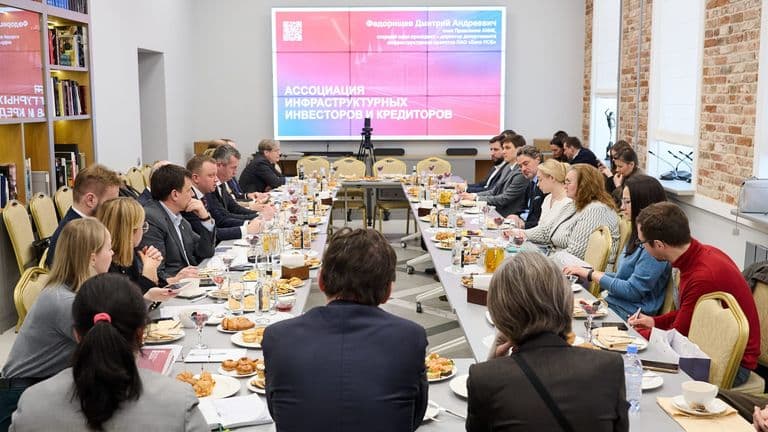
AIIC press breakfast
The event was hosted by the Russian Union of Industrialists and Entrepreneurs (RSPP), where market participants discussed the outcomes of concession mechanism development, the impact of the high key rate on investment activity, and prospects for attracting private capital into infrastructure.
AIIC recalled that the past year was landmark for the entire industry: 2025 coincided with the 20th anniversary of Federal Law No. 115-FZ "On Concession Agreements" and the 10th anniversary of the law on public-private partnership. According to the association's board chairman Igor Koval, over two decades the market has proven its viability as an instrument for attracting investment and reducing budget burdens, while implemented projects have covered virtually the entire infrastructure spectrum: from transport to social facilities.
According to Sovcombank representative Konstantin Batunin, by the end of 2024, 4,322 PPP and concession agreements worth 7.3 trillion rubles had been concluded in Russia, with 70% of investments provided by non-budgetary sources. These figures reflect the core purpose of the concession mechanism—attracting private capital where the state is limited by budgetary constraints.
However, the high key rate remains a factor that directly affects the pace of infrastructure initiatives: projects are shifting to the right on timelines, leading to changes in financial models and investment decisions. At the same time, as noted at the event, the industry today needs not a slowdown, but adaptation: the scale of infrastructure challenges is growing faster than budget capacity.
One of the speakers was Deputy Head of the Department for Structuring Infrastructure Projects and PPP at Gazprombank Darya Tsapko, who noted that in August 2025 the government approved a comprehensive infrastructure development plan through 2036. It envisages construction and reconstruction of approximately 4,500 km of railways, more than 2,000 km of highways, 17 cargo terminals in seaports, and 55 airport complexes. It's clear that such volumes require colossal investment, including non-budgetary, and therefore new mechanisms for project financial sustainability given constant changes in macroeconomic parameters.
Gazprombank is traditionally viewed by the market as one of the key players in infrastructure financing. Recently, Ildar Murtazin, head of the bank's structuring department, indicated that PPP projects cannot be postponed simply because of high cost of money: preparation must begin now so that regions enter the investment cycle with ready solutions. This approach is particularly relevant in a situation where many initiatives stall precisely at the financial modeling and project documentation preparation stage.
The bank emphasizes that a credit institution's participation in infrastructure deals has long gone beyond actual financing: it's about helping regions structure initiatives, attract investors, and support projects at all implementation stages. Gazprombank's infrastructure portfolio exceeds 3.5 trillion rubles, while total capital investments of projects with its participation exceed 9.2 trillion rubles, making it one of the country's largest private infrastructure investors.