This text is an automatic translation from Русский. It was generated by AI and may contain inaccuracies.
Read original →"Economic Pariah": Can the US Cut Off Iran's Trade Channels?
An analysis of new American sanctions against Iran: how Operation Economic Pariah affects trade with China, Russia, and other partners. The effectiveness of restrictions and mechanisms for circumventing sanctions.
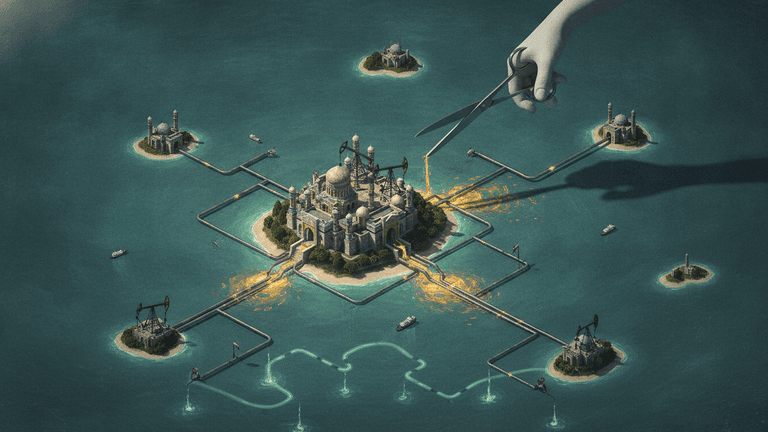
While negotiations to end the armed conflict in the Middle East appear to have reached an impasse, Washington has once again decided to shift the confrontation to the economic sphere by expanding sanctions pressure on Iran. On August 24, U.S. Treasury Secretary Scott Bessent announced the launch of an operation called "Economic Outcast," aimed at isolating the Islamic Republic. According to the American administration's plan, the new campaign is designed to cut off key economic channels that allow Tehran to earn foreign currency revenue and circumvent existing restrictions.
The new American sanctions against Iran are sectoral in nature and target key channels supporting the Iranian economy. According to the U.S. Treasury Department's Office of Foreign Assets Control (OFAC), the restrictions cover technologies related to weapons production, gold used to stabilize the depreciating Iranian rial, aviation and shipping necessary for exports that bypass existing sanctions, as well as cryptocurrency operations.
As a result, the new restrictions affected approximately 60 companies, individuals, and maritime vessels worldwide. The list includes organizations from China and Hong Kong that, according to Washington, helped Iran procure technologies, conduct payments, and organize logistics, including deliveries of dual-use equipment.
At the same time, major Chinese financial institutions and banks that U.S. authorities also link to Iranian trade have not yet been added to the sanctions list. Restrictions against such important elements of the global financial system could result in unpredictable negative consequences, including for the United States itself.
"No one is beyond the reach of American sanctions"
Bessent himself made it clear that this is only the first phase of the campaign: Washington is attempting to influence not only Iran directly, but also its trading partners, who now face secondary sanctions for cooperating with Tehran. The U.S. Treasury Secretary noted that if the restrictions are not observed, Iran's partners could effectively lose access to the dollar system.
However, no details were provided about possible restrictions and their implementation timeline, making it extremely difficult to assess the consequences of American threats. It is only known that Donald Trump is negotiating with world leaders, urging them to cease interaction with the Iranian regime. And here the main question arises: who exactly might be threatened by Washington's sanctions?
Iran's actual trade volume is currently impossible to assess accurately: due to the large number of sanctions, a significant portion of trade flows through shadow schemes, including turning off transponders, changing vessel flags, and relabeling cargo. Nevertheless, it is possible to identify Tehran's main foreign trade connections.
China — the main channel for Iranian oil
First and foremost is China — the largest buyer of Iranian oil. According to Kpler estimates, in 2025 China purchased an average of 1.38 million barrels of Iranian oil per day. More than 80% of these supplies go to independent Chinese refineries, which take advantage of discounts on sanctioned crude and are less dependent on the American financial system.
Excluding oil and petroleum products, the volume of Chinese-Iranian trade in 2025 amounted to nearly $10 billion. However, this official statistic does not reflect the real scale of trade: Iran has formally not supplied oil to China directly since July 2022. Over recent years, the countries have created a complex system of settlements and deliveries: oil changes its origin on paper, is transported through a chain of intermediaries, and payments are conducted predominantly in yuan.
In April, the U.S. already imposed sanctions against an independent Chinese refinery for purchasing Iranian oil and warned Chinese banks about the possibility of secondary restrictions. However, Beijing has no intention of curtailing energy cooperation with Tehran. Moreover, Chinese authorities call unilateral sanctions illegal and declare their readiness to defend their interests.
Russia, UAE, and Iraq: Different Models of Dependence
Iran's next major partner is Russia. Bilateral trade in 2025 totaled approximately $5.8 billion, down roughly 21% year-over-year. In January–April 2026, trade turnover reversed course, growing 2%, while Russian exports to Iran jumped 56% year-over-year. The North-South international transport corridor plays a crucial role here: in the first four months of 2026, cargo volumes through the corridor surged 87% compared to the previous year.
In absolute terms, bilateral trade remains relatively modest, yet its significance extends well beyond ordinary commerce. Moscow and Tehran are developing cooperation in transport, energy, and nuclear sectors. With Rosatom's participation, Iran built the Middle East's first nuclear power plant—Bushehr—while the countries continue expanding collaboration in other sensitive areas, including military affairs.
Before the Middle East war, the United Arab Emirates served as one of Iran's most important trade and financial channels. In 2024, the UAE accounted for roughly 30% of Iran's non-oil imports—approximately $21 billion—as well as 13% of Iranian exports. A significant portion of this trade involved re-exports through Dubai. According to estimates by U.S. financial intelligence agency FinCEN, 71% of Iran-related transactions deemed suspicious by the U.S. passed through UAE-based companies.
The war, however, dramatically altered this picture. Following deteriorating relations with Tehran, Abu Dhabi suspended financial and economic operations with Iran on August 19. Thus, one of Tehran's most convenient foreign trade channels was effectively shut down even before the new American sanctions campaign was announced.
Even more sensitive for both Iran and the U.S. is the situation with Iraq. In 2025, bilateral trade exceeded $10 billion, with Iranian exports consisting largely of food products, consumer goods, and natural gas. According to Iraqi energy officials, Baghdad pays Tehran $4–5 billion annually for gas used in electricity generation.
This is precisely where new American restrictions could create a difficult situation for both countries. Iraq is already forced to conduct settlements with Iran through special accounts in third-country banks, since direct payments are restricted by existing U.S. sanctions. Tehran can only use funds in these accounts for humanitarian purchases. By various estimates, approximately $10 billion has accumulated there.
If Washington tightens the rules, Baghdad will face a choice between risking American sanctions and risking disruptions to Iranian gas supplies. And that becomes a problem not just of foreign trade, but of Iraq's own energy security.
Turkey—Between Washington and Tehran
The situation with Turkey is distinct. Bilateral trade between the two countries runs at approximately $5–7 billion annually, with Turkey exporting industrial goods, machinery, equipment, and chemical products to Iran, while importing primarily natural gas. Iran supplies roughly 13% of Turkey's natural gas imports.
Turkey serves two functions for Tehran simultaneously: it remains a sales market while also acting as an important transit corridor. The shared land border and developed logistics allow Iranian goods to move onward after passing through Turkey. That's why Ankara interests Washington not only as a buyer of Iranian products, but also as a potential channel for sanctions evasion.
Turkey has yet to state its position on the new sanctions, but the context doesn't favor Iran. In January 2026, Trump already threatened to impose an additional 25% tariff against countries doing business with Iran. At that time, amid these threats and protests in Iran, truck traffic through the Gürbulak border crossing dropped 40%. Moreover, in 2018, American sanctions also caused Turkish-Iranian trade to plummet from over $10 billion to $5.4 billion.
Minor Partners
Beyond its largest trading partners, Iran maintains ties with Oman, Pakistan, India, Armenia, and Azerbaijan. However, trade volumes with these countries are significantly smaller: for instance, trade turnover with Oman in 2025 reached $1.5 billion, and with Armenia—$768 million. Still, these countries matter as additional trade and transit channels. In particular, up to 25% of Armenia's foreign trade passes through Iran, and maintaining these connections is important for Yerevan itself: amid deteriorating relations with Moscow, Armenian authorities are keen to preserve alternative trade and transit routes.
Five Thousand Sanctions and Nearly Half a Century of Adaptation
With Operation Economic Pariah, Washington is attempting to isolate Tehran, but this task is far more complex than it appears. Iran ranks among the leaders in the number of sanctions imposed on a country: as of March 1, 2025, the count stood at approximately 5,500. This figure includes restrictions on individuals and legal entities, maritime vessels and aircraft, but not sectoral sanctions.
It's also important to note that sanctions pressure on Iran has a nearly half-century history. The first American restrictions were imposed back in 1979 following the Islamic Revolution and the seizure of the American embassy in Tehran. At that time, Washington banned oil imports from Iran and froze Iranian assets worth $12 billion. In 1984, Iran was added to the U.S. list of state sponsors of terrorism, and in subsequent decades, restrictions gradually expanded to cover trade, investment, the financial sector, the oil and gas industry, and defense.
In 2010, sanctions pressure reached a new level: the UN Security Council adopted a resolution on Iran's nuclear program, the U.S. Congress approved the Comprehensive Iran Sanctions Act, and the EU introduced restrictions against individuals, companies, and sectors linked to the country's nuclear program.
And these are just a few examples. Over the decades, Tehran hasn't simply learned to operate under restrictions—an entire trade infrastructure has formed around the sanctions regime. It includes intermediaries, alternative financial channels, settlements in national currencies, a shadow fleet, jurisdiction changes, and re-export through third countries.
This raises the central question—about the effectiveness of Economic Pariah. To truly isolate Iran, the U.S. would need to pressure not just a few dozen companies, but an entire network of trading partners—from the world's largest economy, which is in a trade war with Washington, to neighboring countries dependent on Iranian gas and transit. Another question is whether the White House will actually resort to such measures, or whether everything will remain at the level of threats, to which the international community has already grown accustomed during Trump's years in office.