This text is an automatic translation from Русский. It was generated by AI and may contain inaccuracies.
Read original →Concrete: Construction's Chief 'Invisible' Asset
Why the price of concrete isn't just rubles per cubic meter, but a risk management tool. We examine how formulation, logistics, and technology affect timelines, margins, and the lifecycle costs of construction projects.
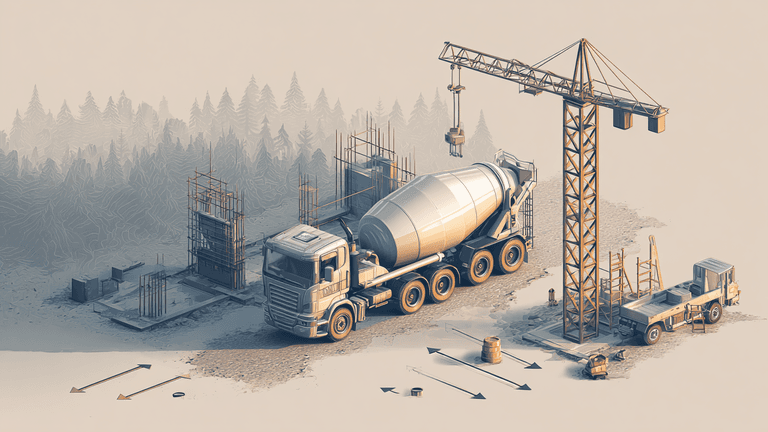
What concrete is actually made of—and why money is hidden in this mixture
Concrete is made from four basic components: cement binds, water triggers the chemical reaction, sand and gravel provide the "skeleton." Sometimes the recipe includes "special spices"—plasticizers for workability, accelerators for rapid strength gain, anti-freeze additives, waterproofing materials. It seems simple enough, but the economics hide in the details. Too much water makes the mix easier to pour, but the finished structure becomes weaker and cracks faster. Too "stiff" a mix is strong on paper but slow in practice: crews rack up overtime, crane time gets expensive, and the risk of rework grows. In this sense, the recipe isn't so much culinary as it is a financial calibration between speed and reliability.
It's important to understand that concrete is more often purchased not as a "product" but as a service. The client doesn't need cubic meters per se, but rather the right strength by the right date, continuous delivery within the pour "window," a lab that will confirm quality, and a fleet of mixers with pumps ready to substitute for each other in case of any breakdown. The price always includes two premiums: for time (readiness to arrive strictly on schedule) and for risk (insurance against defects and disruptions). And one more "unfair" asymmetry: cement makes up a small portion of the mix by volume, but it's what drives price and carbon footprint the most.
Why construction becomes a lottery without concrete
Concrete's main superpower is that it's local and universal. Sand and gravel exist almost everywhere, and the batching plant itself can be located near the site. This sharply reduces transportation and sensitivity to exchange rates or external supplies. The second superpower is formability. Formwork defines almost any shape: a column, floor slab, curved facade, massive foundation for a crane—one material adapts to dozens of tasks. The third is scale. A small contractor pours ten cubic meters, a highway project hundreds of thousands, and in both cases the economics "work": costs grow with volume, but speed grows even faster.
There's also something less obvious. Concrete allows you to manage risks. If steel is stuck at customs, you're hostage to the global supply chain. If there's a shortage of lumber on the market, the schedule dances. But for concrete there are usually alternative quarries, neighboring plants, backup formulations. A project is easier to "switch" without destroying the timeline.
The journey of money from quarry to monolith: where value accumulates
Money begins its journey at the quarry. Rock quality, the required fraction, and simple remoteness determine the starting cost. In major cities, it's often not cement that's expensive but quality washed sand: it needs to be extracted, washed, dried, and delivered. The next stop is cement. This is energy-intensive production: electricity and gas prices, as well as carbon fees, show up directly in the estimate. Any reduction in clinker content in cement (through slags, pozzolans, limestone with calcined clay) reduces both CO₂ and price volatility.
Then the baton passes to the batching plant. Here there are not only mixers, but also a laboratory, dosing equipment, aggregate moisture monitoring, "fine-tuning" the mix for weather and structural details. The plant's reputation is capital: one failed batch on a high-profile project can eat up a quarter's margin. Next comes logistics. The mixer loads the mix and heads to the site. Time is running—literally: with each minute the mix loses workability, and any "let's add a little water" in the drum means minus strength and durability. At the site, concrete meets the pump, crew, vibrators, formwork, and a schedule where everyone has their slot. And finally—curing: protection from drying out, temperature control in massive structures, cutting joints. The cheapest stage in terms of materials is often the most expensive in terms of impact on future repairs.
To feel the "rhythm of money," it's useful to live through one batch cycle: mixed, dispatched, stuck in traffic, arrived, deployed the pump boom, placed, vibrated, covered, checked temperature after a day, pulled control cubes after a week, received strength certificate after 28 days. Any delay at any step costs real money.
Factors that invisibly change the estimate more than a discount of "minus 200 per cubic meter"
First — the water-to-cement ratio. The less water per unit of cement, the higher the final strength and durability. But the mix becomes "stiffer," slowing down the pour. Modern plasticizers come to the rescue: yes, they increase the price per cubic meter, but they prevent cracks and rework—in other words, they save money over the life of the structure.
Second — strength class. This isn't about "playing it safe." An excessively high class means direct waste on cement and additives. Too low—and you risk reinforcement work, fines from technical inspectors, and delays in commissioning. The winner is the one who calculates not the price per cubic meter, but the cost of the structure and the timeline.
Third — workability of the mix. High workability speeds up the job and reduces labor costs, but requires control to avoid segregation. The solution depends on the element: a column with dense rebar, a long-span slab, a massive foundation—each has its own "ideal" regime.
Fourth — logistical "windows." Concrete is a material that lives for hours. If a mixer truck is half an hour late, it's not just "inconvenient": the pump gets delayed, the crane sits idle, crews rack up overtime, and by the end of the week all these little things add up to significant cost overruns.
Fifth — weather. In summer the mix can dry out, leading to shrinkage cracks; in winter it requires heating and antifreeze additives. On paper it's pennies, on the schedule—days.
Sixth — quality control and documentation. Who takes and stores the test cubes, how the batching equipment is calibrated, whether there's batch traceability, whether environmental declarations have been issued for the mix. Paperwork saves time in dealings with banks, insurers, and inspectors—and time in construction is always money.
Concrete as an investment in time: calculating life-cycle cost, not just cost per cubic meter
Initial price is a poor guide. What matters more is lifecycle cost: how much the project will spend on repairs, how quickly formwork can be stripped and the crane freed up, how many days will be lost to slow strength gain, what claims from the management company will cost due to leaks. The right concrete is often more expensive upfront but cheaper over time.
A simple numerical example helps ground the discussion. Say an accelerating admixture increases the price by 15 euros per cubic meter. For a 3,000-cubic-meter frame, that's an extra 45 thousand. However, switching to an accelerated mix and a more "fluid" technology (for instance, self-compacting concrete in columns) removes 30–40 days from the critical path. If a project day costs 8–12 thousand euros (equipment rental, crew mobilization, loan interest), the savings amount to 240–480 thousand. Net effect: hundreds of thousands in the black, even though at the outset it seemed you were "overpaying for chemistry."
Another dimension is operations. A thermally massive concrete frame smooths out peak loads on heating and cooling systems, reducing required equipment capacity and utility bills. A properly executed waterproof parking slab eliminates chronic leaks, saves on sealing work and resident complaints. It's all the same money, just in different budget lines.
Environment and regulation: how CO₂, EPD, and carbon are changing estimates and tenders
The lion's share of carbon in concrete comes from cement clinker. Hence the strategies for reducing footprint: cements with mineral additives, water optimization in the mix, secondary aggregates. The bottom line is a double benefit: lower CO₂ per cubic meter and less dependence on energy prices. In the tender game, a third factor emerges—documentation. Environmental Product Declarations (EPD) are becoming the norm: major clients demand them, banks build assessments around them. In regions with carbon adjustments, "green" formulations also gain tax advantages.
The secret to success is not to "play environmentalist" at the expense of technical performance. Low-clinker mixes behave differently: workability, heat generation, strength gain all differ. They need to be selected together with the connection engineer and contractor. And yes, calculate not just the price but the effect on schedule, risks, and durability.
Technologies that save weeks, not percentages: a brief overview without the magic
Self-compacting concrete flows on its own, uniformly filling dense reinforcement and complex formwork. Vibration is almost unnecessary—meaning less noise, fewer defects on exposed surfaces, faster formwork turnover. Fiber-reinforced concretes add steel or polymer fiber to the mix, partially replacing traditional reinforcement and gaining in crack resistance—especially for industrial floors and tunnels. Sensors embedded in the structure monitor temperature and actual strength gain; stripping decisions are made by data, not guesswork—and that again cuts days. 3D concrete printing is still niche but already useful for non-standard elements where manual labor is expensive and slow. Recycling—crushing old concrete into new aggregates—saves on disposal and aggregate purchase where quarries are scarce.
All this sounds like a "technology showcase," but there's one common denominator: reduced labor intensity and predictable timing. Which means improved economics even without dramatic material discounts.
Three real-world cases: what changed when the concrete changed
High-rise building in the city. The project started with conventional strength, but dense reinforcement in columns and narrow pour windows made each floor "long." Switching to a higher grade in load-bearing elements, accelerating admixtures, and self-compacting mode cut formwork cycle time by a day to a day and a half per floor. Over thirty floors, that's minus a month to a month and a half. The mix price increase was offset by savings on cranes, crews, and interest—project margin grew.
Bridge over a river. Massive piers suffered cracking from heat of hydration during curing. The recipe was changed: cement with admixtures, careful temperature monitoring, different curing regime. Result: fewer cracks, less injection work, fewer warranty repairs. In money terms: the positive difference between "more expensive per cubic meter" and "cheaper in repairs."
Underground parking. Water is the main enemy. The client chose a mix with enhanced waterproofing and crystallizing additives. In the estimate—a few hundred rubles extra per cubic meter; in operation—dozens fewer service requests per year, a satisfied management company, and no chronic "wet spots" on the ceiling. If you calculate the present value of costs over 7–10 years, the decision comes out solidly in the black.
Where concrete gives way to steel and timber, and where it's the other way around
Steel wins where you need speed of assembly and long spans. But steel structures are sensitive to global prices and require fire protection and anti-corrosion solutions. Engineered timber (CLT/GLT) offers lightness and a low carbon footprint, works beautifully in mid-rise construction and interiors, but imposes special requirements for acoustics, vibration, and fire safety. In practice, hybrids increasingly win out: a concrete core and foundations, steel spans, timber floors. In such schemes, concrete is the "anchor" of predictability: it sets the geometry, handles fire and mass, and stabilizes the schedule.
The real price is the price of time and risk
Pricing concrete by the formula "cubic meters × rate" is like evaluating a flight solely by ticket price, ignoring delays and layovers. In a real project, money is made (or lost) in the schedule, in logistics, in quality of curing, and in paperwork that saves weeks of approvals. A good mix design with clear traceability, a joint with discipline, logistics without "surprises," curing by the book—together these deliver predictability, and therefore margin. That's why concrete isn't just the foundation of any construction project, but a financial instrument: it moves construction from the realm of chance into the space of manageable decisions.