This text is an automatic translation from Русский. It was generated by AI and may contain inaccuracies.
Read original →
This text is an automatic translation from Русский. It was generated by AI and may contain inaccuracies.
Read original →Natural disasters cause $2.3 trillion in annual damage. How catastrophe bonds and green bonds work, why their market is expanding, and what's happening with these instruments in Russia—a deep dive into emerging climate finance mechanisms.
In recent decades, the number of natural disasters has been rising rapidly. According to estimates by the UN, when accounting for indirect and ecosystem impacts, annual losses from natural disasters already exceed $2.3 trillion. The increasing frequency of hurricanes, wildfires, and floods is already putting serious pressure on budgets and markets. Several years ago, insurance companies and regulators turned their attention to instruments that allow catastrophic disaster risks to be redistributed across capital markets.
At the same time, insurance payouts cover only a portion of the costs: for example, in the European Union only about a quarter of losses from climate disasters are insured, and in other, less developed countries, this figure is even lower. For instance, in India, Vietnam, Indonesia, and the Philippines, insurance coverage remains below 1%, even though Southeast Asia is particularly vulnerable to natural disasters—the region accounts for roughly 40% of all natural catastrophes on the planet, including typhoons, floods, earthquakes, and tsunamis.
The scale of such costs impacts national budgets and businesses: homes and infrastructure must be rebuilt either by insurers or by the state. Yet traditional insurance mechanisms are in many cases unable to cover the losses. As a result, investors and governments have in recent years been seeking and developing alternative financing instruments, including green bonds to fund projects that mitigate climate change, and catastrophe bonds to transfer natural disaster risks.
Catastrophe bonds (CAT bonds) are a special type of insurance instrument that allows natural disaster risks to be transferred to investors. An insurance company issues a bond and offers investors enhanced returns in exchange for taking on the risk of a specific event occurring—a hurricane, flood, earthquake, and so on. If the insured event occurs, the invested funds are transferred to the insurer. In other words, the investor receives higher yields (in June 2025, the average annual return was 11.8%, twice the average yield on U.S. corporate bonds), but risks losing their entire capital in the event of a catastrophe.
This mechanism emerged after Hurricane Andrew, which in 1992 caused $15.5 billion in damage to South Florida and led to the bankruptcy of at least 16 insurance companies. Since then, the CAT bond market has grown rapidly, primarily in the United States. By the end of 2024, its volume reached a record $17.7 billion, and by late summer 2025, approximately $18.4 billion in bonds had already been issued. In spring 2025, the New York Stock Exchange launched the world's first exchange-traded fund investing in catastrophe bonds, further boosting investor interest.
Demand from insurers is being supported by inflation in the U.S. and Europe: rebuilding destroyed infrastructure and real estate is becoming increasingly expensive. Investor interest, meanwhile, is driven by the fact that catastrophic events (hurricanes, earthquakes) have low correlation with volatile stock markets, and CAT bond yields are higher than most other bonds. For example, U.S. high-yield corporate bonds yield around 6.7%, while bonds rated BBB and above yield approximately 4.5–5%. An additional incentive for investors has been the low level of losses: even major hurricanes in 2024—Helene and Milton—did not result in significant payouts to bondholders. Losses only materialize in truly devastating events comparable to Hurricane Katrina in 2005.
The CAT bond market is gradually expanding, including beyond the United States. Aggregate issues have emerged that insure multiple types of catastrophes at once (snowstorms, floods, etc.), and the geography of issuers is growing: in 2025, individual issues covered losses from earthquakes in India and floods in the United Kingdom. And the growth trend will continue: according to forecasts Moody's estimates that by the end of 2025, total catastrophe bond issuance could exceed $20 billion. The rapid growth of CAT bonds is already affecting the reinsurance market: some risks that typically went to reinsurers are now eagerly taken on by investors, reducing the share of traditional players.
A green bond is a debt instrument in which the borrower commits to using the raised funds exclusively for environmental projects. Essentially, it's an ordinary bond but with an eco-friendly label. These securities typically finance the construction of wind and solar power plants, upgrades to water drainage and treatment systems, and other eco-projects.
Green bonds entered the market in 2007 with the first Climate Awareness Bonds issued by the European Investment Bank. Then in 2008, the World Bank issued the first bonds officially named "Green Bonds," establishing the instrument at the international level.
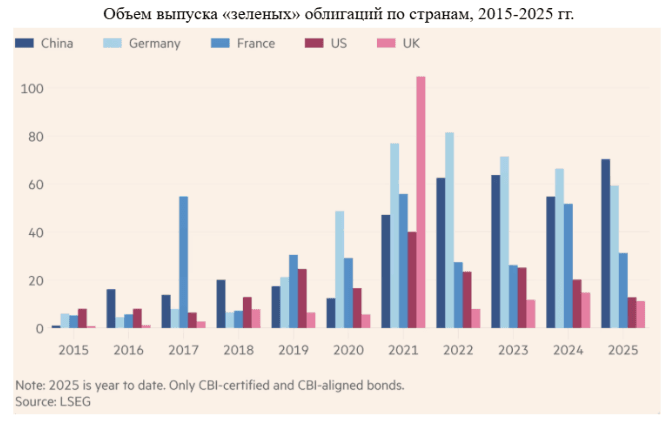
Since then, demand for these instruments has grown rapidly. According to data from LSEG, the total market capitalization of green bonds has reached $2.9 trillion—nearly a sixfold increase since 2018, with issuance volume in 2024 exceeding $570 billion (+10% from the previous year). Traditional leaders in the green bond market are European countries and the US: the EU accounted for nearly 60% of global issuance in 2024 ($388 billion), while the US took first place among countries with a volume of $85 billion.
However, the situation changed in 2025: for the first time, China's green bond market surpassed its Western competitors. In 2025, China accounts for more than 17% of global green bond issuance, while the United States accounts for just 3%. The reasons are as follows: Beijing is actively supporting economic decarbonization, attracting funds for the construction of solar, wind, hydroelectric plants and other green projects. In the US, however, political uncertainty and the Donald Trump administration's skeptical attitude toward the green agenda have led to falling demand for these securities—although many investors continue to finance environmental projects, they try to avoid officially using the term "green bond."
The main systemic risk of green bonds is the absence of unified, strict terminology and oversight. Different standards and weak verification allow some issues to formally carry the "green" label without real environmental impact (greenwashing), so investors need thorough vetting of projects and documentation. Ultimately, the market is still small compared to the necessary investments in climate goals: current annual issuances cover only a portion of required funds (estimates suggest around $2 trillion per year is needed to address climate challenges).
In the end, both green and catastrophe bonds provide new instruments for financing climate risks, but their effectiveness depends on developing standards and transparency. Without proper regulation, they risk remaining niche instruments, while the main burden of dealing with climate disaster consequences will continue to fall on government budgets.
Green bonds appeared on the domestic sustainable finance market only recently, and their volumes remain modest. In 2024, ESG bonds were issued for a total of just 52.8 billion rubles, of which green bonds accounted for only 2.8 billion (5.3% of new placements).
For comparison: at the peak of interest in 2021, green issues exceeded 70% of the market. Back then, Moscow became the largest issuer: the city government placed green bonds worth 70 billion rubles, of which 60 billion rubles went toward the construction and modernization of the metro (including the Big Circle Line), and approximately 10 billion rubles toward the purchase of 400 electric buses. An additional 51 electric buses were acquired through a second green bond issue in 2023. This project demonstrated that green bonds can finance specific infrastructure projects, bringing tangible benefits to the city and engaging residents in investing in the development of their own urban environment.
However, over the past two years, only one company has been issuing such securities—PAO EuroTrans: in 2024, two issues worth 2 and 0.8 billion rubles, and in the first 9 months of 2025, 4 billion rubles. According to data from the Central Bank, by October 2025, bonds in the sustainable development segment had been issued for a total of approximately 504 billion rubles, of which green bonds accounted for 267 billion rubles. This represents less than 1% of the entire Russian bond market.
Meanwhile, the necessary infrastructure has been established in Russia: a national taxonomy of "green" and "transition" projects has been approved, an external verification system is in place to confirm that issues meet established requirements. The Bank of Russia has updated its approach to risk weights, incentivizing banks to lend to sustainable projects, and the Moscow Exchange has launched a sustainable development sector for listing such bonds. In 2025, the government also clarified the list of priority areas—from renewable energy sources (RES) and energy efficiency to hydrogen and carbon capture technologies—making project selection criteria more predictable.
But private capital is in no hurry to enter this market. The reasons: "green" certification is expensive, such bonds are difficult to sell on the secondary market, and there is almost no stable demand from ordinary retail investors—purchases are mainly made by state banks and government-affiliated institutions. According to estimates from market participants, issuing a green bond costs the issuer 0.20–0.25 percentage points more than conventional debt, while the premium from investors is virtually nonexistent.
As for catastrophe bonds, they remain virtually unused in Russia. Although the Central Bank called on insurers to develop such instruments back in 2022, the industry continues to rely on traditional schemes with insurance companies and government support. A case in point was the situation in several Russian regions (Rostov, Belgorod, and Voronezh oblasts), where a state of emergency was declared to ensure insurance payouts to farmers after spring frosts. This raises the question of what farms in similar situations should do if they cannot secure an emergency declaration—without specialized instruments, the risks remain on the budget's shoulders.
Thus, further growth in the global market for green and catastrophe bonds can be expected. Insurance companies and governments will likely increasingly transfer climate risks to capital markets, but CAT bonds will remain high-risk and volatile, especially for large investors, due to the threat of "one major shock." Green bonds have more stable prospects: demand for financing renewable energy and energy efficiency will grow, but scaling depends on the economic attractiveness of projects, predictable government energy policy, and transparent rules for investors. Otherwise, "green" issuances risk remaining a niche instrument heavily dependent on government support.