This text is an automatic translation from Русский. It was generated by AI and may contain inaccuracies.
Read original →Cheaper, but Not Less: Why the US Is Pressuring Russian Oil Prices
How sanctions against Lukoil and Rosneft are reshaping the oil market: why the US isn't blocking supplies but reducing Russia's profitability. Analysis of the impact on prices, the role of India and China, and consequences for Russia's budget.
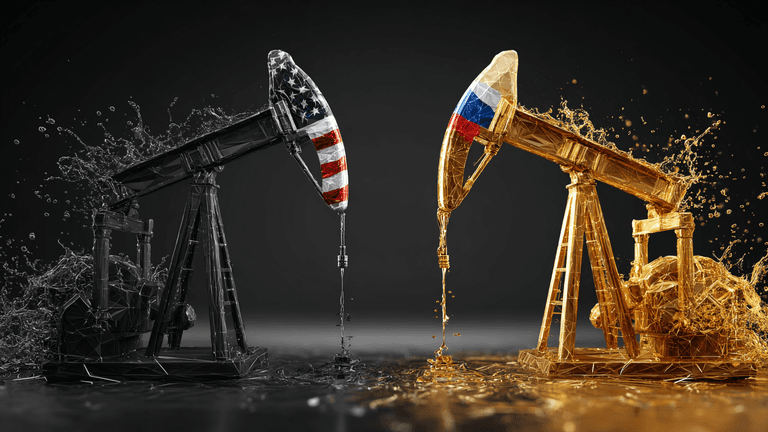
Sanctions Without a Blockade
Washington didn't ban the oil itself—just the companies and infrastructure through which it flows. The sanctions targeted Lukoil and Rosneft, Russia's two largest oil groups, which together account for about five percent of global production.
But unlike the early months of 2022, when any news about Russian oil sparked panic, the market's October reaction was restrained: Brent prices jumped nearly 5% and stabilized around $66 per barrel. By comparison, when the threat of losing Russian oil exports emerged in March 2022, Brent peaked above $130 per barrel.
The main reason for the calm? The market has long learned to live with sanctions. Dozens of workaround schemes exist: a "shadow fleet" of tankers without Western insurance, settlements in yuan and dirhams, chains of intermediaries from Dubai to Shanghai. No one believes Russian barrels will disappear. But everyone understands: now each one costs more to move.
The Goal Isn't to Block, but to Cheapen
The paradox of recent years is that Western sanctions against Russian oil increasingly resemble not a ban but a "friction tax" instrument. The flow doesn't stop, but with each new sanctions wave it loses speed and margin. Russian suppliers are forced to compete for customers through price dumping. Russia ranks in the top three global suppliers; in August, daily oil supply volumes, according to the IEA, reached 7.3 million barrels, or 10% of the market.
Meanwhile, 60% of all Russian "black gold" exports come precisely from Lukoil and Rosneft. On a global scale, these two largest companies account for about 5% of total world crude oil production—around 5.3 million barrels per day (b/d)—of which they export about 3.5 million barrels per day.
This is where transaction costs emerge: every barrel requires a steeper discount, a longer route, riskier insurance. This is Washington's hidden calculation: not to knock Russia out of the oil market, but to make its participation maximally unprofitable. Lower prices for Russian oil mean lower exchange quotations—and cheap oil is one of Trump's key promises.
In geopolitical terms, this is a compromise between "hitting the budget" and "not exploding prices." The global economy still depends on Russian oil. Even in October, after all the restrictions, it covers up to 10% of global demand. For the US, what matters is that the barrels keep flowing—and get cheaper.
"India's Pause" and "China's Insurance"
India has become a symbol of the "price reduction through sanctions" strategy—the largest buyer of Russian oil after China. Its oil giant Reliance, which operates a complex with 1.24 million barrels per day capacity in Jamnagar, has already warned it will strictly comply with Western sanctions. This means: some Russian oil purchases may halt, while the remainder will flow through longer chains.