This text is an automatic translation from Русский. It was generated by AI and may contain inaccuracies.
Read original →Caviar Production Surges in 2025—But Will Prices Actually Drop?
Salmon catches rose 44% in 2025, yet red caviar prices are barely budging. We break down why: from retail markups to climate risks. Plus, a price forecast for the New Year holidays.
Salmon Is the Foundation
The basis of red caviar production is salmon, which is caught primarily in the Pacific Ocean. The fish carcass goes for "meat," while the roe is salted and sold. According to Rosstat data, the price per kilogram of red caviar in Russia dropped below 9,500 rubles in September of this year—the first time this has happened since late 2024. This trend continued in October. The high prices throughout 2025 are largely tied to seasonality: the fishing season runs from June through October. Nearly 70% of all caviar volume enters the market in the second half of the year, so the price peak traditionally falls in July–August. In spring and summer, retail prices remain elevated because only stocks from the previous year's production remain on the market. In other words, throughout the first half of the year, the market was supplied with leftover "last year's caviar," and 2024 saw a record-low salmon catch of 233,000 tons.
According to the Russian Fish Union (based on statistics from VNIRO), as of October 20, 2025, the Pacific salmon catch in the Far East reached 335,000 tons—44% higher than the figure for the same date in 2024. This significant growth is due to the low base effect from last year's "non-salmon year," meaning seasonal factors and the fish's life cycle.
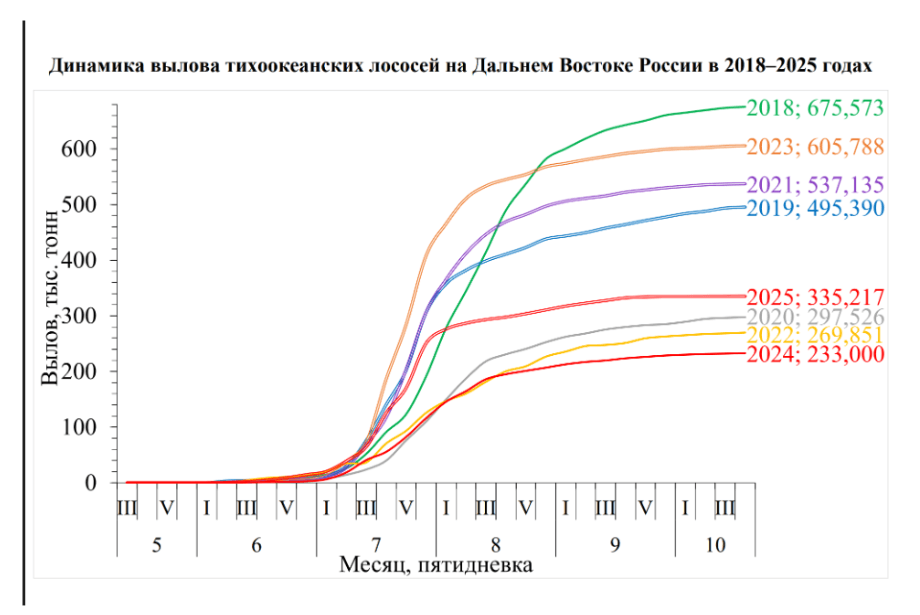
Typically, salmon catches are better in odd years than in even years, since the reproductive cycle of pink salmon (the main target species among Pacific salmon) is two years. To put this in perspective: in the odd year of 2023, the catch was one of the highest on record, exceeding 600,000 tons, while in the even year of 2024 it plummeted by half—around 230,000 tons (the worst fishing season in recent years of observation).
The record was in 2018—676,000 tons. In the odd year of 2025, we're again seeing growth in salmon catches—over 335,000 tons (by year-end, the catch could reach around 350,000 tons).
This was confirmed by a representative of the Russian Fish Union in a conversation with Argument Media, noting that the Union's Analytical Center relies on official statistics. Taking into account the volume of salmon catch and the roe yield coefficient (4-4.5% on average), the forecast for red caviar production is around 15,000 tons. Meanwhile, domestic market demand is estimated at 11-13,000 tons. "In other words, there's sufficient caviar on the market, and the price of this delicacy will be determined by the balance of supply and demand," the association notes.
Where Salmon Is Caught and How Much
Looking at catch regions, there's also an imbalance. The bulk of salmon fishing occurs in the northern Far East, in Kamchatka—nearly 80%. This concentration of production intensifies the market's dependence on a single region. Any disruptions in Kamchatka—whether weather-related, logistical, or administrative—immediately impact the federal price of red caviar. Meanwhile, southern regions of the Far Eastern Federal District are seeing declining catches.
Catch statistics by Far East region. As of October 20, 2025:
- Kamchatka Krai – 259,000 tons (77% share of catch),
- Khabarovsk Territory – 33,000 tons (10%),
- Magadan Region – 13,000 tons (4%),
- Sakhalin Region – 21,000 tons (6%)
- Primorsky Territory – nearly 9,000 tons (3%),
- Chukotka Autonomous District – 0.3 tons (0.1%).
For example, in Sakhalin Region during January-October 2025, the salmon catch reached only 33.8% of the recommended volume – 21,000 tons. Sakhalin Region's Minister of FisheriesIvan Radchenkotold Argument Media that this year the region faced unfavorable climate conditions that caused a decline in Pacific salmon catches. According to him, this was offset by the development of commercial aquaculture and the effective operation of salmon hatcheries.
"The total chum salmon catch practically reached last year's level," the minister emphasized.
Scientists also confirm the danger that climate change and rising sea temperatures pose to salmon spawning. According to the head of the salmon fish laboratory sector at SakhNIROAnton Makoedov:
"This year (on Sakhalin) we recorded extremely high temperatures in these waterways and coastal areas—up to 28-29 degrees Celsius. We've seen years like this before (2021, 2023), and the trend is accelerating year after year. Most likely, we're looking at what has now become a pattern."
Climate has become one of the key factors in planning fishing seasons: at temperatures above 25°C, mortality rates for fry and roe spike dramatically, meaning that two years from now—in the next "odd" season—the industry could face another drop in catch volumes.
3,000 rubles–the gap between wholesale and retail prices for caviar
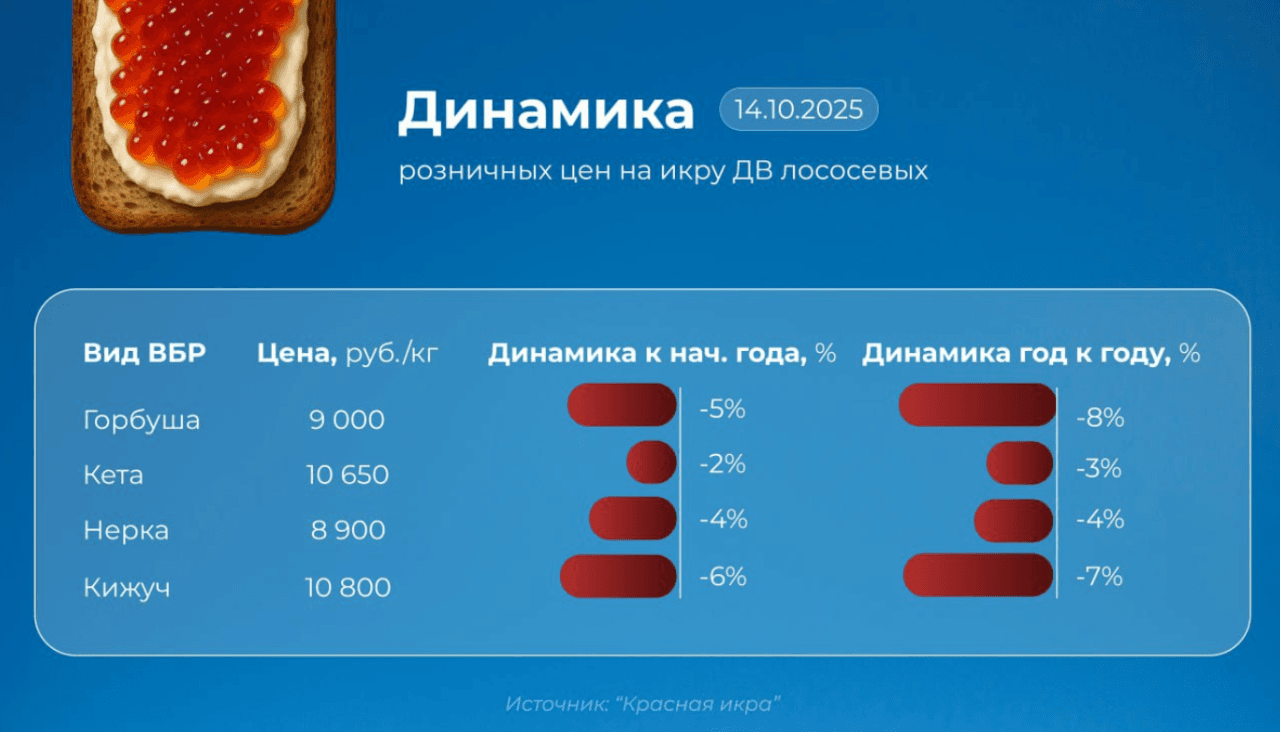
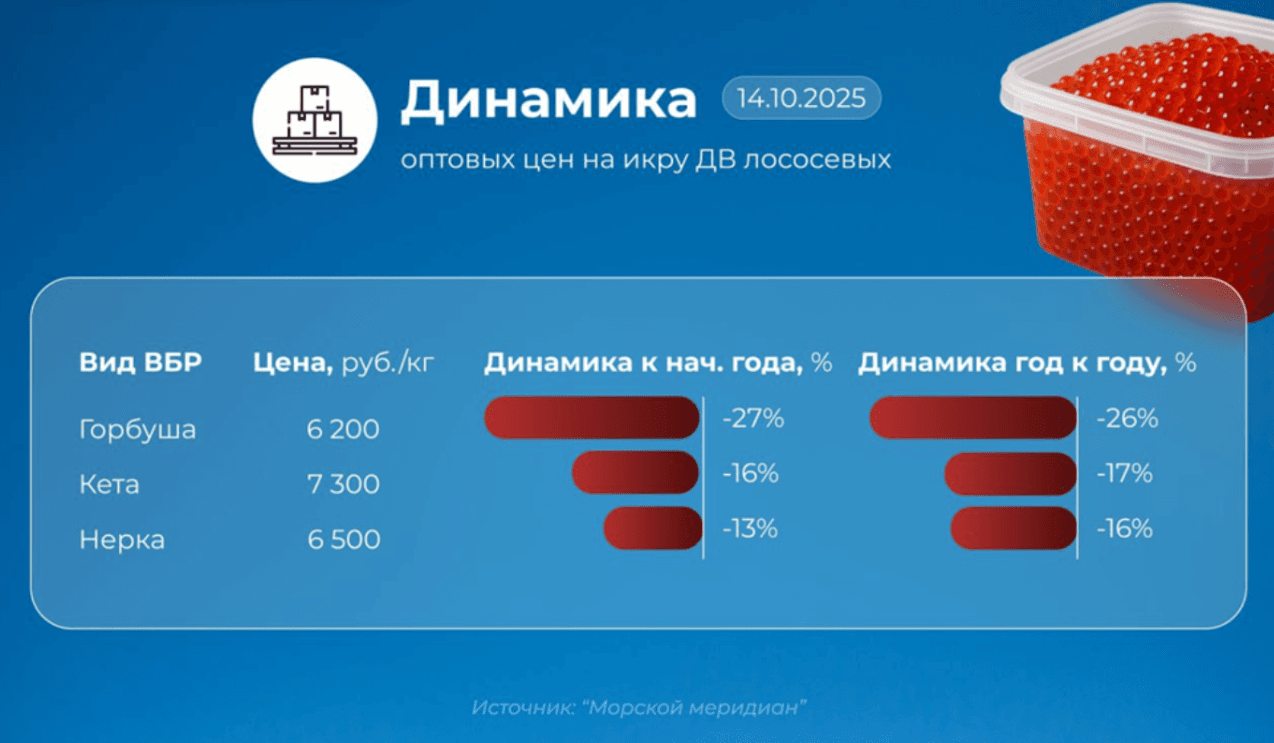
As for retail prices, caviar from certain salmon species now costs less than 9,000 rubles per kilogram, with prices falling between 2% and 6%. Yet over the same period, wholesale prices dropped 13–27%. In absolute terms, the gap between wholesale and shelf prices reaches 3,000 rubles. In effect, retail markups, processing, and intermediary margins absorb the entire benefit of increased catch volumes. For consumers, this means that even when supply rises 30–40%, actual shelf prices fall only 6–8%—not the double-digit drops that market logic would suggest.
Red caviar isn't just a holiday staple—it's a sensitive barometer of food inflation: its price responds to shifts in logistics, climate, and export demand faster than most other products. That makes the red caviar market a litmus test for food policy as a whole: can production volumes actually translate into lower prices, or will caviar permanently shift into the category of festive delicacies accessible only on special occasions?
At first glance, the formula seems simple: the bigger the catch, the more caviar, and therefore the lower the price. In practice, it's far more complicated. The market is highly concentrated: most of the volume and fishing quotas pass through a handful of large processors and distributors. Independent fishermen often sell their caviar wholesale right on the shore, and pricing from that point forward is out of their hands. State Duma deputyFedot Tumusov, in conversation with Argument Media, points to several factors that prevent transparent pricing:
"First, there's high concentration in processing and distribution. When the chain from producer to store shelf is controlled by a narrow circle of companies, it's difficult to talk about genuine competition and transparency. Second, there are opaque mechanisms for reselling quotas and raw materials between companies, which leads to artificial price inflation. And third, there are seasonal factors and logistics costs, especially for remote regions."
Following the fishing season, Fedot Tumusov plans to submit a parliamentary inquiry to the Government and Rosrybolovstvo demanding detailed analytics to understand the price structure: from extraction and processing stages through to sale. According to him, prices could be reduced by implementing a mechanism whereby part of the quotas for catching valuable fish species are granted to companies on the condition that they supply a certain volume of product (for example, 50–60%) to the domestic market at fixed, affordable prices.
Exports – Not a Death Sentence
Many analysts and citizens are also convinced that a significant portion of caviar is exported, which affects the market. However, according to industry association data, about 30% of caviar is supplied abroad — primarily to Asian countries. But when catch volumes decline, this share decreases. In the "unsuccessful" 2024 fishing season, caviar exports totaled just over 1,000 tons, or about 10% of total production. Fish market observer and managing editor at Sfera Media Polina Aslanovatold Argument Media that currently the impact of exports on the domestic market is not critical:
"Exports are not 'draining' cheap red caviar from the domestic market, since supply is currently sufficient and regulated to ensure the domestic market is provided for. Theoretically, however, under unfavorable conditions (declining catch, rising export demand), the situation could change, and then export restriction measures could be introduced to stabilize the domestic market and prices."
In other words, exports today are not the main price driver, but rather a "cushion" for excess supply.
What Will Happen to Caviar Prices by New Year's?
Head of the Federal Agency for FisheryIlya Shestakovnoted that the red fish and red caviar harvested in Russia in 2025 will be sufficient for both the domestic market and exports.
"The greater the supply, the lower the price—that's how it should work in a market economy. Let's hope that's how it will be," the agency head said confidently.
At the same time, the Russian Fish Union told Argument Media in an interview that caviar prices in stores could rise ahead of the New Year.
"The bulk of demand for salmon caviar falls during the pre-New Year period, so prices may increase slightly. For those looking to save money, now is the best time to buy red caviar for the New Year's table," a Union representative noted.
Polina Aslanova(Sfera Media) in a conversation with Argument Media suggests considering a pragmatic scenario with price increases of 20-25% ahead of the New Year.
"Even taking into account the 'odd year' factor and large harvest volumes, we shouldn't forget about inflation, logistics costs, implementation of the Honest Sign labeling system, and other expenses," the expert noted.
Overall, precise price forecasts in consumer sectors are often unpredictable due to numerous factors. For example, even with record catches in 2023, retail prices never dropped below 6,000 rubles/kg..