This text is an automatic translation from Русский. It was generated by AI and may contain inaccuracies.
Read original →Why Family Mortgages Haven't Made Housing Affordable for Russian Families
The family mortgage program has created a price bubble instead of solving the housing crisis. An analysis of housing affordability, income requirements, the developer crisis, and planned changes to the program in 2026.
Prices are rising, affordability is falling
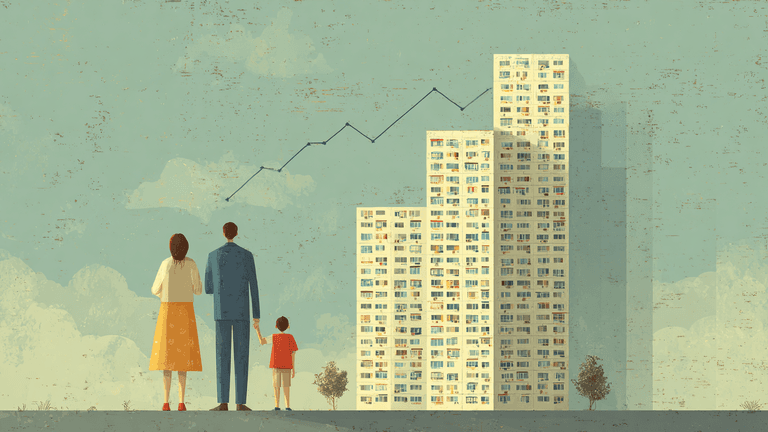
The family mortgage limit in most Russian cities (6 million rubles) only allows for the purchase of a studio or one-bedroom apartment. According to data from the analytical center Dvizhenie.ru, on average just 44% of primary market offerings fall within the program's limit, while in five cities the share of such micro-apartments exceeds 90%, and in Kazan it reaches 100%. Since the beginning of 2025, the situation has worsened: in 12 out of 17 major cities, the share of larger apartments available under the program has declined.
An even more alarming signal is the drop in new project launches: in 2025, developers began construction on just 41.3 million square meters, which is 12% less than a year earlier. This means that over the next 2–3 years, the supply of new builds will continue to contract, especially in the mass-market segment. And buyers will face another round of apartment price increases.
Developers are responding to buyers' purchasing power by reducing unit sizes (to 49 square meters and smaller). According to DOM.RF data, 70% of housing under construction in Russia consists of one-bedroom apartments and studios, yet actual demand for them is falling. In regions where their share reaches 70–75%, oversupply is evident: investment demand has dried up, while buyers want proper housing. The result is that the market isn't responding to real needs, but instead creating a "compact housing trap"—small units that are functionally inadequate and will become illiquid in 10–15 years.
The market is building what people don't want to buy
A gap has emerged between the housing Russians consider comfortable and what they're actually being offered. According to a Domklik survey (more than 3,000 respondents, May 2025), 40% of citizens believe that the optimal apartment size is 70–100 square meters. This format provides space for a family, storage, and a full-fledged household. Another 34% prefer 50–70 square meters, while 15% are willing to consider options over 100 square meters.
However, the new construction market offers significantly less: 46% of supply consists of apartments ranging from 30 to 50 square meters (studios and one-bedroom units), 31% are 50 to 70 square meters, while the most sought-after segment (70–100 square meters) accounts for just 15%. The median size of a new-build apartment in Russia is only 48.6 square meters, and in the secondary market it's 50.6 square meters. This is nearly a third smaller than the minimum comfort threshold for most families.
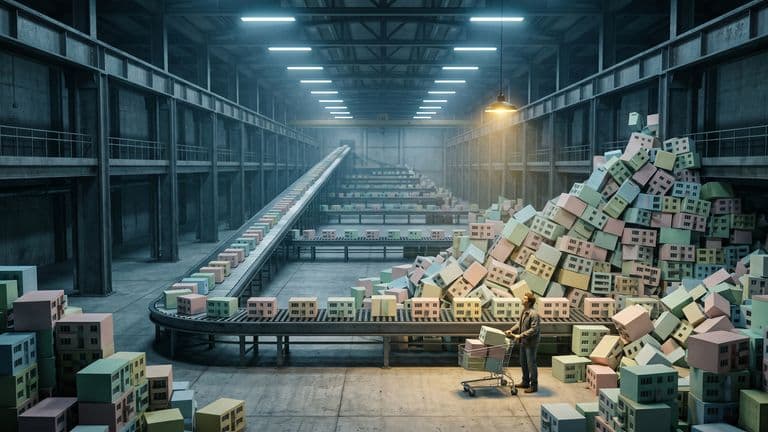
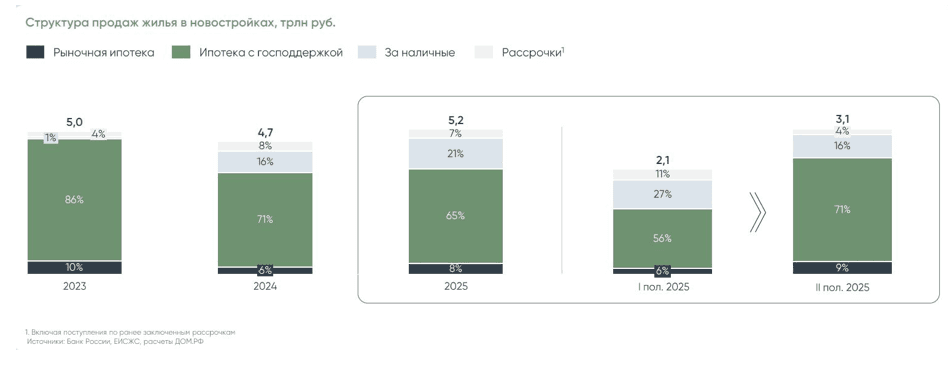
It turns out that developers are mass-producing housing that doesn't match the actual needs of the population. And the reason lies in the parameters of both the mortgage program itself and families' financial capabilities. Mortgage limits with minimal down payments mainly allow for the purchase of small apartments. Amid falling demand, developers have begun changing their sales strategy. They are choosing more high-margin projects, and the volume of new buildings in the mass-market segment has fallen 2.3 times over the year. This, in turn, directly affects buyers' choices: there are fewer new affordable apartments available, and the timeline for new ones to appear is getting longer.
Mass-market housing is getting more expensive faster than anything else, but it's barely being built
Comfort-class new builds in Moscow have risen in price by nearly 40% over the year, to 21 million rubles per apartment, according to data from bnMAP.pro. Meanwhile, the average purchase budget across the entire primary market in the capital has grown even more sharply: from 29 million rubles in January 2025 to 38 million rubles in January 2026 (+32% year-over-year).
The price growth is particularly striking against the backdrop of shrinking supply in the mass-market segment. Last year, the share of comfort-class housing in Old Moscow dropped to less than 30%. Back in 2021, mass-market new construction accounted for more than half of residential development in the capital. Business-class projects now exceed 50% of supply within the MKAD, while the average budget there stands at 36.5 million rubles (+16% year-on-year). Developers' ingenuity has reached the point where they've started calling even projects beyond the MKAD "business-class."
This intensifies the structural imbalance: demand for affordable apartments remains high (according to EISZHС data, in Moscow the sell-through rate in the economy and comfort classes exceeds 100%), but developers can't build in this segment due to low margins, expensive land, and financing difficulties. Developers are now rationalizing even plots under 1 hectare and increasing building heights: the average height of new construction has reached 19 floors, with every fourth project being a skyscraper over 25 floors. As a result, the market continues to grow more expensive even as the economy and household incomes fail to keep pace with prices.
The gap between incomes and new construction costs is widening due to mortgages
Even with subsidized mortgages, housing remains unaffordable for most Russian families. Banks assess not simply income, but payment capacity—the borrower's ability to service debt. The key metric for bank approval is the PDN (debt burden indicator). To receive approval, monthly payments on all loans (including the future mortgage) must not exceed 50% of income. In practice, this means income must be at least double the payment amount.
Take a standard one-bedroom apartment of 36 m²—precisely the minimum area recommended According to DOM.RF data for the end of 2025, the cost per square meter for a one-bedroom apartment in Moscow stood at 452,000 rubles (within the MKAD ring road – 478,000 rubles). Consequently, its total cost should be no less than 16.3 million rubles. For the Moscow region, an apartment with these parameters (at 224,000 rubles per square meter) would cost from 8 million rubles.
It's also important to consider that the price of the apartment itself in new construction is inflated precisely because it "qualifies" for the mortgage program. The markup can reach 20–30% compared to the market value of similar housing not tied to government programs. This happens because developers include in the price not only the cost of construction, but also the cost of the "mortgage product": the subsidized rate, installment plans, and other marketing options.
At a market rate of 20% (the actual average at the beginning of 2025) and a 20% down payment, the monthly payment and required income would be as follows: for Moscow – 218,000 and 436,000 rubles, for the Moscow region – 107,000 and 214,000 rubles respectively. At the subsidized rate of 6% with a 20% down payment, the monthly payment and required income would be: for the capital – 78,000 and 156,000 rubles, for the region – 38,000 and 78,000 rubles respectively.
However, families mainly purchase larger apartments. According to DOM.RF, in 2025 the average size of an apartment purchased through the family mortgage program was 57 square meters. Such a two-bedroom apartment costs approximately 25.7 million rubles in Moscow, and 11.7 million rubles in the Moscow region. Monthly payments with a family mortgage would be 123,000 and 56,000 rubles respectively, with borrower income requirements of 246,000 and 112,000 respectively. But one must also consider that the limit for such mortgages in Moscow and the region is up to 12 million rubles, meaning the remaining portion of the apartment's cost must be financed through a market-rate mortgage. Therefore, the overall debt burden on borrowers is even higher.
For comparison: the median salary in Russia in 2025 was around 74,000 rubles, and in Moscow—110,000 rubles. It turns out that even in the capital, the average family cannot afford a mortgage on a standard apartment without subsidies if they lack savings or another property for a trade-in deal. And if the family has no official proof of income, their chances of approval approach zero.
Thus, subsidized mortgages make housing accessible only to the top 20% of the population (and after the planned segmentation of mortgage rates by number of children—even fewer). The rest either cannot scrape together the down payment or fail the debt-to-income ratio test. As a result, the program doesn't solve the housing affordability problem—it merely props up demand for compact apartments that developers build to stay within the limits. Subsidized mortgages work as a demand redistribution mechanism, not as a tool for reducing housing costs. They help developers sell overpriced square meters but don't make housing more affordable for families. The frenzied demand only temporarily supports prices, creating a bubble that will sooner or later require correction, especially amid stagnation.
Developers' financial models don't allow them to sell cheaper
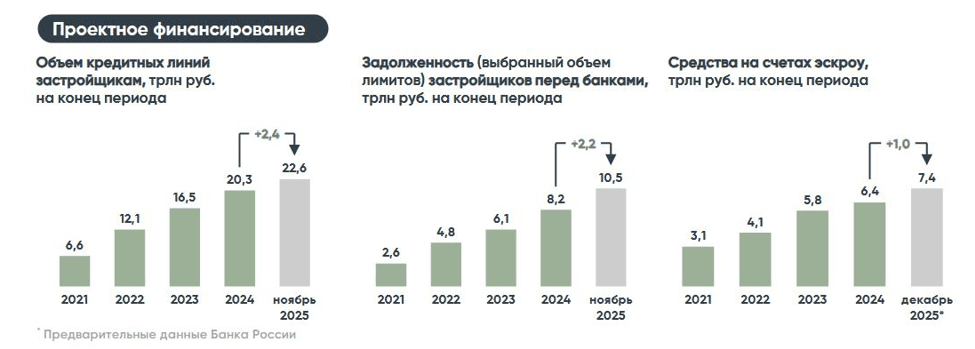
The project financing system for developers is increasingly breaking down. According to the Unified Resource of Developers (ERZ.RF), the average coverage ratio of project financing debt by buyers' funds in escrow accounts across Russia as of December 1, 2025 stood at just 72%. That's 11 percentage points lower than a year earlier (83% as of December 1, 2024). In 70 regions, coverage deteriorated over the year, and in 19—over the past month alone.
This means most developers cannot fully repay their loans with buyers' funds. The gap must be closed through equity capital, refinancing, or slowing construction—which in turn leads to delivery delays, rising costs, and bankruptcy risks. Meanwhile, project financing rates remain high (up to 15–20%), while the moratorium on late penalties reduced incentives to complete projects promptly.
But now the moratorium has been lifted—or rather, penalty payments have been pushed back to the end of 2026. According to Alfa-Bank's calculations, the potential volume of penalties could reach 331 billion rubles — more than twice the combined net assets of most mid-sized developers. This explosive growth stems from a simultaneous increase in construction volume with delayed timelines (from 19 million m² in 2021 to 27 million m² in 2025), rising prices per square meter (up 132% over four years), and a persistently high share of delays — 22–23% of the entire portfolio. Even with moderate sales rates and partial debt coverage through escrow accounts, developers find themselves trapped: they can't pay penalties due to liquidity shortages, while rushing to complete unsold buildings is prohibitively expensive given high loan rates.
The case of Samolет is telling — the company appealed to the government for financial assistance. The developer aggressively expanded its land bank during the mortgage boom (through 2024), often using floating-rate loans, and only later shifted to optimization — but it was already too late. As a result, some plots entered construction only in 2024–2025, when demand had weakened and construction costs had risen. According to EISZHS data, Samolет's sales rates for projects scheduled for completion in 2026 remained high (80% and above). However, newer projects already show a notable demand deficit: sales rates drop to 52% for recently launched buildings.
According to the Unified Developer Resource, as of end-2025, 25.8% of housing under construction (1.2 million m² out of 4.7 million m²) was being built behind the planned completion schedule — a quarter of the entire current portfolio. In other words, the developer couldn't sell enough housing to meet its obligations to banks. In 2025, Samolет's adjusted net debt exceeded 350 billion rubles against sales of 272 billion rubles. This confirms the market shift: launching projects on a wing and a prayer is no longer viable — the market has stopped absorbing housing simply because it's been built. Meanwhile, authorities refused to "rescue" the developer with budget infusions. Most likely, the group of companies faces a change of ownership with assets being transferred to other entities.
Conclusion
The family mortgage system hasn't solved the housing question for most Russians; instead, it inflated a price bubble in the primary market. It forced developers to build small, nominally "affordable" apartments that don't meet families' actual needs. In January 2026, revenues for developers in the Moscow region grew by 6% compared to January last year. But this is the result of rising prices and shrinking average apartment sizes. The price per square meter rose 14% across the region overall, while square footage dropped 6%. This is the only way to maintain revenue growth amid falling physical demand. Buyers are getting less and less living space, but paying more and more for each square meter, which is now marketed as "business class."
In December 2025, Russians rushed to take out mortgages before the program's terms changed. This produced a short-term spike in sales (+79% y/y in monetary terms and +71% y/y in volume), but a cutoff is coming—many families no longer qualify for the mortgage terms. Starting in February, they banned registering two subsidized mortgages for one family and required spouses to be co-borrowers. Now authorities are discussing differentiating the rate based on number of children: 10% for one child, 6% for a second, 4% for a third and subsequent children. In parallel, they're preparing measures against investment use of the program: among the proposals are a ban on purchasing compact housing and restrictions on obtaining credit outside one's place of registration.
In effect, the family mortgage has ceased being a social instrument and turned into a targeted lever for market regulation, where affordability is increasingly giving way to control over demand and budget expenditures. At the Ministry of Finance believe that the share of subsidized mortgage programs in the market should be reduced to 25–30% from the current 90%. One solution could be the construction of social housing for rent to young families. Already, Moscow's Renovation Fund leads in housing construction volume, and part of this volume could be converted into rental housing with the option to purchase at a subsidized price. Such a model would be an alternative to commercial housing, which developers are making increasingly expensive and cramped for occupancy.