This text is an automatic translation from Русский. It was generated by AI and may contain inaccuracies.
Read original →The Age of Kaiju
Large language models have become the modern-day kaiju—forces we've created but can't control. We examine how AI has transformed the economics of communication, why human attention has become scarce, and what's left for people in a world where machines write the texts.
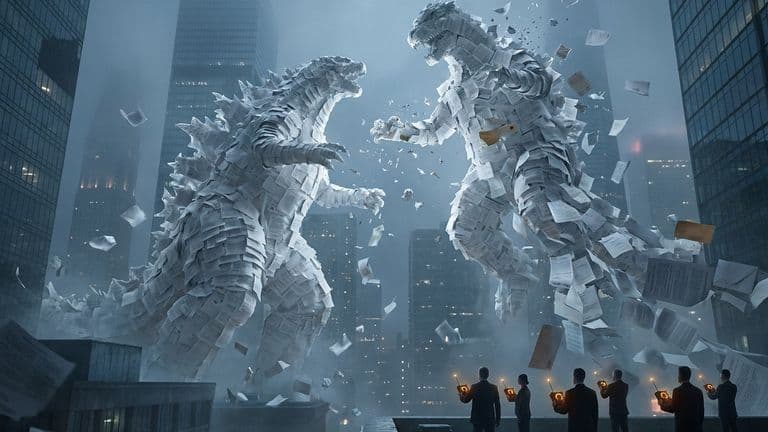
I'll start with a confession. Some of the texts that go out under my name are written by artificial intelligence. Emails, replies, comments: I provide the thought and tone, the model arranges them into neat paragraphs, and off they go into the world as mine. Most of the time I proofread them. Not always. Sometimes the text looks so competent and appropriate that my eye glides over it without pausing, and my finger hits "send" on its own. I suspect the same thing happens on the other end. My message is met not by a person, but by their model, which compresses it into three lines and suggests a response. It turns out two people are corresponding without having written or read a single word. Our models are doing the corresponding. We're just setting the mood for them.
To understand what this means, I needed a metaphor from a completely different era.
Where the monsters came from
The kaiju genre (Japanese for "strange beast") wasn't born from childhood fantasy, but from quite adult history. On March 1, 1954, the United States tested the Castle Bravo hydrogen bomb at Bikini Atoll. The explosion turned out to be two and a half times more powerful than calculated, and radioactive ash covered the Japanese fishing trawler Lucky Dragon No. 5, which was catching tuna outside the declared danger zone. All twenty-three crew members suffered radiation sickness; radio operator Aikichi Kuboyama died six months later.

Panic over "atomic tuna" swept the country, with contaminated fish being pulled from markets across Japan. The press called the incident the third atomic bombing. For a country that had experienced Hiroshima and Nagasaki just nine years earlier, this was an unsettled score, and it had reopened.
That same year, Toho studio producer Tomoyuki Tanaka conceived, and director Ishiro Honda filmed, "Godzilla." An ancient lizard, awakened by nuclear tests in the ocean, comes ashore and burns Tokyo. Honda had been through the war and seen the ruins of Hiroshima with his own eyes. The texture of the monster's skin, according to its creators' recollections, referenced the keloid scars of bombing survivors. This wasn't an attraction, but a dark requiem film. The first kaiju was not so much a monster as a consequence: the embodiment of a force that man himself had unleashed into the world and whose scale he couldn't match. Godzilla can't be defeated, can't be reasoned with. He can only be endured.
From there, the genre took a revealing path. The monsters multiplied and began fighting each other. Godzilla versus King Kong, versus Mothra, versus Ghidorah. In these films, humans shifted from victim to spectator. Tiny figures on rooftops look up at where giants converge in the fog, and root for them like teams at a stadium. By 2021, when Hollywood was filming "Godzilla vs. Kong," studio marketing was directly offering a choice of sides: Team Godzilla or Team Kong. People had developed "their" monsters. The illusion of connection to a power that doesn't ask your opinion.
Today's giants have names and price lists. After its May round of $65 billion, Anthropic is valued at $965 billion, approaching a trillion, and for the first time worth more than its main rival. After its March round of $122 billion, OpenAI is valued at $852 billion and has filed documents for an IPO, and its founder, if the press is to be believed, considers any valuation below a trillion unacceptable. Each of these private companies is comparable in value to the economy of a sizable European country. And we stand on rooftops and cheer. "My" Claude versus "your" GPT, arguments about benchmarks instead of sports scores, model releases staged like a kaiju emerging from the ocean. Choosing sides has become part of identity, though strictly speaking, neither side is ours.
The genre also has a mandatory character: the state. In kaiju films it's always present, in the form of command centers, generals, and fighter jets futilely spraying the monster with fire. Sometimes it builds its own monster, Mechagodzilla. This summer the scene played out almost according to script. Back in spring, Anthropic announced that its new Mythos model was too powerful at finding vulnerabilities to release publicly, and gave the general public a stripped-down version with safeguards. Three days after release, the U.S. Department of Commerce ordered foreign nationals' access to both models closed. Export controls were applied for the first time not to chips, but to the model itself—meaning a software product was treated the way only weapons used to be treated. The company shut down the models entirely that same evening, for all users, and only restored them two and a half weeks later with enhanced protection. Tellingly, the story about the monster's danger was largely told by Anthropic itself: the company's head managed to publish an essay two days before the government letter arguing that the state should have the right to block deployment of overly dangerous models. Too dangerous to release, said the creator. Too dangerous to allow, replied the state. The very same state that's simultaneously asking OpenAI to give its newest model only to approved partners and discussing a five percent stake in it. It's not a judge in the stands here. It's simultaneously shooting at the monster, feeding it, and sizing up getting one of its own.
I can't think of a more accurate metaphor for our moment.
Our lizards
Large language models fit the definition of kaiju without stretching. We created them and don't fully understand how they work. A neural network has no blueprint by which you can trace the course of its "thought," so researchers study their own creation much as biologists study deep-sea fauna: through observation and experiment, not by reading schematics. They're incommensurate with humans. Trillions of parameters, the entire internet read, a scale to which ordinary intuition no longer applies. And they're already fighting each other while we watch from the rooftops.
Look at what business communication has become. A model writes the letter. The recipient's model reads it, compressing it into a summary. A third model writes the response. Humans flicker through this chain twice: at the input, when setting the tone, and at the output, when glancing at the digest. Negotiations, complaint correspondence, job applications and their screening, commercial proposals and responses to them. All of this is visibly turning into an exchange of blows between giant lizards, which the parties observe from the sidelines. People sincerely believe they're controlling their monster—after all, they're holding a remote with a mood dial. But the mood dial isn't control. It's a fan's scarf.
It's easy to dismiss this with irony, but the loss is real. Written speech was a technology of thought. By formulating, we thought. By reading, we let someone else's thought into our heads. When both operations are delegated, communication doesn't disappear—it transforms into ritual. Texts continue flowing back and forth, ever longer and more impeccable, except they no longer change anyone, because no one truly reads them anymore. The kaiju battle at some point stops being a fight and becomes ceremony. The monsters perform it for each other because the audience needs a spectacle.
The Economics of Feeding
Now about money, because every monster has a metabolism.
First and foremost: text generation has become almost free, while human attention hasn't gotten a penny cheaper. Throughout the history of writing, text was expensive to produce and cheap to consume. Now it's the reverse. Economists know well what happens to a market where producer costs fall to zero: supply goes to infinity. We're producing more text than all of humanity throughout previous history, and there's no one to read it. The scarce resource, and therefore the source of value, is no longer writing but reading. Filtering, verification, the ability to understand what's truly important in those forty pages. I wouldn't be surprised if someone who actually reads documents becomes a separate highly paid profession in coming years, like auditors once were.
Second: kaiju are voracious, and only a handful can afford to feed them. The computational arms race is consuming hundreds of billions of dollars in capital expenditures annually: data centers, chips, energy. We're talking gigawatts; discussions about nuclear power plants for AI needs have long ceased being exotic. The barrier to entry into the club of monster owners is such that the market for cutting-edge models operates as an oligopoly, whatever antitrust laws may say. Everyone else, including you and me and entire countries, isn't choosing between "getting our own lizard or not," but between whose lizard to rent. This is a new map of dependencies, and it's already more important than many old ones.
Third, the most curious part: a notable portion of this economy consists of blows that no one sees. A company pays for the tokens in which its model writes a letter. The counterparty pays for the tokens in which their model compresses that letter and responds. Both transactions honestly flow into providers' revenue, into investment presentations, and ultimately into GDP. But what share of this turnover is communication, and what share is ceremony? Statistics don't distinguish between read and unread text. We may be witnessing the growth of an entire sector that produces letters from machines to machines, and its size remains to be assessed. Jevons paradox is at work here too: the cheaper each letter, the more letters there are and the longer each one becomes. Efficiency increases aggregate consumption rather than reducing it.
And fourth, about signals. The trust economy relied on expensive signals. A thoughtful letter, a well-developed proposal, a competent response cost effort and therefore communicated something about the sender. When effort costs zero, the signal dies. The market is already seeking new expensive signals and finding them, ironically, in the pre-digital era. A phone call, a live meeting, a handshake. What cannot be delegated is becoming currency again.
What Remains for Us
I'm not a Luddite and don't intend to pretend to be one. This text was produced in a newsroom that builds AI tools and takes pride in them. The monsters have already emerged from the ocean, they won't go back, and in many battles I honestly root for my own. But the lesson of the genre is different. The best monster movies aren't about monsters at all. They're about people on rooftops, about what they do while giants converge above them. If almost everything can be delegated to machines, the short list of what cannot be delegated becomes all the more valuable. Reading, truly, with your eyes, slowly. Formulating, because that is thinking. And talking to each other out loud. It seems these will soon be the only negotiations that humans conduct.