This text is an automatic translation from Русский. It was generated by AI and may contain inaccuracies.
Read original →The Hidden Costs of Energy Transition: Sovereignty Through Innovation
How historical decisions created Indonesia's coal dependency and why floating nuclear power plants and Russian VVER-1200 reactors could become a path to energy independence. An analysis of institutional barriers to energy transition.

Indonesia's energy transition faces not only technological and economic challenges but also deeply entrenched institutional dependencies formed during previous stages of the country's development. This process is shaped by the peculiarities of domestic political economy, the influence of vested interest groups, and significant disparities in energy infrastructure development across regions.
Using Actor-Network Theory (ANT) as a framework, we examine how green energy transition goals interact with existing political, economic, and technological structures. Historical factors related to early fast-track development programs are particularly significant, as are new technological directions including floating nuclear power plants (FNPPs) and local smart grids, which could transform the established system of relationships in the energy sector.
We also compare Indonesia's experience with mid-20th century India under Jawaharlal Nehru, when technological development was viewed as an instrument for strengthening national independence. This approach offers a fresh perspective on the problem of inadequate electrification in Indonesia's remote island and rural areas—a problem linked not only to geographic conditions but also to historically formed mechanisms of resource allocation and influence.
We examine technological innovations not merely as tools of modernization, but as independent actors capable of transforming existing energy systems and creating conditions for overcoming dependence on fossil fuel sources.
Historical development path: the formation of coal dependency
The vulnerability of Indonesia's modern electricity system is not the result of isolated technical failures or infrastructure deficiencies. It emerged from a series of decisions made during previous stages of the country's development that set the direction of energy policy for years to come.
One pivotal stage was the launch of the Fast Track Program (FTP). It was created as an emergency measure to prevent electricity shortages and rapidly increase energy production capacity. However, its implementation focused primarily on reducing upfront construction costs for new power plants, while questions of long-term system sustainability took a back seat.
The choice of subcritical coal-fired power plants, which at the time were considered the most accessible and economical solution, led to the formation of a persistent dependence on coal energy. As a result, the entire national energy system became locked into the chosen development model, which subsequently limited opportunities for a faster transition to alternative energy sources.
The expansion of energy infrastructure, oriented primarily toward solving short- and medium-term challenges, created a massive system whose stability directly depends on a single resource—coal. Gradually, Indonesia's energy security became tied to a market where prices are determined by global trends, and access to resources largely depends on a limited number of influential domestic companies.
Disruptions in coal supplies, including those caused by the diversion of resources to more profitable export markets, exposed the weaknesses of Indonesia's centralized energy model. At the same time, problems related to opaque decision-making and corruption in the energy sector came to light.
Against the backdrop of this systemic crisis, the main conclusion of my (note—Wiryanta Mulyono) from a 2010 doctoral dissertation examining disparities in rural electrification levels and the vulnerability of the so-called Outer Islands (editor's note: a collective geographic term used to describe remote, often sparsely populated or uninhabited island territories) of Indonesia.
The persistent gap between development in territories connected to the Java-Bali power grid and the country's remote regions cannot be explained solely by technical difficulties or infrastructure shortages. These disparities reflect deeper problems with Indonesia's energy model itself, built around excessive centralization and resource concentration rather than equitable distribution across regions.
Reducing the archipelago's dependence on fossil fuels: floating nuclear power plants as an additional development tool
To address the chronic electricity shortage in Indonesia's remote, coastal, and hard-to-reach areas without deepening dependence on fossil fuels, new technological approaches must be considered. One such solution could be floating nuclear thermal power plants (FNPPs), based on small modular reactor technologies similar to those used on Russia's Akademik Lomonosov floating nuclear thermal power plant.
In this context, FNPPs should be viewed not as a replacement for renewable energy, but as a complementary power source capable of compensating for its limitations and helping overcome the geographic and political barriers that currently sustain dependence on coal-fired power and the influential groups tied to that sector.
The key advantage of this technology lies in its mobility, which eliminates the rigid territorial constraints of conventional power facilities. Traditional large-scale coal and gas plants require substantial land areas, developed infrastructure, and high levels of constant energy consumption to remain economically viable. Yet the characteristics of Indonesia's remote islands are entirely different: electricity demand there is unevenly distributed and often too small to justify building large thermal power stations. Meanwhile, reliance on diesel generators remains an expensive and economically unfavorable solution.
Floating nuclear plants can solve this problem through their flexibility. Modular reactor units mounted on specialized vessels can be delivered and connected directly at remote ports or in new industrial zones in Eastern Indonesia. This approach reduces the energy system's dependence on complex and vulnerable fuel supply chains.
Unlike traditional coal-fired plants, which depend on constant maritime fuel deliveries and are vulnerable to seasonal storms, logistical disruptions, and market fluctuations, FNPPs can operate for several years after nuclear fuel loading without requiring regular supplies during operation. This provides a higher level of energy stability for remote regions.
Furthermore, floating nuclear plants can serve as a reliable complement to renewable energy sources. Large-scale solar and wind farms remain essential elements of the long-term transition to low-carbon energy, but their dependence on weather conditions creates challenges for the stable operation of small regional power grids.
Nuclear energy, by contrast, can provide constant baseload power regardless of time of day or weather factors. The introduction of such a stable energy source in remote regions could accelerate territorial economic development, create conditions for fish processing, growth of small and medium industrial enterprises, and ensure more reliable electricity supply to rural areas without the constant threat of outages.
The development of floating nuclear infrastructure could also shift the foreign policy balance in the energy sphere. Creating new technological partnerships in nuclear energy allows for an expansion of international ties and reduces dependence on traditional sources of financing and supply.
Historically, many of Indonesia's energy projects have been tied to Western financial centers, international capital markets, and dollar-denominated settlements. Introducing independent technological solutions into the national energy system creates additional opportunities to protect critical infrastructure from external economic risks and the influence of particular groups within the extractive sector.
Artificially Manufactured Dependence: The Political Economy of the Outer Islands
The persistent lag in electricity development in Indonesia's remote regions is often explained by challenging geographic conditions, high maritime transport costs, and low population density. Yet these factors are frequently used as convenient explanations that obscure deeper political and economic reasons for maintaining the existing system of dependence.
One of the most telling examples is the diesel power development model and the profit-making from diesel fuel supplies. The widespread adoption and long-term persistence of diesel power plants in rural areas contradicts basic economic and technical efficiency principles. This is especially striking given that using high-speed diesel fuel results in some of the highest electricity generation costs.
Despite the obvious economic disadvantages of this model, it has persisted for decades. The reason lies in the fact that fuel procurement, supply distribution, maritime delivery, and local provisioning form a stable profit chain valued in the trillions of rupiah.
A transition in remote regions to decentralized energy systems—such as small hydroelectric plants, local solar installations with energy storage, or floating modular nuclear power plants—could disrupt these entrenched revenue streams. This is precisely why influential players in the energy system, operating within existing institutional networks, offer hidden resistance to such changes, seeking to preserve rural communities' dependence on liquid fossil fuels (see Figure 1).
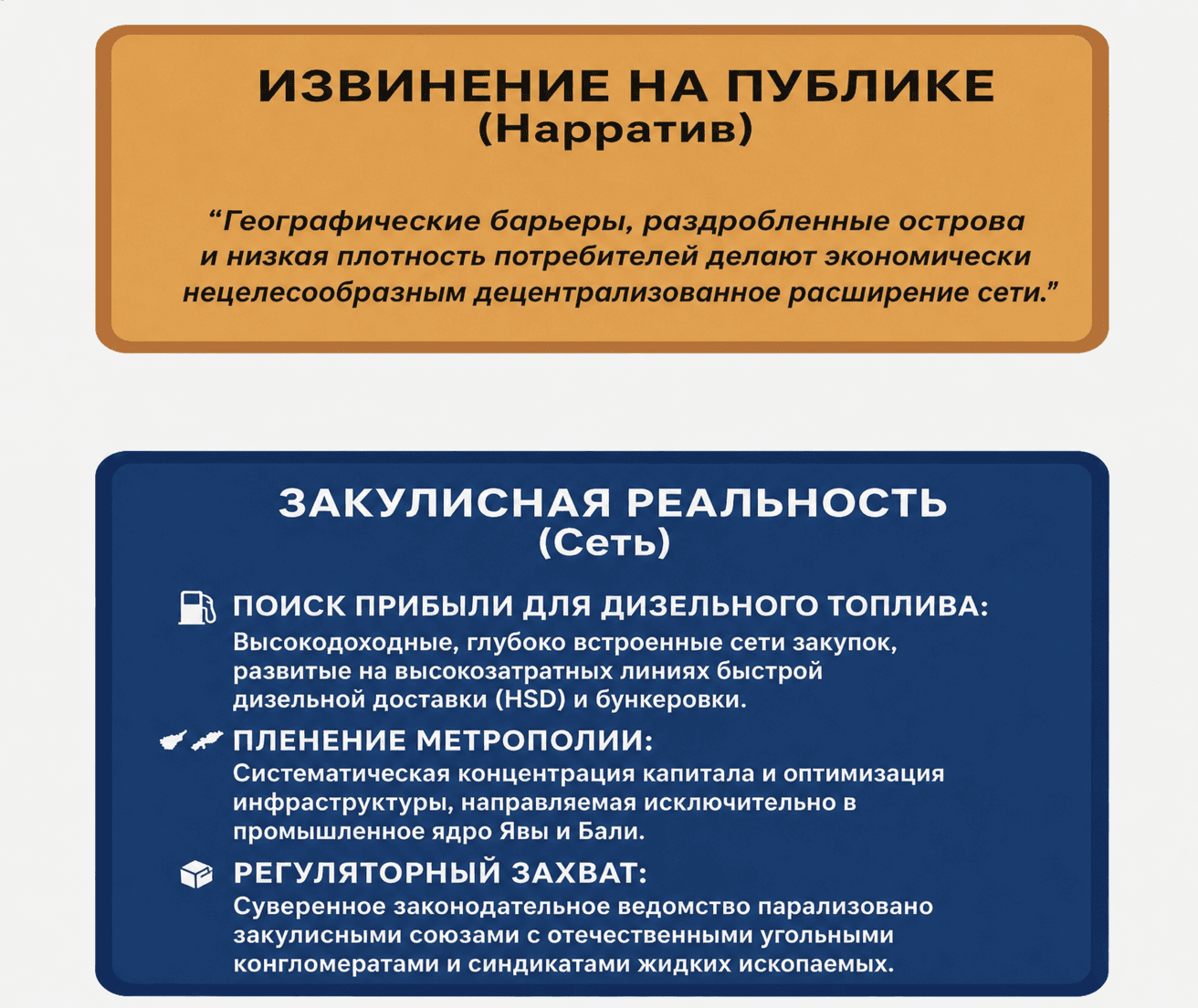
The problem of uneven energy development in remote territories is exacerbated by excessive capital concentration around Java. The financial and management policies of both the state energy company PT PLN and the Ministry of Energy and Mineral Resources are largely oriented toward large projects where maximum economic effect can be achieved through scale.
The bulk of investment flows to the Java and Bali energy system, serving the needs of industrially developed regions and enabling financial sustainability for previously implemented large projects. As a result, the Outer Islands effectively find themselves in the position of peripheral territories: their natural resources—primarily coal and nickel—are actively exploited to supply industrial centers located in other regions, while local residents living near major extractive enterprises continue to face regular power outages.
This territorial inequality is compounded by the absence of a long-term national development strategy based on sustainable political and institutional principles. This situation differs markedly from India's experience after independence. Between 1951 and 1953, Prime Minister Jawaharlal Nehru established the Indian Institutes of Technology, which became key institutions for developing the national scientific and technical base and strengthening the country's technological self-reliance.
Meanwhile, Indonesia after the reform period abandoned long-term mandatory development strategies, replacing them with five-year state plans that largely depend on the current political situation and electoral cycles. As a result, energy policy has become less consistent and more susceptible to short-term changes.
This approach has led Indonesia to partially adopt market models from developed countries without having analogous institutional control mechanisms. While in developed economies independent judicial and regulatory systems can limit abuses by large corporations, in Indonesia the introduction of market competition occurred within an administrative system vulnerable to the influence of interested groups. The result has been not the formation of an efficient competitive market oriented toward the public interest, but rather the strengthening of major national mining companies' influence over energy sector decision-making.
From an actor-network theory perspective, the transition to green energy isn't simply about swapping one set of technologies for another. It's a complex process of restructuring the entire system of interactions among people, organizations, technologies, and infrastructure. Successfully completing this transition requires coordinating the actions of various stakeholders and establishing a stable new energy system.
The experience of Indonesia's periphery shows that this process still faces serious obstacles. Cementing this new development model requires not only technological changes but also institutional reforms capable of transforming existing rules and power structures.
The analytical matrix presented below identifies the main causes disrupting this process and explains how radical technological and organizational changes can help establish a new sustainable energy system (see Table 1).
To eliminate deep imbalances, the state needs to move beyond individual regulatory changes and return to the principles of long-term strategic management of energy development.
Much like India undertook a large-scale institutional transformation in 1953, Indonesia needs to build a resilient system grounded in technological self-reliance and a long-term national energy course. Within such a strategy, the development of decentralized regional energy systems and ensuring equal access to electricity in rural areas must become not temporary political goals, but development priorities enshrined at the level of foundational state principles. This will protect energy policy from constant changes tied to government turnover and short-term political interests.
Equally important is ensuring the independence of key energy institutions from political influence. This requires changing the approach to managing state energy companies and regulatory bodies, making their work more professional and competency-oriented rather than based on political loyalty. Leadership positions in strategically important structures should be occupied by specialists with deep technical and managerial expertise.
From an actor-network theory perspective, sustainable energy sovereignty is impossible if the state remains merely a consumer of ready-made foreign technologies and depends on external financial incentives. True independence begins when the state uses its regulatory capacity to establish unified open standards, develop its own technological base, and implement advanced solutions capable of transforming existing dependency structures.
High-tech innovations should be viewed not only as tools for energy sector modernization, but as a means of transforming the management system itself, enabling the reduction of entrenched interest groups' influence and eliminating profit mechanisms based on preserving inefficient development models.
How Systemic Dependency Forms: Political Declarations and Real Processes
Indonesia's transition to "green" energy under state company management cannot become sustainable as long as key decisions are determined by political and economic compromises. The main problem with developing clean technologies in the country lies not so much in the technical limitations of solar or wind power, but in the fact that state capacity is constrained by the influence of established economic groups and interests tied to traditional energy.
Achieving a just energy transition in rural areas and remote islands outside the Java and Bali power grid requires deeper changes: developing decentralized energy systems, local networks, and reliable energy sources independent of fossil fuels. However, such transformations require not only new technologies, but also long-term state policy based on principles of technological independence.
This structural problem reveals the gap between official statements about developing "green" energy and the actual capabilities of the existing management system. Formal political institutions often prove unable to effectively unite various stakeholder groups around energy transition goals. As a result, many decisions made at the legislative level become merely a set of documents and regulations that don't lead to real change.
From an actor-network theory perspective, people involved in decision-making find themselves constrained by the established system of interdependencies. They are influenced not only by other process participants, but also by material factors—energy resources, infrastructure, financial flows, and technological limitations. Parliament in such a system serves more as a source of formal decision validation than as a space for deep analysis of technological and economic consequences.
The lack of technical expertise further complicates the situation. Legislators often lack specialized knowledge to evaluate complex energy decisions—from managing smart grids and the specifics of coal power to the potential of floating small modular nuclear reactors. Therefore, many political decisions are made not based on deep understanding of technological processes, but under the influence of public pressure, economic interests, and industry group activism.
This situation shows that material conditions often exert greater influence on energy development than formal political decisions. Officials and politicians may perceive the creation of new rules as an independent process of choice, but in practice their actions are constrained by existing contracts, infrastructure, global commodity prices, and international financial flows.
Even modern digital monitoring and accounting systems, such as the Minerba One Data Indonesia platform, are primarily capable of tracking resource movement and collecting information. They cannot always counter the influence of global markets, where changes in international prices and export conditions often affect domestic resource allocation more powerfully than state restrictions.
This problem has deep historical roots connected to the peculiarities of Indonesian governance system development. The modern interaction between state energy structures, local coal companies, and international financial centers largely replicates historical patterns of influence distribution formed during the colonial period.
Just as the Giyanti Treaty agreement of 1755 led to the weakening of the Mataram state's independence through a system of political concessions to the Dutch East India Company, the modern energy system also often sacrifices long-term independence to preserve the current balance of interests. Instead of deep structural reforms, priority is frequently given to distributing political influence and appointing people to key positions chosen not solely for their professional qualities.
Today's version of the "divide and rule" principle manifests itself in maintaining fragmentation between different social groups. The urban middle class is increasingly shifting its civic engagement into digital spaces, while rural and remote communities remain dependent on centralized fossil fuel-based energy systems, including diesel generation.
Breaking out of this situation requires an alliance of different social forces: an active middle class, local communities, and professional specialists capable of forming a more autonomous model of energy development oriented toward society's long-term interests.
One possible direction for such an approach is the concept of "Digital Leadership 5.0," which combines the idea of governance based on a clear public mission with the development of indigenous technological solutions aimed at strengthening national autonomy.
Quantitative data: dynamics of the coal industry at the national level (2021–2025)
To substantiate the above, the following table presents data showing a notable gap between rapid production growth and persistent instability in the energy supply system.
The End of the Thermal Power Era and the Transition to New Energy Systems
Global energy transition models show that replacing traditional baseload power sources with variable renewable energy can undermine grid stability. Such a transition requires not only the development of new technologies but also a fundamental rethinking of how energy markets operate, along with widespread deployment of energy storage systems.
Thermal power plants—facilities that convert the energy from fuel combustion into mechanical energy for electricity generation—are categorized by the type of fuel they use. The choice of fuel largely determines the future trajectory of the energy system: it can either lock in long-term dependence on a particular technology or create conditions for a more autonomous path of technological development (see Figure 2).
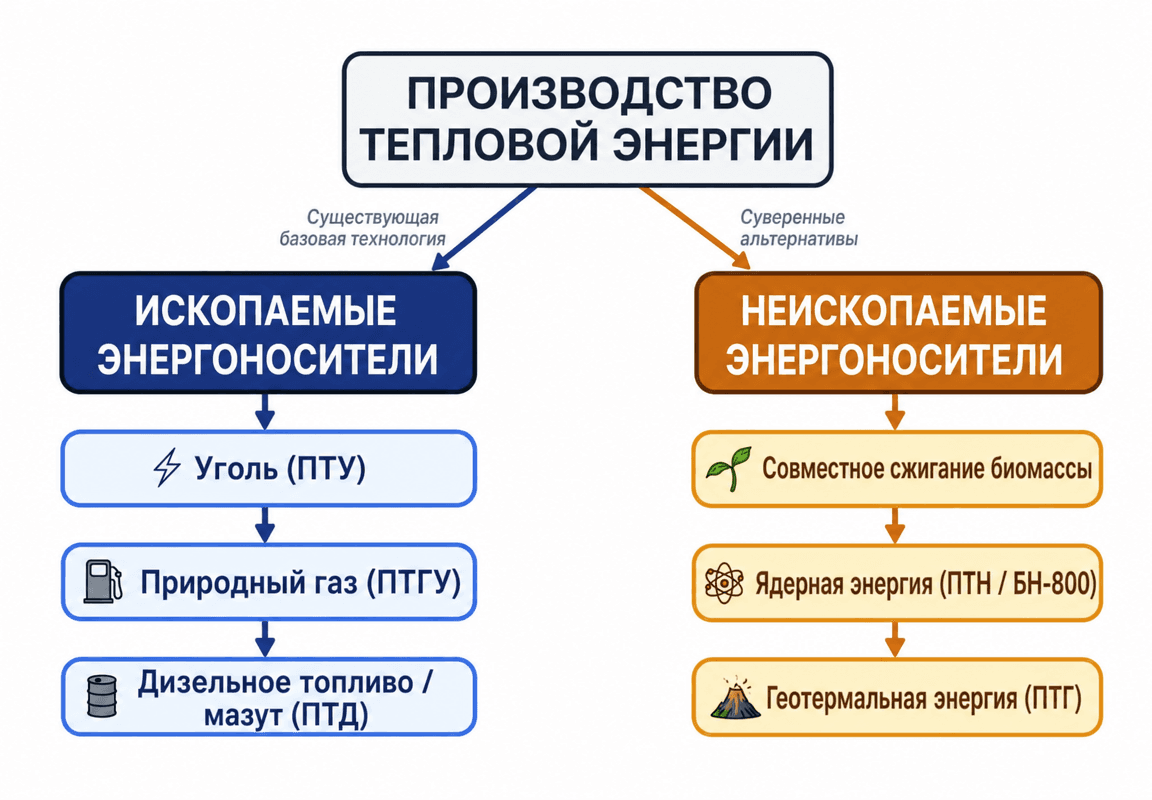
Fossil fuels are the primary factor locking national energy systems into existing development models. Coal plays a particularly significant role here, as it formed the foundation of modern energy infrastructure through a network of conventional coal-fired power plants whose operation involves long-term financial commitments and high transition costs to alternative technologies.
Additional components of this system include natural gas, used in gas and combined-cycle power plants as a cleaner transitional energy source, as well as petroleum products—diesel fuel and heavy fuel oil—which are used in diesel power plants. The latter primarily supply electricity to isolated and remote areas or serve as backup capacity during periods of peak demand.
Meanwhile, non-fossil energy sources represent alternative development pathways capable of reducing dependence on the centralized energy model. These include, for example, biomass, which involves direct combustion or co-firing of agricultural waste with coal—such as palm kernel shells or wood pellets—within existing infrastructure.
Another pathway is nuclear power, which uses the fission of uranium or plutonium to generate energy and can provide stable output with low carbon emissions. Additionally, geothermal energy harnesses heat from the Earth's interior and natural hot water to produce electricity at specialized facilities, providing a constant energy source independent of weather conditions.
In the context of global climate commitments, the gradual phase-out of fossil fuels primarily targets the reduction of coal, gas, and oil-fired generation, as these technologies lock in the existing energy model and are the main source of accumulated carbon emissions.
At the same time, non-fossil energy technologies such as geothermal plants and modular nuclear reactors can be viewed as important tools for transitioning to a new energy system. Thanks to their ability to provide stable baseload power and maintain grid reliability, they create conditions for overcoming the limitations that arise in centralized systems dependent on coal and other fossil fuel generation.
Policy and Technology Analysis: Options for Ensuring Energy System Flexibility Under Energy Sovereignty
To reduce Indonesia's island energy system dependence on fossil fuel-based thermal generation, a flexible approach is needed that combines variable renewable energy sources, stable clean energy sources, and modern distributed energy technologies (see Table 3).
The slow adoption of domestic technological solutions under these conditions demands critical analysis of the political and economic nature of international infrastructure project financing, particularly the practice of so-called "tied aid."
From an AST perspective, this approach can be viewed as an artificially constructed mechanism of technological dependence, where external financing conditions effectively lock national energy infrastructure into technologies and suppliers from specific foreign countries. This creates a situation where external support becomes not a development tool but a constraint on building an independent technological base.
Breaking free from this dependence requires rethinking the very approach to assessing local content requirements (TKDN). True technological independence is impossible if TKDN targets of 30–40% are achieved merely through local companies supplying simple construction materials—such as cement, gravel, or steel rebar—without mastering key technologies and manufacturing critical components (see Fig. 3).
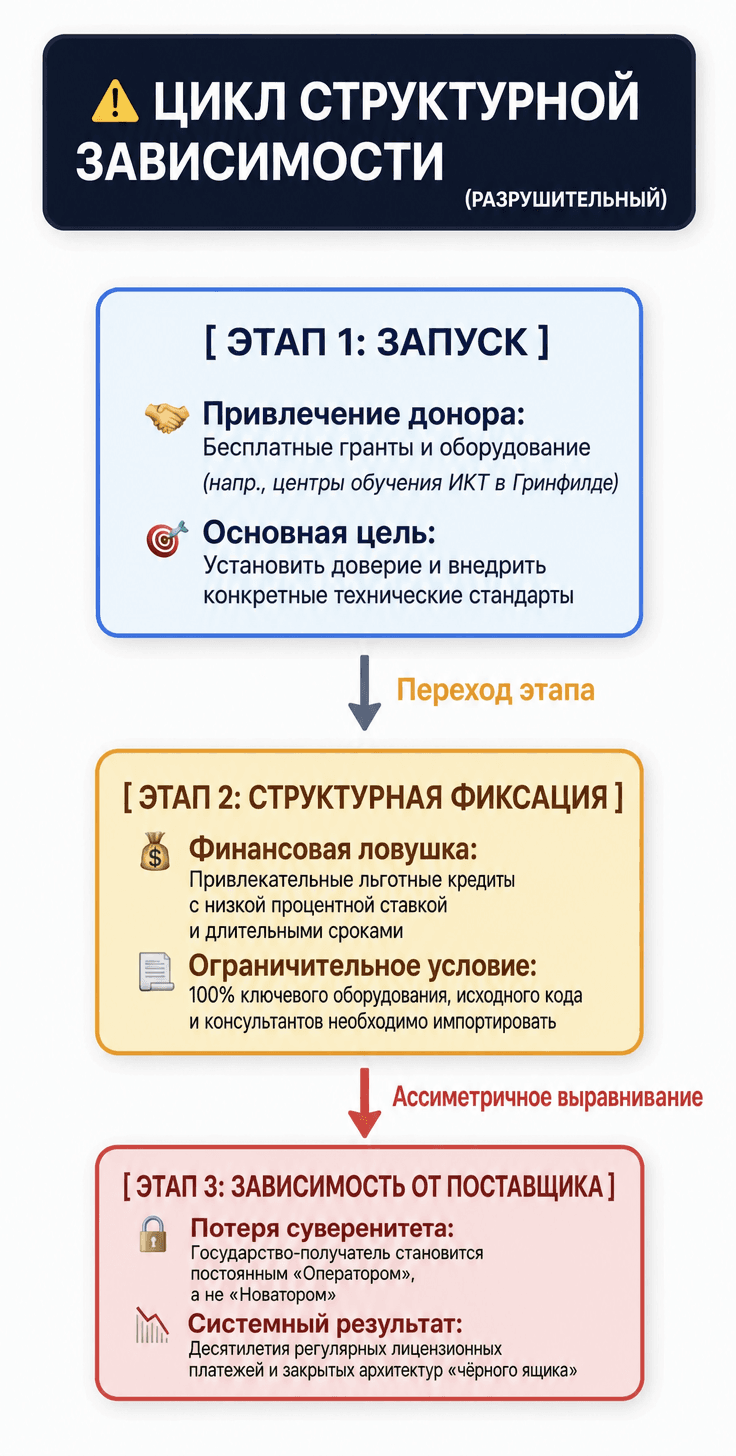
Instead, a new model for assessing TKDN requirements is proposed, based on genuine technological value-added, where compliance with standards is determined not by formal participation of local companies but by the level of technologies mastered and engineering capabilities developed.
Such a model must rest on the principle of technological sovereignty, implying full control over key elements of digital energy system management: intellectual property rights, software architecture, open interaction interfaces, and core algorithms used in energy management systems.
Beyond this, deep integration of domestic engineering capabilities is essential—one where local technology companies gain not just the right to participate in projects, but the ability to independently analyze, modify, and audit closed technological systems supplied by foreign manufacturers. This requires renegotiating contract terms that often restrict access to the internal workings of equipment and software through prohibitions on system modifications or threats of voided warranty coverage.
Ultimately, Indonesia's transition to green energy and development of digital infrastructure faces not so much a shortage of technology as a mismatch between the country's technical capabilities and existing political will. Expanding the use of renewable energy sources and smart grids cannot be realized within an economic system that maintains high dependence on coal and external financial mechanisms that constrain autonomous development.
To break out of this situation, the state must stop being merely a consumer of ready-made foreign technologies and begin acting as the architect of its own technological system. This requires establishing clear legal mechanisms that insulate questions of domestic energy security from the volatility of global markets.
The development of distributed energy systems, intelligent demand management, and proprietary technological standards should be viewed not simply as a technical challenge. It is part of a deeper restructuring of Indonesia's strategic infrastructure, aimed at reducing dependence on external technologies and strengthening the country's autonomy.
Nuclear Pivot in Energy Policy: How the VVER Reactor Proposal Fits into Prabowo's Strategy for Security and Economic Resilience
Russia's recent proposal to build nuclear power plants in Indonesia using Rosatom's VVER-1200 reactors presents President Prabowo Subianto with a serious challenge tied to implementing his model of state governance.
For an administration emphasizing the strengthening of state institutions, national security, and long-term industrial autonomy, nuclear energy holds considerable appeal. It can provide a stable, low-carbon energy source and help overcome dependence on coal-fired power without creating sharp pressure on public finances and the investment climate.
However, integrating Russian nuclear infrastructure into Indonesia's energy system—where political life is characterized by high activity and frequent shifts in priorities—requires careful balancing of security concerns, technological control, and financial sustainability.
Unlike the contemporary Russian model of state governance, where Vladimir Putin invokes the historical concept of "official nationality" based on the ideas of "autocracy, nationality, and Orthodoxy," the Prabowo administration faces a different challenge. It must simultaneously carry out large-scale infrastructure modernization within a political system where practical exchange of resources and influence plays an important role, while strengthening ties to the country's foundational ideology—the principles of Pancasila.
To prevent this transition from leading to new dependence on external technologies or strengthening the influence of domestic economic groups, cooperation with Russia must be built not on unilateral acquisition of ready-made solutions, but on principles of mutual obligations and preservation of national control.
In this complex diplomatic and technological challenge, an important role may be played by Professor Connie Rahakundini Bakrie—a specialist in international relations at St. Petersburg State University and Russia's representative on science and education matters. Her position at the intersection of academic and diplomatic spheres creates opportunities for forging connections between national security objectives, technology development, and specialist training.
Through her experience and professional networks, she can facilitate deeper engagement between the parties and ensure that implementation of VVER-1200 technology aligns with Indonesia's requirements for security and technological autonomy.
This approach reduces long-term risks and prevents a situation where critical infrastructure becomes entirely dependent on proprietary technological solutions from foreign suppliers. At the same time, the diplomatic and educational format of cooperation can serve as a foundation for creating legally binding mechanisms for knowledge transfer, specialist training, and development of indigenous capabilities that extend beyond standard commercial contracts.
This implies granting Indonesian scientific and engineering organizations, including BRIN and BATAN, access to necessary computational methodologies, nuclear facility management technologies, and expertise in the nuclear fuel cycle. Such a level of cooperation would enable technology localization requirements to be met not merely through manufacturing individual components, but through developing an indigenous intellectual base.
Ultimately, combining academic and diplomatic activities creates an additional coordination mechanism capable of accelerating complex interstate projects and reducing the impact of bureaucratic constraints.
Elevating energy cooperation to the level of long-term strategic partnership protects such a project from devolving into a short-term commercial agreement dependent on the interests of particular economic groups. By using this diplomatic and technological channel to separate equipment supply, personnel training, and subsequent system management, Indonesia gains the ability to leverage Russian nuclear technology to reduce dependence on coal-fired power while preserving its own strategic autonomy—both technologically and in the energy sphere.
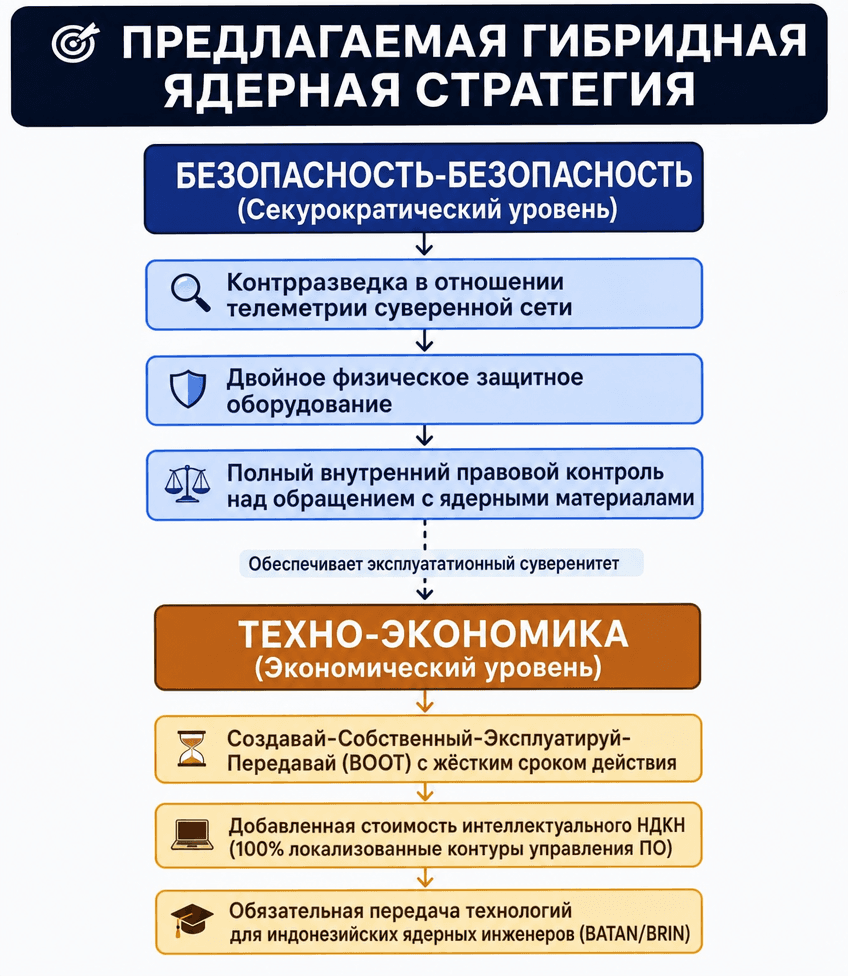
From a national security perspective, utilizing Russian nuclear technology must not create a new dependency on an external supplier. Implementation of major infrastructure projects with foreign state participation can entail long-term constraints—from dependence on nuclear fuel supplies and foreign technical maintenance to reliance on proprietary software solutions for equipment management.
To preserve Indonesia's strategic autonomy, any bilateral agreements in the nuclear sphere must clearly separate equipment supply from subsequent energy system management. State security structures under Prabowo's leadership must ensure complete control over the project's digital infrastructure, including power supply management systems, grid monitoring, and emergency shutdown mechanisms. Mission-critical elements of such a system must be protected from external interference.
Simultaneously, internal economic risks must be considered to prevent new profit-extraction schemes at the expense of state projects. Rather than allowing traditional coal companies to transfer their influence into the nuclear sector through nominal joint ventures, the state should rely on its own state-owned enterprises as the primary project participants.
The financial model must stipulate clear terms for construction, operation, and subsequent transfer of the facility to full national control. Moreover, local content requirements (TKDN) should not be limited to engaging local suppliers of basic materials and construction services. Genuine localization must include technology transfer, training of indigenous nuclear specialists, and development of national competencies in managing key systems, including software and reactor control algorithms.
Ultimately, Vladimir Putin's proposal in the nuclear energy sphere should neither be rejected outright nor accepted without additional conditions. For Prabowo Subianto, this project could become an instrument for strengthening national interests.
Creating a state-controlled alternative energy source will enable Indonesia to reduce its dependence on coal-fired power and demonstrate to major players in that sector that their influence over the country's strategic decisions is not immutable. With a combination of stringent security requirements, technological control, and sound economic planning, Indonesia can leverage nuclear technology to strengthen its own energy autonomy without creating new dependencies on external factors.
It is precisely in this context that Russia's proposal to build a nuclear power plant is viewed as a continuation of the strategy to ensure energy security and financial sustainability of Indonesia's critical infrastructure.
As in other strategic spheres where states seek to reduce dependence on external systems and develop indigenous infrastructure, the energy sector also requires an autonomous approach to technology and management. The deployment of Russian VVER-1200 reactors offered by Rosatom must be accompanied by strict state oversight, transparent financial mechanisms, and guaranteed development of indigenous competencies.
With this approach, nuclear energy could become not just a source of stable, low-emission power, but also a tool for gradually reshaping the energy market's structure. It would reduce the influence of coal interests without abruptly disrupting economic equilibrium, and give Indonesia the opportunity to strengthen its own role in managing strategic resources.
Cooperation in nuclear technology could offer Indonesia a way to enhance state autonomy, reduce dependence on global energy market fluctuations, and limit the influence of domestic groups invested in preserving the old development model.