Consumer Cooperatives as a Tool for Participatory Economics: Opportunities for Business and Citizens
How consumer cooperatives help small businesses and citizens reduce costs, optimize taxes, and build shared infrastructure. An analysis of the financial model, tax considerations, and practical case studies.
5 min read
Share:
Why the traditional model has stopped being convenient
In the classical economy, a person most often remains just a buyer: they come in, pay, receive a product or service—and that's where their role ends. For business, this model also comes with a high individual burden: a single participant must provide premises, warehouse space, accounting, advertising, staff, equipment, and pay taxes.
In conditions of high cost of capital, this becomes particularly noticeable. As of June 2, 2026, the Central Bank's key rate stands at 14.5% per annum1. This means borrowed funds remain an expensive resource, and financial mistakes hit businesses harder.
Consumer cooperatives offer a different logic: instead of each participant building infrastructure separately, resources are pooled to meet the group's common needs. Expenses are distributed among participants, and infrastructure is used jointly.
The main benefit isn't a discount, but a different financial model
Consumer cooperatives are often described through the "cheaper" effect. However, that's just one outcome.
The cooperative model changes the very scheme of interaction: from "seller—buyer" to a model of shared resource use to meet participants' needs. A member not only purchases goods or services, but also participates in forming the cooperative's property and organizational base.
According to the law, a consumer society is a voluntary association of citizens and legal entities based on membership and property share contributions for conducting trade, procurement, production, and other activities aimed at satisfying members' needs2.
In practice, a cooperative can function not only as a trading organization but also as a supply system for its participants. For a member, this means access to goods, services, infrastructure, and support, while for an entrepreneur, it's an opportunity to operate within a shared economic environment.
Tax Logic: Financial Metrics and Economic Fundamentals
A distinctive feature of the cooperative model is the different legal and tax status of incoming funds.
In a traditional commercial model, customer payments generate revenue and form the tax base. In a cooperative system, a portion of funds may be classified as targeted contributions or membership fees directed toward statutory activities.
The Russian Tax Code stipulates that targeted contributions for the maintenance of non-profit organizations and their statutory activities, provided they are used for their intended purpose, are not included when calculating the profit tax base3.
It's important to note that this doesn't mean an absence of tax burden. Taxation remains applicable to wages, property, transactions with third parties, and commercial activities.
Thus, with proper legal and accounting structure, the cooperative model allows for separation between commercial revenue and targeted contributions directed toward developing shared infrastructure.
Assets: Protection Not from the Law, but from Fragmentation
Another aspect concerns the organization of the asset base.
In small business, assets are often distributed among various forms of ownership and participants, which can create complications in management, inheritance, or conflict situations.
Under current legislation, the property of a consumer cooperative belongs to the legal entity and is not distributed among members as individual shares4.
This reduces the risk of asset fragmentation and simplifies management of the common property base.
Moreover, a cooperative has the right to establish various funds, including share, reserve, and indivisible funds, which enables the accumulation of long-term assets—premises, equipment, warehouses, transportation, and other infrastructure.
Practice: How the cooperative model works in the regions
In recent years, projects have emerged across various Russian regions that apply consumer cooperative principles to address supply challenges, infrastructure development, and entrepreneurial support.
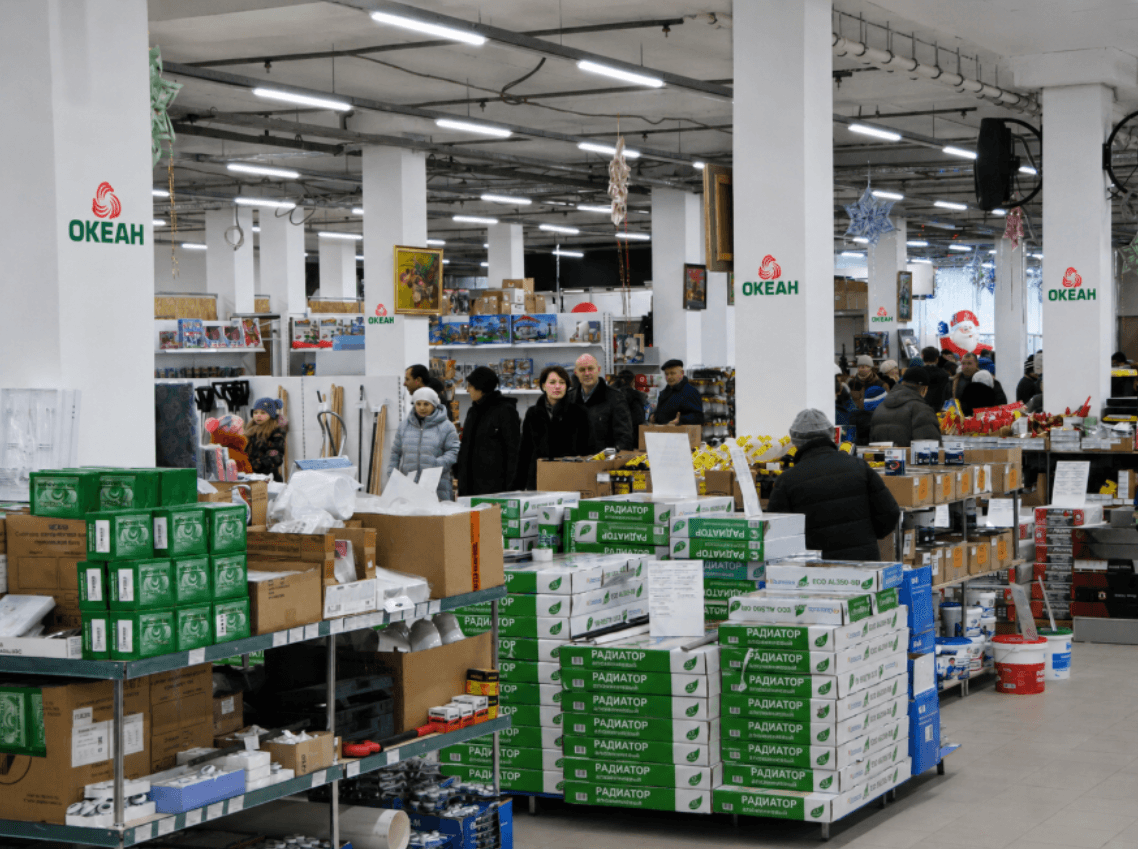
Take, for example, PK "STSON OKEAN" in Kostroma. The cooperative has been operating since 2016 and brings together several lines of business related to meeting members' needs. According to the chairman of the consumer cooperative "OKEAN" board Vardan Enfendzhyan, current projects include a cooperative hypermarket for household goods, as well as infrastructure and service programs for participants.
"Cooperative hypermarket of household goods PC "STSON OCEAN", Kostroma. Source: PC "STSON OCEAN" / author's archive"
This case is interesting not so much for the organization's scale as for its demonstration of the cooperative mechanism itself. Participants pool demand and resources, while the cooperative handles procurement, infrastructure use, and support for programs that members need.
Similar models can be found in other sectors—from selling farm produce and organizing group purchases to creating warehouse complexes, educational projects, and service platforms. They share a common principle: collective use of resources to reduce costs and tackle challenges that individual participants would find harder to address on their own.
Thus, the experience of PK "STSON OKEAN" can be viewed as one example of practical application of the cooperative model in the modern economy, alongside other regional initiatives.
Why this benefits entrepreneurs
For small and medium-sized businesses, the cooperative model may be of interest in several areas.
First, it allows for reduced initial investment through shared use of infrastructure.
Second, pooling purchases increases participants' negotiating power when dealing with suppliers and contractors.
Third, some resources can be directed toward developing the cooperative and creating new programs for members, which contributes to the long-term sustainability of the system.
Finally, entrepreneurs gain access not only to infrastructure, but also to an established community of consumers and partners—particularly relevant for local producers, farms, service businesses, and retail enterprises.
Why this benefits members
For ordinary participants, cooperation represents a tool for meeting practical needs—purchasing goods, obtaining services, accessing programs and infrastructure facilities.
The fundamental difference is that a member is not merely an external client of the organization. Their participation is tied to forming the cooperative's resource base and creating infrastructure that they subsequently use on equal terms with other members of the society.
This approach creates a closer connection between contributed funds and the results obtained.
Cooperation as an alternative to going it alone
In an environment where small businesses often face limited resources and intense competition, cooperative mechanisms can serve as a tool for consolidating the efforts of entrepreneurs and citizens.
Experience from individual cooperative projects shows that consumer cooperation can function not only as a legal organizational form, but also as an instrument for joint resource management. The effectiveness of this model, however, depends not on the cooperative status itself, but on the quality of management, transparency of financial processes, availability of relevant programs, and a sustainable economic foundation.
The main advantage: participatory economics
The main advantage of consumer cooperation lies in the ability to pool resources to achieve common goals.
The cooperative model enables the formation of long-term assets, use of collective infrastructure, distribution of costs among participants, and creation of sustainable supply and interaction mechanisms.
In this context, consumer cooperation can be viewed not as an archaic institution of the past, but as one of the tools of participatory economics, capable of complementing market mechanisms and promoting the development of local economic systems.
With compliance to legislative requirements and effective management, this model can ensure more rational use of resources, increase the resilience of individual projects, and create additional opportunities for both entrepreneurs and citizens.