This text is an automatic translation from Русский. It was generated by AI and may contain inaccuracies.
Read original →Choosing the Right Electricity Pricing Category for Corporate Procurement
Selecting an electricity pricing category: the difference between single-rate and two-part tariffs. How industrial enterprises can avoid overpaying tens of millions of rubles when purchasing electricity.

Choosing a Category: The Cost of Getting It Wrong
Selecting the right price category for electricity procurement is a critical decision for the chief power engineer at any industrial enterprise. A mistake can result in overpayment of tens of millions of rubles per year. What's more, once chosen, the category cannot be changed during the regulatory period. That's why it's essential to consider the specific characteristics of each enterprise and its electricity consumption profile before making a decision. This article examines how electricity costs can vary depending on the price category selected.
One of the main questions facing chief power engineers at industrial enterprises is: which price category should we choose? According to the rules governing retail electricity markets, consumers must independently determine the category under which they will purchase electricity.
A price category is a type of electricity tariff that consumers select based on the specifics of their energy consumption, primarily their electrical load profile. The calculation procedure for price categories is established by regulatory documents. However, conducting the necessary calculations independently for an industrial enterprise can be quite complex.
The choice between the third and fourth price categories can only be made once a year—within the calendar month following publication of the decision establishing unified pooled tariffs for electricity transmission in a particular region. After this deadline, the category cannot be changed until the end of the regulatory period. If the choice proves unfavorable, overpayment can amount to tens of millions of rubles per year. Moreover, such overpayment would be entirely legal.
How Price Categories Work
There are six price categories in total. The first and second can be used by small enterprises with maximum capacity of electrical equipment up to 670 kVA. For industrial enterprises, the third through sixth categories are primarily used. The third and fourth are most common, since the fifth and sixth are less advantageous in most cases.
The cost of electricity in each price category consists of several components: the cost of electrical energy, electrical capacity, transmission services, sales markup, and infrastructure payments. For the third and fourth categories, most components are identical. The main difference lies in payment for electricity transmission services: the third category uses a single-rate tariff, while the fourth uses a two-part tariff.
The calculation methodology for these tariffs differs. The single-rate tariff does not depend on the nature of the enterprise's electrical load profile. With the two-part tariff, by contrast, such dependence is direct.
That said, one cannot assume that one tariff option is always cheaper than the other. The relationship between single-rate and two-part tariffs depends on the tariff voltage level and the region in which the enterprise pays for electricity transmission services.
Figure 1 shows electricity transmission tariffs approved for regions of the Central Federal District for Q4 2026. Values are shown for single-rate and two-part tariffs at the HV and MV2 voltage levels. These levels were selected because they are most commonly used by industrial enterprises in Russia.
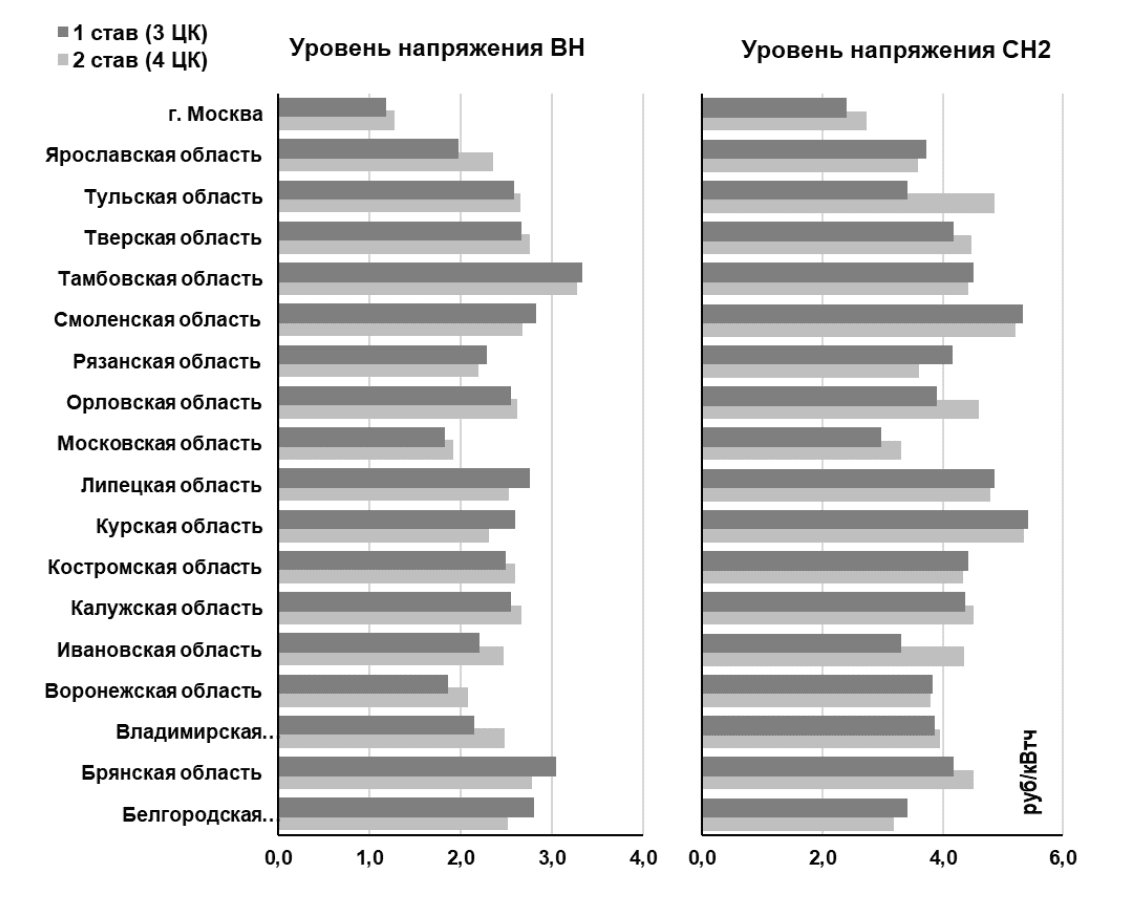
As the charts demonstrate, single-rate and two-part electricity transmission tariffs differ across several parameters.
First, the values differ for each region and each price category. Moreover, the difference between tariffs is not uniform: in some cases it's larger, in others smaller. Additionally, the direction of this difference can also vary: in some places the single-rate tariff is higher than the two-part tariff, while elsewhere it's the opposite.
Second, the tariffs themselves vary depending on the region and voltage level. Therefore, price categories need to be compared taking into account the specific conditions under which the enterprise operates.
Since this article examines the choice of price category—that is, determining the most advantageous electricity transmission tariff for an industrial enterprise—it's important to consider three factors simultaneously: the region where it's located and the voltage level at which electricity is billed. We'll therefore focus on how price categories differ from one another under different conditions.
The difference in tariffs between single-rate and two-part electricity transmission tariffs will be calculated using formula (1).
where: T1rate – single-rate transmission tariff for a given region and voltage level (rubles/kWh);
T2rate – two-part transmission tariff for a given region and voltage level (rubles/kWh);
If ΔT > 0, then for the region in question the single-rate tariff is most advantageous, meaning the third or fifth price category;
If ΔT < 0, then for the region in question the two-part tariff is most advantageous, meaning the fourth or sixth price category;
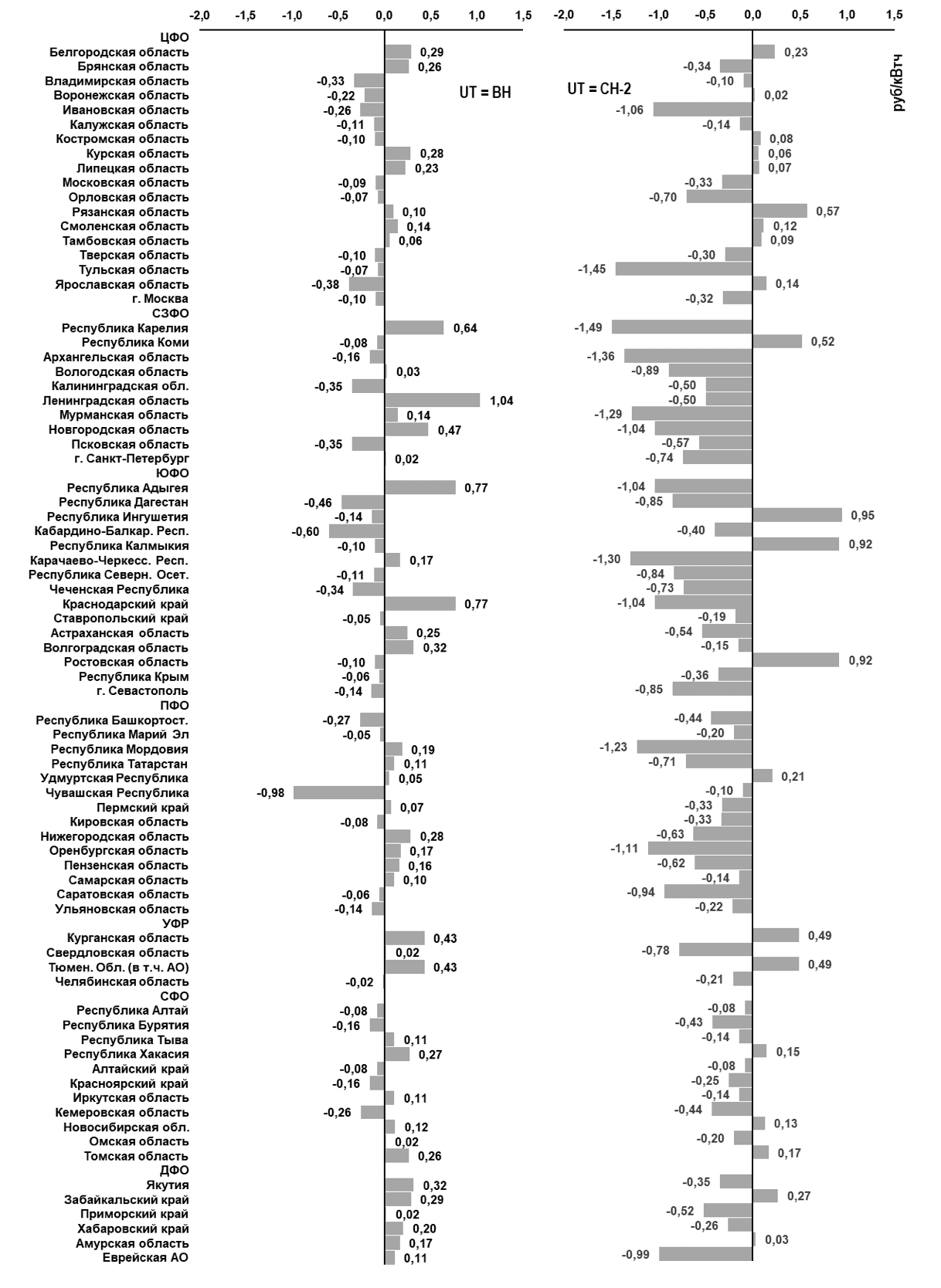
Figure 2 presents diagrams showing the difference between single-rate and two-part tariffs for electricity transmission for the third and fourth price categories at the HV and MV2 tariff voltage levels.
As the diagrams show, the difference between tariffs has no consistent trend. It varies both from region to region and within a single region depending on the tariff voltage level.
For example, in Ryazan Oblast, the indicator ΔT > 0 for both voltage levels under consideration. However, at the HV level, the difference between tariffs is 0.1 rubles/kWh, while at the MV2 level it is 0.57 rubles/kWh. This shows that it is impossible to definitively consider the single-rate tariff more advantageous at the HV level. If the nature of the enterprise's electrical load profile changes, the two-part tariff may prove more beneficial.
The same dependence on voltage level is observed in the Komi Republic, but with the opposite result: for the HV level, the two-part tariff is more advantageous, while for MV2, the single-rate tariff is preferable.
Thus, the choice of price category for electricity procurement should be based on individual calculations. The chief power engineer of an industrial enterprise must determine which electricity transmission tariff and which price category will be most advantageous specifically for their enterprise. Relying solely on recommendations or previous period experience is inadvisable: such an approach can lead to overpayments of several tens of millions of rubles per year.
The following data will be required for the calculation:
- The order establishing unified boiler tariffs for electricity transmission for the corresponding regulatory period.
- The act on technological connection of the enterprise's electrical installations to external electrical networks. This is necessary to determine the tariff voltage level by which the cost of electricity will be calculated.
- Hourly electricity consumption schedules for several typical periods. It is advisable to use data for March, June, September, and December.
- The planned enterprise operation schedule for the next regulatory period, taking into account possible changes in the production program that may affect the nature of electrical loads.
Based on this data, the cost of electricity transmission services is calculated for both single-rate and two-part tariffs. The resulting options are then compared, and the most advantageous price category is determined. After making a decision, the enterprise sends the appropriate notification to the electricity supplier, with copies to the backbone and territorial grid organizations.
Article reprint: Dzyuba A.P. On the Selection of Price Categories for Electricity Procurement by Industrial Enterprises / Energosberezhenie. No. 3. 2026. pp. 16-19.