Russia's Company Towns: From Dependency to Diversification
An analysis of the situation in Russia's 321 company towns: why 92% are losing population, how the government is investing 234 billion rubles in their development, and what strategies experts propose for transitioning from single-industry dependency to a sustainable economy.
10 min read
Share:
Company Towns: The Legacy of a Planned Economy
A monogorod is a municipality where tax revenues are generated by a single city-forming enterprise or a narrow set of enterprises, which also determine local employment. In official practice , a monogorod is defined as a settlement where more than 20% of the working-age population is employed by a single enterprise, or which is included in the state register of monogorods. This geo-economic structure creates a strong interdependence between the fate of the enterprise and the fate of the city: when production falls, the budget, social services, and urban infrastructure immediately suffer.
In the USSR, this approach was ubiquitous: hundreds of settlements and towns were built around metallurgical plants, processing mills, pulp and paper factories, and transport hubs. After privatization and the market shocks of the 1990s, many enterprises scaled back production or changed their profile, but the linkage of workforce, infrastructure, and social services to a single industry remained—giving rise to the modern monogorod problem.
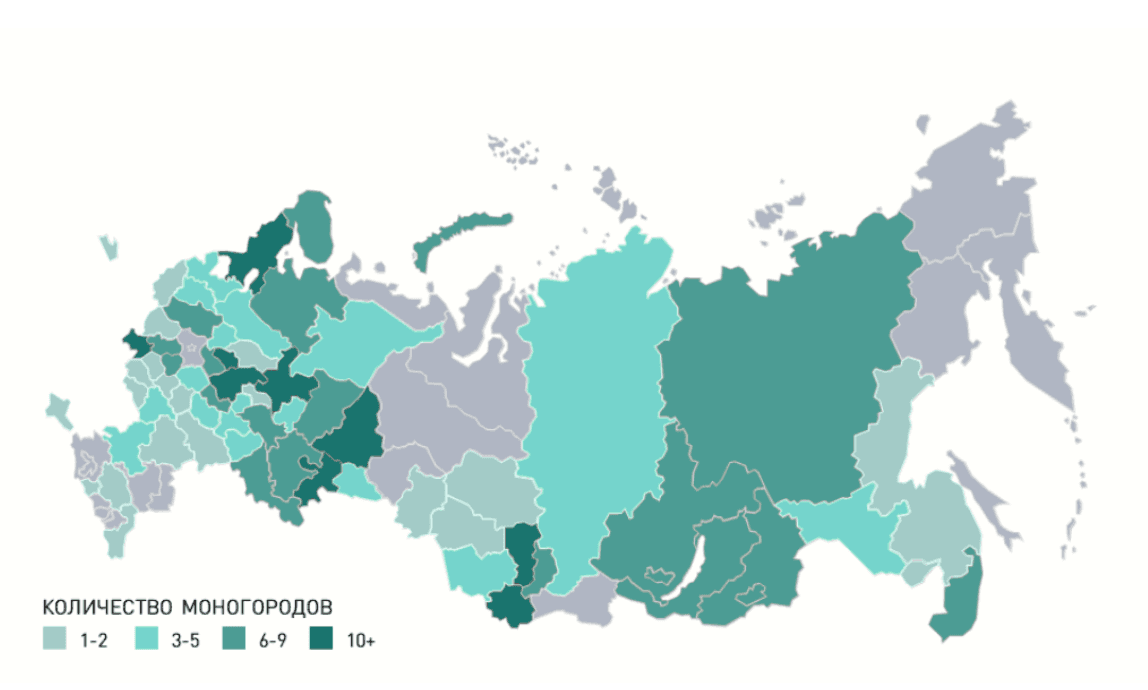
Today, Russia has 321 monogorods, home to 10% of the country's population. Monogorods are scattered across Russia from the European part to the Far East, with concentrations in resource-rich regions and industrial centers—the Urals, Siberia, the North, and the Volga region. Some are major industrial centers of high strategic importance; many are small cities heavily dependent on a single employer.
Source: VEB.RF
Monogorods in a Trap: Why the Single-Industry Model No Longer Works
Some statistics: as of 2024, 8.4 million people live in monogorods with "difficult socio-economic conditions" or at risk of deterioration. A painful problem for monogorods is the outflow of young people and the economically active population. Over the past 10 years, 92% of monogorods have experienced population decline—more than 700,000 people have moved to other settlements, and in roughly 70% of monogorods, average wages are below the industry level in the region, according to research by RBC. Thus, the problem is not episodic—it is systemic and affects millions of people.
Russia's modern monogorods face a complex of interrelated problems rooted in their economic model. The main vulnerability lies in total dependence on a single city-forming enterprise (GOP). This dependence manifests in the fact that the city's budget, employment, and social stability are directly tied to the fortunes of one industry. In a crisis, this threatens the city with mass unemployment and social collapse, as happened, for example, in Pikalevo (Leningrad Oblast), where three major enterprises shut down simultaneously during the 2008 global financial crisis.
According to sociologist and professor at AlmaU University Aleksandr Vileikis, the very logic behind such settlements today contradicts the modern economy:
"A single-function city could exist within the Soviet planned system, where it fulfilled a clearly defined role. But in a dynamic environment, a monocity loses stability because it can't adapt to changes quickly enough."
In a conversation with Argument Media, the expert noted that the catastrophe of the 1990s was a consequence of the absence of an adaptation mechanism: enterprises closed down, and cities rapidly emptied out.
Urban planning specialist and expert in urban communications Elena Vereshchagina noted that, in essence, most smaller Russian cities can actually be called "mono."
"Vyacheslav Glazychev, the founder of Russian urban studies, actually called such cities 'slobodas,' and they only had a chance to become real cities. For that to happen, you need a strong local community, diverse types of economic activity, and developed entrepreneurship. So many issues that concern monocities actually concern everyone," the expert added.
According to the director of the Institute of Regional Economics and Intergovernmental Fiscal Relations at the Financial University under the Government of the Russian Federation, PhD in Economics Pavel Stroev, the monocity problem is not unique to Russia: Germany, the United States, and post-Soviet countries have faced similar difficulties. Despite a comprehensive package of state support measures, particularly in improving the quality of the urban environment, developing the social sphere, and supporting small and medium-sized businesses, the monocity problem remains extremely pressing. According to Stroev, one of the key reasons lies in the limited capacity of local economies to ensure development independently.
"When production contracts, attracting new investors is difficult, and small business alone cannot compensate for the loss of the industrial core," the expert notes.
At the same time, Pavel Stroev sees the reasons for population outflow not only in the absence of promising and well-paid jobs, but also in the declining quality of life: "the reduction of educational, healthcare, and cultural institutions." Responding to questions from Argument Media, the economist noted that the problem of population outflow is characteristic not only of single-industry towns, but of Russia as a whole: "there is migration to large and major cities, since living conditions and quality of life are higher there, as well as access to services, leisure activities, and so on." But single-industry towns are more susceptible to this trend.
Sociologist and co-founder of the research agency Synopsis Group Pavel Stepantsov, responding to questions from Argument Media, develops this idea further, pointing out that the quality of the urban environment is critically important for young people.
"For them, it's important to have the opportunity not only to earn money, but also to spend it, to spend their free time in a quality way."
Single-industry towns, Stepantsov emphasizes, cannot compete with regional centers in terms of infrastructure and cultural offerings, which is what pushes young people to leave.
Pyotr Ivanov, co-founder of the School of Urban Studies and Urban Research "Goroda," author of the Telegram channel "Urbanism as the Meaning of Life", draws a clear distinction between young people and qualified specialists: young people, in his opinion, will leave in any case in search of environmental diversity and social opportunities, while for retaining specialists, the key factors are professional fulfillment and decent wages. At the same time, a normal salary in a small town is quite achievable—around 60,000 rubles per person, whereas a good salary, according to Russians' own estimates, is around 120,000 rubles per person.
Ivanov notes that despite the absence of successful examples of economic diversification in single-industry towns, the situation in many such towns has improved dramatically due to the current geopolitical environment: government orders have increased, and as a result, enterprise capacities are fully utilized, wages are rising, which helps retain the local population.
Thus, single-industry towns represent not an episodic but a systemic problem, one that directly affects the well-being of millions of Russians living in zones of heightened socio-economic risk. In this context, developing and implementing effective state support measures for single-industry towns is one of Russia's key strategic priorities.
Rebooting Single-Industry Towns
State support for single-industry towns entered a new phase in 2025. Russia's Ministry of Economic Development initiated a reduction in the number of officially designated single-industry towns from 321 to 218, explaining this by changed criteria and a desire to improve aid effectiveness. The main goal is not simply to preserve existing enterprises, but to stimulate economic diversification and create new jobs outside the town-forming companies. A comprehensive set of measures is being applied: preferential lending, co-financing of infrastructure projects, support for small and medium-sized businesses through the SME Corporation and SME Bank. According to data from VEB.RF, the total volume of attracted investment in the economies of single-industry towns exceeded 234 billion rubles, with approximately 36.5 billion rubles in subsidies allocated from the federal budget.
Within the framework of the state program supporting Russia's single-industry towns, special attention is given to developing and implementing master plans—strategic documents aimed at comprehensive territorial development. Unlike traditional general plans, master plans are more flexible and interdisciplinary in nature, integrating urban planning, economics, and the interests of local communities to create a balanced and sustainable urban environment.
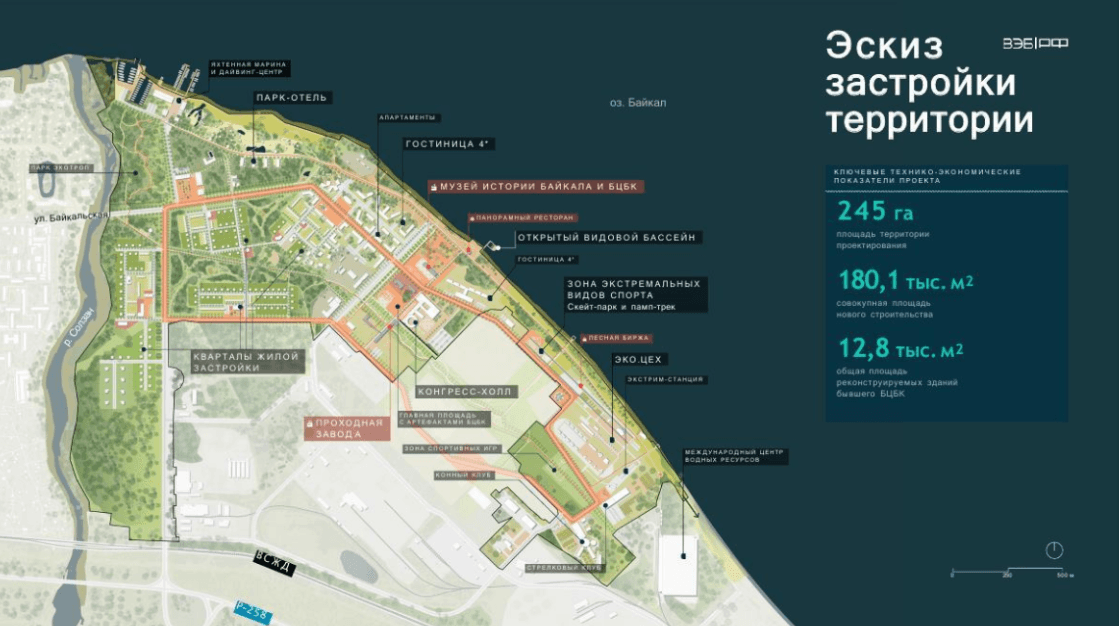
One example of using a master plan as a tool for "reviving" a depressed single-industry town is a project being implemented with VEB.RF support in the city of Baikalsk in Irkutsk Oblast. On the site of a former pulp and paper mill, which was the town-forming enterprise, plans call for creating a new modern district and an international-level all-season resort. The project includes construction of housing, hotels, water transport infrastructure, restaurants, parks and public spaces, a congress center, cycling and pedestrian routes, and sports infrastructure.
Development sketch of the Baikal Pulp and Paper Mill territory in Baikalsk
All experts agree on one key point: there is no "magic bullet" for solving the problems of single-industry towns—what's needed is comprehensive, multi-level support. According to Pavel Stroev, only a combination of various mechanisms, including financial instruments, infrastructure projects, and educational programs for residents and entrepreneurs, creates a chance to keep the economy afloat and generate new jobs. Preferential loans and subsidies must go hand in hand with institutional support—"one-stop shops," investment sites, and market access programs.
Experts pay special attention to the urban environment as a key factor in retaining population. According to the urbanist Elena Vereshchagina, it was largely through the monocity development program that a systematic approach to working with the urban environment began:
"A connection emerged: in the competition for people, we improve the places where they live. A framework concept appeared—'Five Steps of Improvement'—with a focus on quick wins: using relatively inexpensive methods to show that the environment is changing right now. Hence the focus on improving public spaces."
Pyotr Ivanov notes that comfortable pedestrian infrastructure, lighting, public spaces, and cultural events form the foundation of quality of life. "It's important to make the city interesting for residents themselves.
"It's important to make the city interesting for residents themselves. Tourism cannot be a primary strategy if the city isn't interesting to its own citizens," he emphasizes.
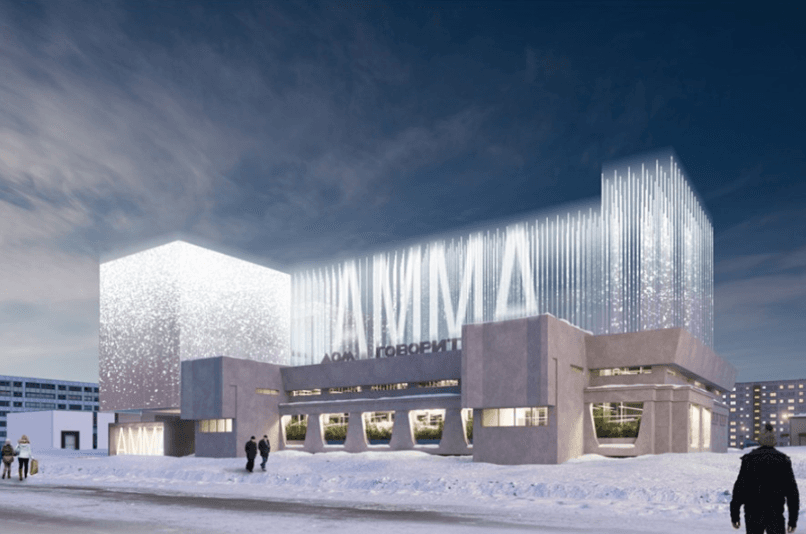
In a conversation with Argument Media, Ivanov cited the example of Norilsk, where Nornickel, through corporate social responsibility, is developing creative and immersive spaces, creating cultural events, and engaging residents in public initiatives. However, the expert adds that "there are practically no examples of successful economic diversification," which demonstrates the depth of monocities' structural problems.
Architectural project of the Arctic Museum of Contemporary Art, Nornickel participates in project financing
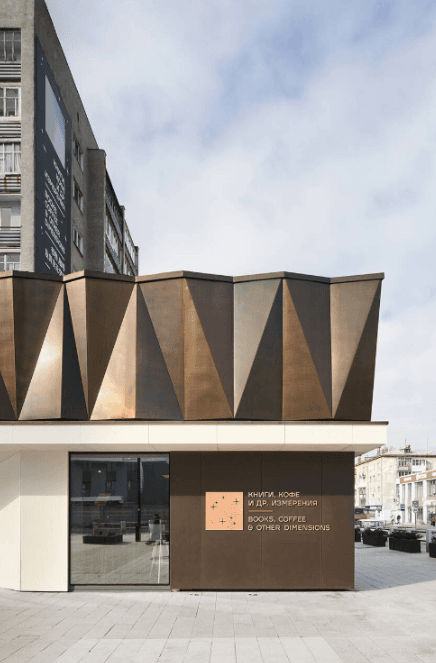
Alexander Vileikis emphasizes culture and creative infrastructure as essential elements of urban attractiveness. According to him, monocities must become places where it's "pleasant to live"—with parks, cafes, creative spaces, and modern infrastructure. The sociologist cites real examples of grassroots initiatives: the bookstore Drugie Izmereniya in Verkhnyaya Pyshma, which hosts festivals and supports cultural projects, and OMK's activities in Vyksa, where development of the cultural sector creates points of attraction for creative youth. In Vileikis's view, such projects form local communities, increase cultural richness, and create jobs in the service and leisure sectors.
Bookstore "Books, Coffee and Other Dimensions", Verkhnyaya Pyshma, Sverdlovsk Region
Sociologist Pavel Stepantsov links urban environment development to demographic sustainability. He emphasizes that young people leave not only because of a lack of jobs, but also due to the absence of an interesting and vibrant environment.
"The diversity of urban life creates life chances—the opportunity to choose between different spheres of activity," he notes.
Ultimately, experts arrive at a unified formula: tourism and culture can become part of a development strategy for single-industry towns, but only on the condition that they grow from internal demand—from the interest of residents themselves. Without an attractive urban environment, diverse services, and community engagement, no external tourism projects will deliver long-term results.
Single-Industry Towns in the 21st Century: What Will Replace the Old Model
Experts agree: the future of single-industry towns lies not in preserving the outdated "city as function" model tied to a single enterprise, but in adapting to a new economic and social reality. According to Pavel Stroev, demand for the classic single-industry town format is gradually declining—new such cities are no longer being formed, the economy is becoming more dispersed, the service sector is growing, platform employment is emerging, and this creates conditions for diversifying the local economy, making it possible to escape the trap of mono-dependency.
Pyotr Ivanov emphasizes the systemic nature of these changes: single-industry towns as Soviet-era centers existed within a nationwide production complex and spatial planning framework; under conditions of modern "radical capitalism," such schemes become inefficient—the logic of efficiency comes to the fore, and territory is developed differently. Hence his conclusion: preserving the old model is pointless; we need to think about new formats of organization and employment.
Sociologist Alexander Vileikis frames the choice more pragmatically: single-industry towns have two viable paths—transformation into diversified small cities or transition to a rotational/project-based work regime.
"Some cities will grow into diversified economies, others will shift to a rotational method," he says, adding that the key task is not to prolong the status of single-industry towns, but to manage the transition—so as not to repeat the mistakes of the past.
Elena Vereshchagina believes the palette of strategies for single-industry towns needs to be broader:
"In some cases, we need to soberly assess the prospects and adopt a strategy of managed contraction; in others, transition to the format of modern rotational shift settlements; in still others, provide single-industry towns—particularly science cities—with additional resources... and elsewhere, gradually diversify the economy."
In the context of competition with major cities for young people—a battle that Vereshchagina believes is a losing proposition from the start—she offered an alternative in conversation with Argument Media:
"Cities need a concept of urban body positivity, if you will, and development without strain. They can realistically assess their capabilities and bet not on some mythical creative youth, but on becoming a city of dignified retirement, for example."
Pavel Stepantsov points to another important trend: the emergence of industrial "nomads"—specialists ready to move between sites where demand exists. In his view, single-industry towns that can raise the prestige of industrial professions and offer professional conditions along with an acceptable urban environment will be competitive in recruiting such talent.
It thus becomes clear that under current conditions, the single-industry town model is already outdated—what's needed is flexibility, diversification, and a combination of industrial function with active work on the quality of the urban environment, attracting specialists, and well-developed support for small business. Only then will the transition from dependency to sustainable development become possible.