This text is an automatic translation from Русский. It was generated by AI and may contain inaccuracies.
Read original →"0.0% Doesn't Mean Zero Interest": Non-Alcoholic Wine in Russia — Hype, Market, or the New Normal?
Russia's non-alcoholic wine market is growing 60% annually, but high production costs and legislative barriers hinder development. Experts weigh in on technology, pricing, and the future of alcohol-free beverages.
What is non-alcoholic wine and how is it made?
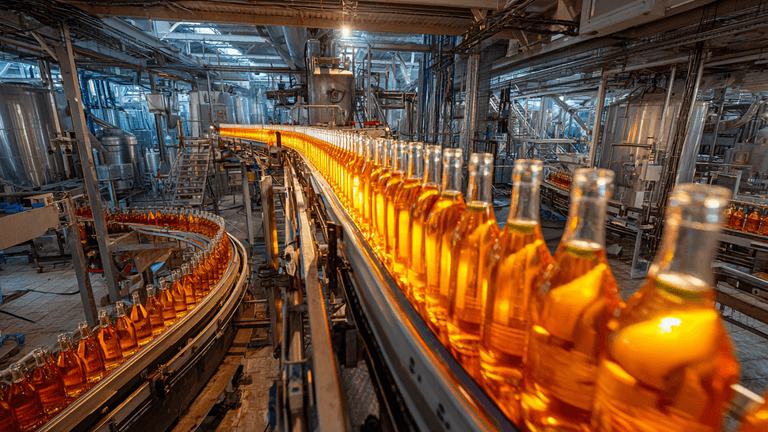
Non-alcoholic wine is wine with an ethanol content not exceeding 0.5%. It's produced using various methods, but always starts with a traditional alcoholic beverage. The most common technologies are vacuum distillation, reverse osmosis, and spinning cone columns.
All three methods "steal" some of the aromatics, so producers must "rescue" the bouquet: working with the original wine material, temperature, speed, and most importantly, not cutting corners on equipment. This leads to the category's first paradox: creating a "zero-degree" beverage essentially requires more technology and money than regular wine.
The experts we spoke with agree on one thing: this is a real product, not an imitation. But it has its own taste — usually drier and "thinner" than conventional wines of the same variety. And consumers still need to be brought around to this taste.
Production bottlenecks: cost, alcohol, and regulations
Russia's main pain point is production economics. Dealcoholization is energy-intensive: equipment, loss of aromatics, technological discipline. Plus there's a legal question: what to do with the alcohol extracted from the wine. If it must be disposed of rather than returned to circulation in another area or sold through legal "white" logistics, the cost multiplies significantly.
"Вина Арпачина" was among the first in Russia to attempt industrial-scale non-alcoholic wine production, purchasing modern equipment from Europe. According to them, creating such a beverage costs more not only due to greater raw material volume, but also additional expenses for infrastructure, electricity, and equipment purchases. Ekaterina Malik, CEO of Вина Арпачина, emphasized in conversation with Argument Media:
Non-alcoholic wine production is undoubtedly more expensive than alcoholic wine, because we make approximately one bottle of non-alcoholic from 1.8 bottles of quality alcoholic wine — that is, a ratio of 1.8 to 1.
Meanwhile, laws related to alcohol add problems for this product that's relatively new to our market. Under current legislation, all alcohol obtained during production cannot be used without an expensive license and special storage facilities. The procedure for its disposal hasn't been established either. This was also emphasized to Argument Media by Aleksandr Stavtsev, Vice President of the Russian Association of Retail Market Experts:Aleksandr Stavtsev:
In non-alcoholic wine production, if you dispose of the alcohol — it becomes a very expensive story, because if we look at the production technology, you need to remove alcohol from a regular bottle of wine, which is up to 15% per liter, and it's clear that if we simply evaporate it, a significant amount of other liquid will evaporate along with the alcohol. Losses exceed 50%.
To reduce costs and increase the accessibility of non-alcoholic wine, according to Ekaterina Malik, the industry is working with the Ministry of Agriculture, Ministry of Finance, and regulators on preferential licensing options that would allow companies to legalize small-scale non-alcoholic wine production without purchasing an expensive alcohol license (note: it costs 9.5 million rubles). "But there's been no progress on this issue yet," emphasized the CEO of Вина Арпачина. The press service of Rosalkogoltabakkontrol, in response to Argument Media's inquiry, reported that the issue was considered in late September at a meeting of the Public Council under Rosalkogoltabakkontrol, and it was decided to continue this discussion within the Working Group.costs 9.5 million rubles), somehow legalize small-scale non-alcoholic wine production. "But there's been no progress on this issue yet," emphasized the CEO of Вина Арпачина. The press service of Rosalkogoltabakkontrol, in response to Argument Media's inquiry, reported that the issue was considered in late September at a meeting of the Public Council under Rosalkogoltabakkontrol, and it was decided to continue this discussion within the Working Group.
"It's not just hype": Do non-alcoholic wine and other beverages have a future?
Retailers are seeing genuine interest. The Lenta group told Argument Media that over the first nine months of 2025, non-alcoholic wine sales in stores grew by approximately 60%. Experts are also seeing increased demand from audiences. According to Anastasia Palferova, author of the Telegram channel "Вино? Why No!", subscribers frequently ask her about alcohol-free wine:Вино? Why No!" Anastasia Palferova, subscribers frequently ask her about alcohol-free wine:
First and foremost, it's women who can't drink alcohol for various reasons, but are attracted to wine aesthetics.
Palferova also dispelled the myth about "three times more expensive than alcoholic wine" in conversation with Argument Media: "Today non-alcoholic wine is slightly more expensive than regular — not 2–3 times, more like 20%." An important nuance: this refers to imported assortment (Hans Baer, Codornui, Torres) and retail, where brand and technology competition has already begun.
Wine enthusiast Dmitry Nechaev told Argument Media that non-alcoholic wine is becoming a new trend:Dmitry Nechaev told Argument Media that non-alcoholic wine is becoming a new trend:
This is undoubtedly the next big thing worldwide — healthy lifestyles are in fashion, forty-something managers run more marathons than bar-hop, and young people are happy to get into something new and unusual.
At the same time, he notes that this segment is still developing, and it's an opportunity for producers. "The market is still open; if producers reduce their appetites when introducing a new product to shelves, the starting price will likely be only slightly higher than regular wine," Nechaev emphasized.
Pavel Shvets, founder of UPPA Winery — simultaneously as consumer, restaurateur, and winemaker — sees meaning and a niche in "zero-alcohol" products. In an interview with Argument Media, he emphasized:Pavel Shvets — simultaneously as consumer, restaurateur, and winemaker — sees meaning and a niche in "zero-alcohol" products. In an interview with Argument Media, he emphasized:
Indeed, sometimes we want to drink non-alcoholic wine or beer, because we're driving or for other reasons, but we're accustomed to getting some emotions from the beverage itself. Restaurants can make money from such products because this product is much more complex, expensive, and interesting than lemonade or water. However, if you approach winemaking as the art of winemaking, then of course non-alcoholic wine doesn't fit into this framework at all.
The price question: Does "0.0%" hurt traditional alcohol?
The declining share of "regular drinkers" in Russia and growing alcohol sensitivity in cities pose a challenge for the industry. But this isn't a "war of segments." Worldwide, most major producers aren't closing product lines but adding non-alcoholic positions — from beer and cider to sparkling wines and gins.
According to our sources, wine cannibalization is minimal: non-alcoholic bottles are often purchased for different occasions (business lunches, driving, alcohol-free family celebrations, office events). For the market, these are new consumption scenarios and an additional shelf, not a replacement. Alexey Sinelnikov, author of the Telegram channel "Wine and People," emphasized in conversation with Argument Media:Alexey Sinelnikov emphasized in conversation with Argument Media:
I see real consumer interest in non-alcoholic wine. It's logical for winemakers to consider this as new opportunities. Especially considering that more and more people are giving up drinking alcohol. Why not replace it with wine with zero alcohol content?
At the same time, the expert stated that winemakers' "indifference" to non-alcoholic wine is mainly because the alcohol industry is already over-regulated. "And all questions relating to alcohol basically don't exist in winemakers' minds at all," Sinelnikov emphasized.
Where will real growth be in the "0.0%" segment: beer, wine, cider, or gin?
The map is simple.
- Beer is already the largest non-alc segment: it has habit, isotonic logic, and sports. Hence — the largest volume and best purchase repeatability.
- Cider is a niche growing on the wave of craft and flavors.
- Wine has high growth rates in percentages (low base, but expensive technology); growth is constrained by taste/aromatics and price. That's why quality "zero-alcohol" wines will grow through recognizable brands and dealcoholization technologies, not just marketing.
- Gin and other spirits, but alcohol-free — truly thrive in bar environments: mixes, non-alcoholic cocktails. In retail, they're more exotic than even niche.
Beer, as the foundation of the alcoholic beverage market, will remain the most mass-market and dominant in non-alcoholic categories. According to Aleksandr Stavtsev, Vice President of the Russian Association of Retail Market Experts, non-alcoholic beer is an established, formed segment. The production technology is different there. There aren't those volumes of alcohol waste. The beer itself is brewed so there isn't high alcohol content and it's easy to remove during technological operations, while it tastes like beer, and it's being actively consumed now.Aleksandr Stavtsev, non-alcoholic beer is an established, formed segment. The production technology is different there. There aren't those volumes of alcohol waste. The beer itself is brewed so there isn't high alcohol content and it's easy to remove during technological operations, while it tastes like beer, and it's being actively consumed now.
Regarding the wine segment, Pavel Shvets (UPPA Winery) notes that a socio-demographic factor limiting consumption growth is also crucial here:Pavel Shvets (UPPA Winery) notes that a socio-demographic factor limiting consumption growth is also crucial here:
Wine has historically been quite expensive for us and remains so. I mean good wine. People start drinking and getting interested in wine at 35+, somewhere around that age; before that, young people aren't particularly into wine.
But experts call alcoholic "hard liquor" something that's unlikely to enter consumption culture. Anastasia Palferova notes:Anastasia Palferova notes:
Analogues of spirits — gin, whiskey, etc. — are, in my opinion, something strange. They have quite an ambiguous composition, and taste-wise they're completely different — in spirits, alcohol provides a substantial part of the flavor — without it, the balance is lost.
We can conclude that drinking culture is evolving along with society. And this can't be changed, so producers have to adapt to current reality, creating non-alcoholic alternatives to the delight of both audiences and the Ministry of Health.