This text is an automatic translation from Русский. It was generated by AI and may contain inaccuracies.
Read original →INTC Russky: What Awaits the Far Eastern Silicon Valley?
Prospects and risks of INTC Russky—a technology center in Vladivostok. Plans through 2030, incentives for residents, and expert opinions on its chances of becoming the Far East's answer to Silicon Valley.
Napoleonic Plans
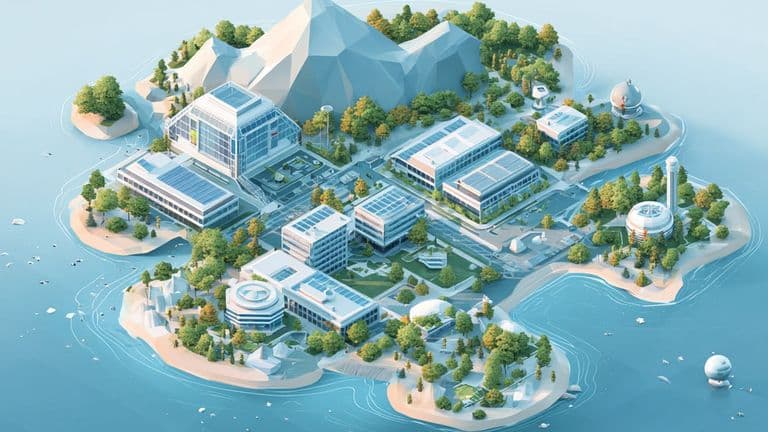
INTC Russky was established on Russky Island in Vladivostok on the initiative of Far Eastern Federal University and approved by Russian government decree in November 2020. The launch of the pilot site became the starting point for forming an entire cluster, which is intended to eventually unite dozens of companies, research laboratories, and educational institutions. By 2030, INTC Russky is expected to register 80 residents from among the best science-intensive companies, which will create nearly 5,000 new high-tech jobs, with 160 innovative scientific and technological projects in development. Plans also include launching major scientific and educational complexes: an IT park, centers for biomedicine, biotechnology, and marine engineering. Parallel to this is the development of the social environment: the project includes construction of an international private school and infrastructure facilities.
Center residents are provided with a whole package of preferences: tax breaks for up to 10 years, reduced insurance contributions, simplified procedures for attracting foreign employees, and access to the research facilities of FEFU. All of this is designed to reduce costs and accelerate the implementation of new technologies, making the site attractive for business and researchers from across the country and beyond.
But what are Russky's chances of becoming the Far Eastern analog of Silicon Valley and a driver for the development of the macro-region, which has received close government attention in recent years—we discussed with experts.
Competition for Talent and Investment
Denis Zhuravlyov, editor-in-chief of the online publication Nauchno-obrazovatelnaya politika, responding to questions from Argument, noted that INTC Russky already has a solid foundation for development. The center is integrated into the second phase of the FEFU campus, which means there's every chance of becoming a sought-after technology valley. According to him, FEFU's potential in training personnel allows for expectations of an influx of researchers and entrepreneurs not only from Russia, but also from Asia-Pacific countries. An important element will be the construction of the synchrotron RIF, which Zhuravlyov believes will become a point of attraction for domestic and foreign scientists.
The expert also points to priority areas for the region: "marine and oceanic research, biology and biotechnology, shipbuilding, fisheries, agricultural development, as well as environmental safety, including the preservation of Red Book animals, such as the Amur tiger."
However, at the plenary session of the Eastern Economic Forum, President Vladimir Putin ordered the expansion of preferential tax treatment to all investors in the Far East and the Arctic. According to Denis Zhuravlyov, this will cut off from INTC those who might have come exclusively for tax breaks. Project participants will instead be startups, small technology companies, as well as state companies and companies with state participation, which, following the president's directive, are obligated to open their laboratories in the Russky technology valley.

At the same time, Zhuravlyov warns of risks: postponement of deadlines, possible management instability in Vladivostok and Primorsky Krai, as well as the lack of ready infrastructure in the initial stages. "The main problem now is not that business doesn't want to come, but that there's nowhere to come to yet," he notes. The success of INTC, in his opinion, will depend on the competitiveness of the incentives provided and on how well the center manages to integrate into the national system for developing technology projects—the Priority-2030 program, advanced engineering schools, and world-class campuses.
The editorial team of the Telegram channel Nauchnaya iznanka is somewhat less optimistic. In their view, expecting the emergence of a "Far Eastern Silicon Valley" without meeting a number of conditions would be premature:
"We dare to suggest that it won't reach the scale of the term 'Silicon Valley.' Such a result is only possible with synergy among all participants—from contractors to authorities that will monitor the targeted use of funds. Second in importance is attention to future employees: creating 'greenhouse' conditions for them without bureaucracy, with transparent funding and long-term support."
The Telegram channel authors point to specific niches where the center could take off: aquaculture, agriculture, as well as developments that require a special level of secrecy. At the same time, experts emphasize: for INTC's success, strong managers and strict oversight, including from law enforcement agencies, are needed. And equally important—the project will require promotion:
"When INTC gets up and running, it will need advertising. Otherwise, no one in the Central Federal District, as the main solvent conglomeration, will ever learn about the capabilities of domestic Far Eastern science."
"Millionaires' Alley"
State Duma deputy Fedot Tumusov is confident that INTC Russky won't remain a paper project. In conversation with Argument, he emphasized that the center's very concept already incorporates mechanisms for supporting young scientists and startups: housing, social infrastructure, opportunities for commercializing projects and entering global markets. "It's simply an oasis for creative and enterprising young people! I'm certain that very soon a 'millionaires' alley' will appear here, grown at the Center," Tumusov notes.
According to him, Russky will become an example of a new model of interaction between the state, science, education, and business. Which means it can not only change Russia's innovation map, but also become a driver for Far East development. Moreover, in conditions where Russia is preparing to transition to a new, sixth technological paradigm, the project takes on strategic significance.
The participation of major companies, in his opinion, will ensure the scaling of new technologies, while startups will get a chance to "take off." In social terms, the project should give the region thousands of high-paying jobs, retain talented youth, and create a comfortable environment for living and recreation—the head of Primorsky Krai directly oversees the implementation of this project. "There will be great competition for the opportunity to live, study, work, create, and implement projects here," Tumusov concluded.
State Duma deputy Marina Kim shares a similar position. In conversation with Argument, she noted that Russky's promise lies precisely in the project's comprehensiveness. After all, in the coming years the center will give the region not only high-tech production, but also a modern social environment—housing for specialists, the Russkaya School with multilingual education, creative spaces. The state is laying this infrastructure immediately, understanding that retaining people is no less important than laboratories and technology. "When a region has quality work, modern education, and a comfortable environment for families—young people stay, and new specialists arrive," the deputy concluded.
According to Marina Kim, today we see only the beginning of the journey, but when the clusters (Biomedicine, IT Park, etc.) become fully operational, the center will become a true driver of Far East development. Their launch will transform Russky into an ecosystem where research isn't divorced from production, but directly influences regional development.