This text is an automatic translation from Русский. It was generated by AI and may contain inaccuracies.
Read original →Full Speed Ahead: Prospects for the Moscow–St. Petersburg High-Speed Rail Line
The Moscow–St. Petersburg high-speed rail line: 2.4 trillion rubles in investment, speeds of 350+ km/h, launch in 2028. Analysis of technological challenges, passenger traffic forecasts, and expert opinions on project feasibility.
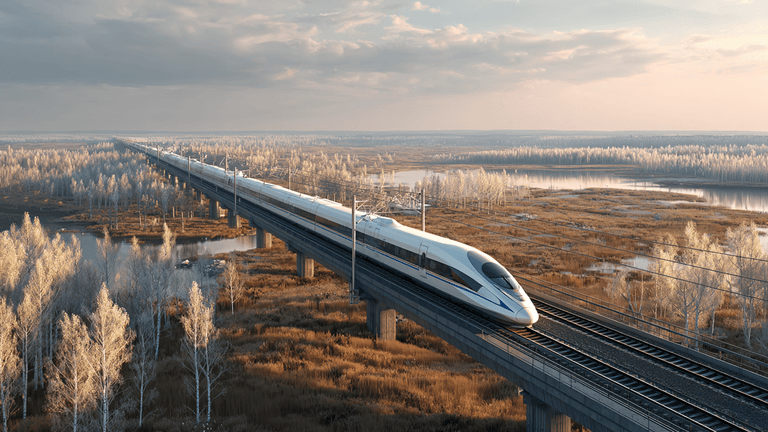
A Railway With Global Ambitions
The high-speed rail line is more than just a railway. It's a large-scale technological and economic project of national importance, scheduled to launch in 2028. The new line will span approximately 680 kilometers and feature over 200 engineering structures—bridges, overpasses, and tunnels—as well as 16 stations, including new transport hubs in Tver, Veliky Novgorod, and other cities.
As of late 2024, the total cost of building the high-speed rail line was estimated at 2.4 trillion rubles, of which around 300 billion rubles is planned to come from the National Wealth Fund, with another 450 billion rubles from the Non-State Pension Fund. The bulk of financing will be secured through syndicated loans: 960 billion rubles for construction and 281 billion rubles for rolling stock. Additionally, regional governments and OAO Russian Railways itself will invest in the project, with the latter not only overseeing construction but also preparing infrastructure to service the high-speed trains.
Link to detailed route map (RBC)
On one hand, Russia isn't breaking new ground: high-speed rail has long been standard in Europe and Asia. Japan launched the Shinkansen in 1964, France introduced the TGV in 1981, and China has built the world's largest high-speed rail network over recent decades. On the other hand, the Russian project is striking in its scale and technical ambitions. In a conversation with Argument Media, managing partner and co-founder of ROLLINGSTOCK Agency Alexander Polikarpov noted that the stated specifications for the line and Russia's high-speed train are unique—such technology has not yet been deployed anywhere in the world: "Currently, even China has no high-speed rail lines operating above 350 km/h, and in other countries, speeds on wheel-on-rail systems are even more modest."
The high-speed rail information center emphasizes that while the experience of countries with existing high-speed rail was studied for Russia's first line, direct copying is impossible. And it's not just about sanctions and economic constraints. Russia's climatic realities—temperature swings from +40 to −50°C, diverse soil types, and a track gauge different from Europe and China—all require special solutions, officials note. That's why the project relies primarily on homegrown technologies adapted to Russian conditions, while incorporating global best practices.
Between Ambition and Reality
The key question is creating reliable rolling stock and infrastructure adapted to speeds that are record-breaking for the Russian transport system. "One-fifth of the components have already been developed and certified, with over 150 companies and more than 500 engineers participating," reports the high-speed rail information center. Special emphasis is placed on ballastless track slab technology—patented by the Natsproektstroy holding company—which is planned for production at robotic factories in Tver and Novgorod regions.
In September, welding began on the body of the first high-speed train at the Uralskie Lokomotivy plant in Verkhnyaya Pyshma—production will be established right here in the Urals. The president of the Sverdlovsk Regional Union of Industrialists and Entrepreneurs and former head of Sinara Group Dmitry Pumpyansky stated that creating these trains requires developing more than 30,000 assemblies, parts, and components. Of these, 1,400 are critical items that need to be developed from scratch, plus another 1,200. It's a non-trivial challenge for Russian manufacturers, especially given the tight timeline: according to the plan, Russian Railways should receive the first trains for testing by summer 2027, with full commercial service to begin in 2028.
Alexander Polikarpov points out that while Russia had previously planned to create high-speed trains in partnership with Germany's Siemens (the Lastochka is a Siemens product), the German manufacturer withdrew from the project in 2022, cutting Russian companies off from many global industry leaders. To compensate for losing this key partner, some components now have to be sourced from friendly countries, while others are being developed domestically. The expert cited asynchronous electric motors, traction gearboxes, running gear, brakes, and motion control systems as examples of components currently under development or already in testing.
Nevertheless, industry journalist Kirill Balberov, responding to questions from Argument Media, expressed doubts about the realism of such forecasts. He noted the absence of even clear visualizations of the future trains and the mixed success of import substitution in other industry projects. "Uralskie Lokomotivy failed to replace the Lastochka with the Finist in a way that actually works properly—the train still keeps breaking down," the expert concluded.
Who will ride the high-speed rail?
According to the Ministry of Transport's forecasts, by 2030 passenger traffic on the Moscow–Saint Petersburg high-speed rail line could reach 23 million people per year. At first glance, this seems extremely ambitious. But as journalist Kirill Balberovpoints out, the Sapsan trains already carry about 5 million passengers annually and run packed to capacity. According to Oktyabrskaya Railway data, 37 million people used them in just the first eight months of 2025 alone. Demand consistently exceeds supply, which means there's potential for growth.
At the same time, the expert believes, cutting travel time to two hours will generate new traffic as well. Today, passengers often stay in Moscow for several days, combining business—but with a convenient schedule, there will be more round trips in a single day. "This will increase mobility and essentially create new passengers," explains Balberov. True, seasonality won't disappear: trains will be overcrowded in summer and during holidays, while autumn and spring will see lighter loads.
An equally important factor is price. For now, authorities estimate the cost of travel on the high-speed line at around 9,000 rubles. But here, according to Balberov, for now it's "pure marketing": it's difficult to predict what the economy and inflation rate will look like in five years. There are two scenarios—either low off-peak fares with mass ridership, or fewer trains at higher prices. As practice shows, Russians are willing to pay for speed: demand for Sapsan trains is traditionally higher than for overnight trains, even with tickets priced at 7,000–8,000 rubles for economy class.
A similar view is held by managing partner of ROLLINGSTOCK Agency Alexander Polikarpov. He notes that demand for high-speed service between Moscow and St. Petersburg has long exceeded infrastructure capacity: Sapsans have been in high demand for over 15 years, and even regular publications about expensive tickets haven't dampened interest. On the future line, the expert believes, pricing policy will play a key role: experienced teams of marketers and pricing specialists will balance accessibility for passengers with the carrier's interests.
Thus, the forecast of 23 million passengers, according to experts, cannot be considered fantastical: it's realistic if the right combination of speed, price, and service can be achieved.
A Step Into the Future
Whether the HSR project will meet expectations remains an open question. On one hand, high Sapsan ridership confirms sustained demand for high-speed service, and the new line could provide a powerful boost to the development of manufacturing and infrastructure. On the other hand, uncertainty around rolling stock, readiness timelines, and pricing policy makes experts cautious in their assessments. The HSR information center, however, is confident: the project will become the foundation for creating a network of high-speed lines across the country and may even become an export product for countries with similar climatic conditions. Moreover, as Vladimir Putin emphasized, the launch of the first HSR line, and subsequently an entire system of such routes, should strengthen Russia's status as a key logistics hub of Eurasia.
One way or another, the Moscow–St. Petersburg HSR is a test of the maturity of Russian technologies and institutions. How well ambitions align with capabilities will determine not only the comfort of traveling between the two capitals, but the future of the country's entire transportation system.